The Great North Road, the Old Mail Road to Scotland: York to Edinburgh — A Closer Reading
Edition facts
The catalog record for The Great North Road, the Old Mail Road to Scotland: York to Edinburgh — A Closer Reading provides practical reading context through 70,964 words, 5 hr 9 min estimated reading time, and 8 detected text sections.
The text analysis averages about 28.8 words per sentence, while the detected sections provide another way to judge how the source is divided.
Project Gutenberg metadata also associates the work with “Great Britain -- Description and travel,” connecting these edition facts with the source record’s subject description.
Calculated from edition completeness, EPUB availability, text structure and catalogue metadata. Not a user rating.
How this score is calculated
- Description quality20 pts
- Title & short description10 pts
- Source metadata20 pts
- Text length15 pts
- Chapters / structure15 pts
- EPUB file integrity20 pts
Total of 100 points, scaled to a 2.5-5.0 range. Editions with an empty description or a missing EPUB file are not scored.
Read the Text
e miserable, and so simply fell victims to that revenge which has been aptly described as “a kind of wild justice.”
Clifford’s Tower, standing where these scenes were enacted, is a roofless shell, standing isolated on its mound within the Castle walls, and obtains its name, not from its builder, but from Francis Clifford, Earl of Cumberland, who made a doorway in it in the time of Charles the First. It was ruined by explosion and fire in 1684, and so remains, shattered and overgrown with trees and grass, a picturesque object that the eye loves to linger upon in contrast with the classic buildings that occupy the old Castle wards, and speak of crime and its penalties. He who would bring back the crimes and ferocities of a hundred and fifty years or more to the mind’s eye can have his taste gratified and the most vivid pictures conjured up at the sight of such choice and thrilling relics as the horn-handled knife and fork with which the bodies of rebels captured in the ’45 were quartered; the leathern strap that Holroyd used for the purpose of hanging his father from the boughs of a cherry-tree; a fragment of the skull of Eugene Aram’s victim, Daniel Clark; the curiously varied implements used by wives and husbands who murdered their yoke-fellows, ranging from the unwifely sledge-hammer and razor wielded by wives, to the knives and pokers chiefly affected by the husbands; Jonathan Martin the incendiary’s impromptu flint and steel, and the bell rope by whose aid he escaped from the Minster; and those prime curiosities, Dick Turpin’s fetters. Even Turpin’s cell can be seen by those who, after much diligent application to the Prisons Department of the Home Office, procure the _entrée_ to the Castle; and in that “stone jug,” as the criminals of old called their cells, the imaginative can reconstruct their Turpin as they will. Many a better man than he has occupied this gloomy dungeon, but scarce a worse.
[Picture: York Castle: Clifford’s Tower]
ONE of the most notorious of the criminals who were haled forth from this condemned hold to end their days on Knavesmire was Richard Turpin, who was hanged on the 17th of April, 1739. This cruel and mean ruffian, around whose sordid career the glamour of countless legends of varying degrees of impossibility has gathered, was the son of a small innkeeper and farmer at the appropriately named village of Hempstead, in Essex. The inn, called the “Crown,” almost wholly rebuilt, however, is in existence to this day, and his baptismal record may yet be read in the parish register:—“1705, Sept. 21, _Richardus_, _filius Johannis et Mariae Turpin_.”
Apprenticed to a butcher in Whitechapel, he soon set up in business for himself, obtaining his cattle by the simple and ready expedient of stealing them. He married a girl named Palmer, whose name he afterwards took, and after a career of house-breaking and cattle-lifting in Essex and parts of Middlesex, in which he figured as one of a numerous gang who never attacked or plundered unless they were armed to the teeth and in a great numerical superiority, found the home counties too hot to hold him; and so, after shooting his friend, one of the three brothers King, all highwaymen, in the affray at Whitechapel in 1737, in which he escaped from the Bow Street officers, he fled first into Essex and then into Lincolnshire. Authorities disagree, both as to the particular King who was shot, and on the question of whether Turpin shot him accidentally in aiming at one of the officers, or with the purpose of preventing him giving evidence disclosing his haunts. The legends make Tom King the martyr on this occasion, and represent him as bidding Turpin to fly; but the facts seem to point to Matthew being the victim, and to his cursing Turpin for a coward, as he died. It is quite certain that a Tom King, a highwayman, suffered at Tyburn in 1755, eight years later.
As for Turpin, or Palmer, as he now called himself, he settled at Welton, near Beverley, and then at Long Sutton, Lincolnshire, as a gentleman horse-dealer. He had not long been domiciled in those parts before the farmers and others began to lose their stock in a most unaccountable manner. The wonder is that no one suspected him, and that he could manage, for however short a period, to safely sell the many horses he stole. He even managed to mix freely in company with the yeomen of the district, and despite his ill-favoured countenance, made himself not unwelcome. But his brutal nature was the cause of his undoing. Returning from a shooting excursion, he wantonly shot one of his neighbour’s fowls, and on being remonstrated with, threatened to serve one of his new friends the same. He was accordingly summoned at the Beverley Petty Sessions, when it appeared that he had no friends to find bail for him, and that he was, in point of fact, a newcomer to the district, whose habits, now investigated for the first time, proved suspicious. Eventually he was charged with stealing a black mare, blind of the near eye, off Heckington Common, and was committed to York Castle. From his dungeon cell he wrote a letter to his brother at Hempstead, to cook him up a character. The letter was not prepaid, and the brother, not recognising the handwriting, refused to pay the sixpence demanded by the Post Office. On such trivial things do great issues hang! The village postmaster happened to have been the schoolmaster who had taught Turpin to write. He recognised the handwriting and read the letter. He was a man of public spirit, and, travelling to York, identified the prisoner as the Richard Turpin who had long been “wanted” for many crimes.
After his trial and condemnation the farmers flocked in hundreds to see him. His last days in prison were as well attended as a levee, and, to do him justice, his courage, conspicuously lacking at other times, never faltered at the last. He became one of the shows of that ancient city for a time, but nothing daunted him. He spent his last days in joking, drinking, and telling stories, as jovial, merry, and frolicsome as though the shadow of the gallows was not impending over him. He scouted the Ordinary, and suffered no twinges of conscience, but busied himself in preparing a decent costume for his last public appearance. Nothing would serve him but new clothes and a smart pair of pumps to die in. On the morning before the execution, he gave the hangman £3. 10s. to be divided among five men who were to follow him as mourners, and were to be furnished with black hatbands and mourning gloves. When the time came and he went in the tumbril to be turned off, he bowed to the ladies and flourished his cocked hat as though he would presently see them again. He certainly, when he had mounted the ladder, kept the people waiting for the spectacle they had come to see, for he talked with the hangman for over half-an-hour. But when the conversation was ended, he threw himself off in the most resolute fashion, and had the reward of his courage, for he died in a moment.
Thus died the famous Turpin, in the thirty-third year of his age. After the execution his body lay in state for that day and the succeeding night at the “Black Boar” inn in Castlegate. The following morning it was buried in the churchyard of St. George’s, by Fishergate Postern, and the evening afterwards it was dug up again by some of the city surgeons, for dissection. By this time the mob had apparently agreed that this brutal horse-stealer, who according to the contemporary _London Magazine_, was “so mean and stupid a wretch,” was really a very fine fellow; and they determined that his remains should not be dishonoured. Accordingly they rescued the body and reinterred it, in black lime, so as to effectually balk any further attempts on the part of the surgeons.
Dick Turpin, although his name bulks so largely in the legendary story of the roads, was by no means the foremost of his profession. He was brutal, and lacked the finer instincts of the artist. It could never, for instance, have been in his nature to invite the wife of a traveller he had just robbed to dance a coranto with him on the Common, as Duval did on Hounslow Heath when the distant clocks were sounding the hour of midnight. With Turpin it was an oath and a blow. Curses and violence, not courtesy, were his methods. Therefore, it is with the less compunction that we may tear away the romance from Richard Turpin and say that, so far from being the hero of the Ride to York, he never rode to York at all, except on that fatal morning when he progressed to York Castle in chains, presently to be convicted and hanged for the unromantic crimes of horse, sheep, and cattle stealing. He was little better than a vulgar burglar and horse-thief. It was Harrison Ainsworth who made Turpin a hero from such very unpromising material, and he, in fact, invented not only the ride to York, but Black Bess as well. According to the novelist, Turpin started from Kilburn, and came into the Great North Road at Highgate, with three mounted officers after him. Thence he turned into Hornsey, and so by the Ware route, the mare clearing the twelve feet high toll-gate on the way without an effort. They always do that in fiction, but the animal that could do it in fact does not exist.
At Tottenham (always according to the novelist, of course) the people threw brickbats at the gallant Turpin. They “showered thick as hail, and quite as harmlessly, around him,” and Turpin laughed, as, indeed, he had an occasion to do, because the Tottenham people must have been the poorest of marksmen. And so pursuers and pursued swept through Edmonton and Ware, and quite a number of places which are not on our route. At Alconbury Hill he comes into view again, and the inconceivable chase proceeds until Black Bess expires, at sunrise, within sight of the glorious panorama of York’s spires and towers.
There are very many who believe Ainsworth’s long rigmarole, and take their ideas of that unromantic highwayman from his novel, but the dashing, highsouled (and at times maudlin) fellow of those pages is absolutely fictitious.
AINSWORTH constructed his fictitious hero from a very slight basis of fact. What a pity he did not rear his narrative on better lines, and give the credit of the Ride to York to the man who really did it. For it was done, and it was a longer ride by some twenty-six miles, at least, than that recounted in the vulgar romance of _Rookwood_. It was, in fact, a better ride, by a better man, and at a much earlier period.
John Nevison was the hero of this exploit. It was on a May morning in 1676, at the unconscionable hour of four o’clock, that he robbed a traveller on Gad’s Hill, near Chatham, and, fired with the ambition of establishing an alibi, immediately set off to ride to York. Crossing the Thames from Gravesend to Tilbury, he rode on his “blood bay” to Chelmsford, where he baited and rested his horse for half-an-hour. Thence on to Cambridge and through the town without drawing rein, he went through by-lanes to Fenny Stanton, Godmanchester, and Huntingdon, where he took another half-hour’s rest; continuing, by unfrequented ways, until York was reached, the same evening. Of course, he must have had several fresh horses on the way. Stabling the horse that had brought him into the cathedral city, he hastily removed the travel-stains from his person, and strolled casually to the nearest bowling-green, where the Mayor of York happened to be playing a game with some friends. Nevison took the opportunity of asking him the time, and received the answer that it was just a quarter to eight. That was sufficient for his purpose. By this question and the reply he had fixed the recollection of himself and of the time in the Mayor’s mind, and had his _alibi_ at need. Sure enough, he needed it a little later, when he was arrested for another highway robbery, and the Gad’s Hill traveller happened to be the one witness who could swear to him. Nevison called his York witnesses, who readily enough deposed to his being there on the evening of the day on which the traveller swore he had been robbed by him near Chatham. This was conclusive. No one conceived it possible for a man to have been in two places so remote in one day, and he was acquitted. Then, when the danger was past, his sporting instincts prevailed, and he told the story. He became the hero of a brief hour, and Charles the Second, who dearly loved a clever rogue, is said to have christened him “Swift Nicks.” If we roughly analyse this ride we shall find that Nevison’s performance amounted to about 230 miles in fifteen hours: a rate of over fifteen miles an hour. To have done as much was a wonderful exploit, even though (as seems certain) he had remounts at the houses of confederates. He probably had many such houses of call, for he was one of a numerous band of highwaymen whose headquarters were at Newark.
This escape served him for eight years longer, for it was in 1684 that his career came to a close on Knavesmire, where he was hanged on the 4th of May.
There was something of the Robin Hood in Nevison’s character, if we are to believe the almost legendary stories told in Yorkshire of this darling of the Yorkshire peasantry. He robbed the rich and gave to the poor, and many are the tales still told of his generosity. Such an one is the tale that tells of his being at a village inn, when the talk turned upon the affairs of an unfortunate farmer whose home had been sold up for rent. Among those in the place was the bailiff, with the proceeds of the sale on him. Nevison contrived to relieve him of the cash, and restored it to the farmer. Perhaps he was not so well-liked by the cattle-dealers along the Great North Road, whom he and his gang robbed so regularly that at length they commuted their involuntary contributions for a quarterly allowance, which at the same time cleared the road for them and afforded them protection against any other bands. Indeed, Nevison, or Bracy, as his real name appears to have been, was in this respect almost a counterpart of those old German barons on the Rhine, who levied dues on the travellers whose business unfortunately led them their way. The parallel goes no greater distance, for those picturesque miscreants were anything but the idols of the people. Nevison was sufficiently popular to have been the hero of a rural ballad, still occasionally heard in the neighbourhood of his haunts at Knaresborough, Ferrybridge, York, or Newark. Here are two verses of it; not perhaps distinguished by wealth of fancy or resourcefulness of rhyme:—
Did you ever hear tell of that hero; Bold Nevison, that was his name? He rode about like a bold hero, And with that he gain’d great fame.
He maintained himself like a gentleman, Besides, he was good to the poor; He rode about like a great hero, And he gain’d himself favour therefore.
Yorkshire will not willingly let the fame of her Nevison die. Is not his Leap shown, and is not the inn at Sandal, where he was last captured, still pointed out? Then there is the tale of how he and twenty of his gang attacked fifteen butchers who were riding to Northallerton Fair, an encounter recounted in a pamphlet dated 1674, luridly styled _Bloody News from Yorkshire_. Another memory is of the half dozen men who at another time attempted to take him prisoner. He escaped and shot one of them, also a butcher. Nevison and butchers were evidently antipathetic. Released once on promising to enter the army, he, like Boulter, deserted. That he could break prison with the best he demonstrated fully at Wakefield; but his final capture was on a trivial charge. It sufficed to do his business, though, for the prosecution were now prepared with the fullest evidence against him and his associates, and their way of life. They had secured Mary Brandon, who acted as housekeeper for the gang. According to her story, they were John Nevison, of York; Edmund Bracy, of Nottingham; Thomas Wilbere, of the same town; Thomas Tankard, vaguely described as “of Lincolnshire”; and two men named Bromett and Iverson. This last was “commonly at the ‘Talbott,’ in Newarke,” which was their headquarters. The landlord of that inn was supposed to be cognisant of their doings, as also the ostler, one William Anwood, “shee haveinge often scene the said partyes give him good summs of money, and order him to keepe their horses close, and never to water them but in the night time.” They kept rooms at the “Talbot” all the year round, and in them divided their spoil, which in one year, as the result of ten great robberies, came to over £1,500. No other highwaymen can hold a candle to this gang, either for their business-like habits or the success of their operations.
THAT once dreaded mid-eighteenth century highwayman, Thomas Boulter, junior, of Poulshot in Wiltshire, once made acquaintance with York Castle. The extent of his depredations was as wide as his indifference to danger was great. A West-countryman, his most obvious sphere of operations was the country through which the Exeter Road passed; but being greedy and insatiable, he soon exhausted those districts, and thought it expedient to strike out for roads where the name of Boulter was unknown, and along which the lieges still dared to carry their watches and their gold. He came up to town at the beginning of 1777 from his haunts near Devizes, and, refitting in apparel and pistols, gaily took the Great North Road. Many adventures and much spoil fell to him in and about Newark, Leeds, and Doncaster; but an encounter between Sheffield and Ripon proved his undoing. He had relieved a gentleman on horseback of purse and jewellery, and was ambling negligently away when the traveller’s man-servant, who had fallen some distance behind his master, came galloping up. Thus reinforced, the plundered one chased Mr. Boulter, and, running him to earth, haled him off to the nearest Justice, who, quite unmoved by his story of being an unfortunate young man in the grocery line, appropriately enough named Poore, committed him to York Castle, where, at the March assizes, he was duly found guilty and sentenced to be hanged within fifteen days. Heavily ironed, escape was out of the question, and he gave himself up for lost, until, on the morning appointed for his execution, the news arrived that he might claim a free pardon if he would enter his Majesty’s service as a soldier, and reform his life. His Majesty badly wanted soldiers in A.D. 1777, and was not nice as to the character of his recruits; and indeed the British army until the close of the Peninsular War was composed of as arrant a set of rascals as ever wore out shoe-leather. No wonder the Duke of Wellington spoke of his army in Spain as “my blackguards.” But they could fight.
This by the way. To return to Mr. Thomas Boulter, who, full of moral resolutions and martial ardour, now joined the first marching regiment halting at York. For four days he toiled and strove in the barrack-yard, finding with every hour the burdens of military life growing heavier. On the fifth day he determined to desert, and on the sixth put that determination into practice; for if he had waited until the morrow, when his uniform would have been ready, escape would have been difficult. Stealing forth at dead of night, without mishap, he made across country to Nottingham, and so disappears altogether from these pages. The further deeds that he did, and the story of his end are duly chronicled in the pages of the _Exeter Road_, to which they properly belong.
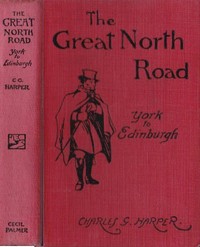
Charles G. Harper's The Great North Road: York to Edinburgh opens not with a traveller's first step but with a mile-by-mile itinerary, a stark list of places and distances that immediately establishes the road as the book's true protagonist. Harper, a prolific writer-illustrator, published this second edition in 1922, revising his 1901 original. The text that follows is part guidebook, part antiquarian ramble, and part personal essay, held together by the physical thread of the A1 highway.
From the outset, Harper signals his method: he will move from town to town, pausing to dig into local history, architecture, and oddities. The opening pages set a tone of unhurried curiosity, promising a journey that values the detour as much as the destination.
A Road of Many Layers
Harper treats the Great North Road as a palimpsest. In the excerpt on Chester-le-Street, he notes the Roman origin of the place, its Saxon name Cunecaster, and the medieval church that preserves an anchorite's cell. He does not simply list these facts; he connects them, showing how each era left its mark on the same spot. The anchorite's cell, he explains, was later let to three widows after the Reformation, and eventually became the curate's residence. This layering of uses—from holy hermitage to practical housing—is typical of Harper's method. He reads the landscape as a document, where a building's function changes but its structure remains, telling a story of adaptation and survival.
Wry Observations on Modernity
Harper's tone is often dry and amused. Describing the coal country around Birtley, he writes that the paths are black, the hedges sooty, and tramways cross the road unfenced, dropping coal in the highway. He concludes: "One coal village is as like another as are two peas." This is not mere complaint; it is a precise observation of industrial monotony. Similarly, his account of Chester-le-Street's Shrove Tuesday football match—where the town takes sides and kicks one another when the ball is out of reach—is delivered with deadpan humour. Harper does not romanticise the past; he notes the present with a sharp eye, whether it is the grime of mining or the rowdy traditions of a market town.
The Antiquarian's Eye
Harper's interest in the past is not academic but tactile. He lingers on physical details: the two-storey anchorite's cell with its low-side windows, the "odd hagioscope or 'squint'" pierced through a pillar. He describes the fourteen monumental effigies in Chester-le-Street church, collected by John, Lord Lumley, who called them ancestors and commissioned local masons to carve more when he could not steal enough. Harper's verdict: "an ill-favoured gang they look, too." This blend of historical fact and personal judgement is characteristic. He trusts his own eyes and does not hesitate to offer an opinion, making the reader feel like a companion on the road, not a student in a lecture.
The Traveller's Pace
The book's structure mirrors the journey itself: a series of stops, each with its own character. Harper does not rush. He devotes several pages to Chester-le-Street, moving from Roman origins to the present-day football match, from the anchorite's cell to the Lumley effigies. This unhurried pace allows him to build a cumulative portrait of a place. The reader is encouraged to dip in and out, following the itinerary or skipping ahead. The mile-by-mile list at the start serves as a map, but the text itself is a meander. Harper's voice—conversational, learned, occasionally sardonic—is the constant that holds the journey together.
Harper's Great North Road rewards the reader who treats it as a companion for slow travel. The book does not need to be read straight through; it works as a series of vignettes, each town or landmark offering a self-contained story. Pay attention to the illustrations, many by Harper himself, which complement his verbal sketches. And note the date: this is a view of England and Scotland just after the First World War, when the old road was still a living artery, not yet a museum piece.
There’s something about old roads that stays with you, the way Harper lingers over forgotten milestones between York and Edinburgh. I felt that same quiet ache reading Wanderings in Spain — Themes and Context, where dusty paths hold their own gentle ghosts. It’s less about travel, more about how places remember us. A soft, unhurried companionship, really.
Wyatt Wilson
1 week agoSamuel Wright
1 week agoOliver Lee
1 week ago-
Danielle Wilkinson - 1 month ago
This delightful volume captures the romance and history of the Great North Road from York to Edinburgh. The author's descriptive prose makes you feel the cobblestones underfoot and the wind on the moors, while weaving in tales of coaching inns, highwaymen, and notable travelers. It's a nostalgic journey through Britain's past, perfect for history buffs and lovers of travel literature. An absolute joy to read. -
Tammy Newman - 2 weeks ago
An engaging historical travelogue that offers a vivid picture of the old mail road to Scotland. The anecdotes are entertaining, but the structure is somewhat scattered, jumping between eras without a clear timeline. Additionally, the lack of photographs (in the original) may disappoint some readers. Still, it's a charming read for those interested in British transportation and local history. -
Randy Howard - 1 week ago
The Great North Road is a missed opportunity: while the subject is fascinating, the prose is overly sentimental and repetitive. The author relies on picturesque details but fails to provide a coherent historical analysis, leading to a superficial overview. For a book about a road, it lacks a sense of direction and would benefit from better organization and more critical rigor.
Take a moment to reflect on this book
Create a short personal record of your experience with this book.
Avery Walker
3 weeks ago