Wanderings in Spain — Themes and Context

(0 User reviews)   148
In Category - Geography
Gautier, Théophile, 1811-1872, McQuoid, Thomas Robert, 1820-1912 [Translator] Project Gutenberg 2016 Not confirmed
Spain -- Description and travel; Spain -- Social life and customs -- 19th century; Gautier, Théophile, 1811-1872 -- Travel -- Spain Readers of public-domain and historical texts
Project Gutenberg digital edition en

Edition facts

Words 144,960
Reading time 631 min
Text sections 26

Wanderings in Spain — Themes and Context can be approached with a clearer sense of reading commitment from its source measurements: 144,960 words, 10 hr 31 min estimated reading time, and 26 detected text sections.

The text analysis averages about 31.6 words per sentence, while the detected sections provide another way to judge how the source is divided.

Project Gutenberg metadata also associates the work with “Spain -- Description and travel,” connecting these edition facts with the source record’s subject description.

Théophile Gautier's travelogue, translated by Thomas Robert McQuoid, records a journey through 19th-century Spain with vivid descriptions of landscapes, towns, and customs. The author's diction blends romanticism and irony, while his eye for detail captures the contrast between natural grandeur and human settlements.
Share
Editorial Edition Score 4.9/5

Calculated from edition completeness, EPUB availability, text structure and catalogue metadata. Not a user rating.

How this score is calculated
  • Description quality20 pts
  • Title & short description10 pts
  • Source metadata20 pts
  • Text length15 pts
  • Chapters / structure15 pts
  • EPUB file integrity20 pts

Total of 100 points, scaled to a 2.5-5.0 range. Editions with an empty description or a missing EPUB file are not scored.

Edition quality

Read the Text

FROM PARIS TO BORDEAUX. PAGE Departure from Paris--Subterranean Dwellings--Château Regnault-- Tours--Châtellerault--Angoulême--The _Landes_--Cubzac--Bordeaux-- The Theatre--The Cathedral--St. Michael's Tower--Mummified Corpses--The Museum 1

FROM BORDEAUX TO VERGARA.

The _Landes_--Arrival at Bayonne--Information for Travellers-- Urrugne--Saint Jean de Luz--Human Smuggling--Bridge over the Bidassoa--Irun--Travelling with Mules--Primitive Carts--Beggar Children--Spanish Bridges--Oyarzun--Astigarraga--A Spanish Supper--Puchero--Arrival at Vergara 11

FROM VERGARA TO BURGOS.

Vergara--Vittoria: the Baile Nacional and the French Hercules-- The Passage of Pancorbo--The Asses and the Greyhounds--Burgos-- A Spanish Fonda--Galley Slaves in Cloaks--The Cathedral--The Coffer of the Cid 20

The Cloisters; Paintings and Sculptures--The Cid's House; the Casa del Cordon; the Puerta de Santa Maria--The Theatre and the Actors--La Cartuja de Miraflores--General Thibaut and the Cid's bones 34

FROM BURGOS TO MADRID.

El Correo Real; the Galeras--Valladolid--San Pablo--A Representation of Hernani--Santa Maria--Madrid 47

Bull-fights--The Arena--Calesins--Espadas, Chulos, Banderilleros, and Picadores--Sevilla the Picador--La Estocada a Vuela Pies 59

The Prado--The Mantilla and Fan--The Spanish Type--Water-Merchants; Coffee-houses of Madrid--Newspapers--The Politicians of the Puerta del Sol--Post-Office--The Houses of Madrid--Tertullias; Spanish Society--The Teatro del Principe--The Queen's Palace; the Palace of the Cortes, and the Monument of the Dos de Mayo--The Armeria and El Buen Retiro 73

VISIT TO THE ESCURIAL.

Aridity and Desolation of the Country--First View of the Escurial-- Sombre appearance of the building--The Church--The blind Cicerone-- The Pantheon Pictures--Anecdote of Spanish Robbers 103

Illescas--The Puerta del Sol--Toledo--The Alcazar--The Cathedral-- The Gregorian and Mozarabic Ritual--Our Lady of Toledo--San Juan de los Reyes--The Synagogue--Galiana, Karl, and Bradamant--The Bath of Florinda--The Grotto of Hercules--The Cardinal's Hospital--Toledo Blades 113

Procession of the Corpus Christi at Madrid--Aranjuez--A Patio Ocaña and its Environs--Tembleque and its Garters--A Night at Manzanares-- Santa Cruz Knives--The Puerto de los Perros--Colony of Carolina--Baylen--Jaen, its Cathedral and its Majos--Granada--The Alameda--The Alhambra--The Generalife--The Albaycin--Life at Granada--The Gitanos--The Carthusian Convent--Santo Domingo-- Ascent of the Mulhacen 144

FROM GRANADA TO MALAGA.

The Robbers and Cosarios of Andalusia--Alhama--Malaga--Travelling Students--A Bull-Fight--Montes--The Theatre 208

FROM MALAGA TO SEVILLE.

Four-wheeled galera--Caratraca--The "Mayoral"--Ecija--The "Calle de los Caballeros"--La Carlotta--Cordova--The Archangel Raphael-- The Mosque--Caliph Abderama--The Guadalquiver--Road to Seville 236

Seville--The Cristina--The Torre del Oro--Italica--The Cathedral-- The Giralda--The Alcazar--The Caridad and Don Juan de Marana 258

FROM CADIZ TO BARCELONA AND HOME.

Cadiz--Visit to the brig "Le Voltigeur"--The Rateros--Jeres-- Bull-fights--The Steamer--Gibraltar--Carthagena--Valencia--The Lonja de Seda--The Convent de la Merced--The Valencians-- Barcelona--The Return to France 274

THE GATE OF VIVARAMBLA _Frontispiece._

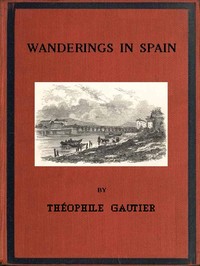
THE BRIDGE OF IRUN _Vignette in Title._

CLOISTERS, BURGOS CATHEDRAL 30

PUERTA DE SANTA MARIA 41

SEVILLA THE PICADOR 66

LADIES ON THE PRADO 75

FOUNTAIN AT MADRID 80

WELL DE LAS ALGIVES, ALHAMBRA 180

EXTERIOR OF THE ALHAMBRA 182

PAVILION OF THE COURT OF LIONS, ALHAMBRA 185

FOUNTAIN, COURT OF LIONS, ALHAMBRA 187

MALAGA FROM THE ALAMEDA 219

CHAPEL IN MOSQUE, CORDOVA 253

MOORISH MILLS, CORDOVA 255

HALL OF DON PEDRO, THE ALCAZAR, SEVILLE 270

CITY GATE, VALENCIA 297

FROM PARIS TO BORDEAUX.

Departure from Paris--Subterranean Dwellings--Château-Regnault--Tours--Châtellerault--Angoulême--The _Landes_--Cubzac--Bordeaux--The Theatre--The Cathedral--St. Michael's Tower--Mummified Corpses--the Museum.

A few weeks ago (April, 1840), I happened, in an off-hand manner, to give utterance to the following phrase:--"I should like to go to Spain." Five or six days afterwards, my friends had suppressed the prudent "I should like," with which I had qualified my wish, and had told every one who chose to listen that I was about to undertake a trip to Spain. This positive formula was soon followed by the interrogation, "When do you set out?" while I, without thinking of the obligation under which I was placing myself, replied, "In a week." At the end of the week people began to manifest some astonishment at seeing me still in Paris. "I thought you were at Madrid," said one. "What! come back?" asked another. I saw at once that I owed my friends an absence of several months, and that I must pay the debt with the least possible delay, unless I wished to be mercilessly pursued, without a moment's respite, by my obliging creditors. The lobbies of the theatres, the various asphaltic and bituminous pavements of the Boulevards, were to me forbidden luxuries for the time being. All I could obtain was the grace of three or four days, and on the 5th of May I commenced relieving my native land of my importunate presence, by scrambling into the Bordeaux diligence.

I shall pass very rapidly over the first few posts, which possess nothing worthy of observation. Right and left stretch all kinds of crops, streaked like tiger or zebra skins, and bearing a most satisfactory resemblance to a tailor's book, in which are pasted his various specimens of trowsers and waistcoat patterns. Although these kinds of views are productive of great delight to farmers, landlords, and other worthies of a similar stamp, they afford but meagre entertainment to the enthusiastic and graphic traveller, who, spy-glass in hand, sets out to note the peculiarities of the universe in the same manner as a police agent does those of an individual. Having left Paris in the evening, my first impressions, after passing Versailles, are but so many feeble sketches _stumped in_ by the hand of Night. I regret that I passed through Chartres without being able to see its cathedral.

Between Vendôme and Château-Regnault, which is pronounced _Chtrnô_ in the language of the postilions, so well imitated by Henri Monnier in his sketch of the "Diligence," there rise a number of well-wooded hills, where the inhabitants dig their houses out of the living rock, and live under ground, after the fashion of the ancient Troglodytes. The stone obtained from these excavations they sell, so that each house thus scooped out produces another _en relief_, like a plaster figure taken out of a mould, or a tower dragged out of a well. The chimney, which is a long passage hammered through the rock, ends at the surface, so that the smoke ascends from the ground itself in bluish spirals, and without any visible cause, exactly as if it proceeded from a sulphur mine, or from some volcano. A facetious traveller would not experience the slightest difficulty in throwing stones into the omelets of this cryptic population, and the rabbits, if they are ever absent or short-sighted, must certainly fall, very often, all alive, into the saucepans. By constructing houses on this principle, the trouble of going down into the cellar to fetch your wine is entirely avoided.

Château-Regnault is a small town built upon a number of serpentine and rapid declivities, bordered by ill-pitched and tottering houses, which appear to lean against one another to keep themselves upright. A large round tower, situated upon the talus of some old fortifications, enveloped here and there in green patches of ivy, redeems, to a certain extent, the appearance of the town. From Château-Regnault to Tours there is nothing remarkable. Earth in the middle, and trees on each side, forming those long yellow bands, which lose themselves in the distance, and which, in the language of the wagoners, are termed _rubans de queue_, are all that is to be seen: then, on a sudden, the road dives down a couple of pretty steep hills, and in a few minutes you perceive the town of Tours, rendered famous by its prunes, Rabelais, and de Balzac.

The Bridge of Tours is very celebrated, and possesses in itself nothing exceedingly remarkable; but the appearance of the town is lovely. On my arrival, the sky, with a few flakes of snow floating negligently over its surface, was tinged with the sweetest blue; a white line, similar to that traced by a diamond upon glass, cut the limpid surface of the Loire, and was formed by a tiny cascade proceeding from one of the sand-banks so frequent in the bed of this river. In the clear air, Saint Gatien reared its brown profile and Gothic spires, ornamented with balls and roundings similar to those of the steeples of the Kremlin, giving to the city a most romantically Muscovite air; a few other towers and spires, belonging to churches the names of which I do not know, completed the picture; while numerous vessels, with their white sails, floated, like so many sleeping swans, upon the azure bosom of the stream. I should have liked to have paid a visit to the house of Tristan l'Ermite, the terrible gossip of Louis XI., which is still in a marvellous state of preservation, with its horribly significant ornaments, composed of coils of rope, entwined with other instruments of torture; but I had not time; I was obliged to content myself with the _Grande Rue_, which must be the pride of the inhabitants of Tours, and which aspires to the rank of another _Rue de Rivoli_.

Châtellerault, which enjoys a high reputation for the article of cutlery, possesses nothing particular except a bridge, ornamented at each extremity with old towers, which present a most charmingly feudal and romantic appearance. As for its manufactory of arms, it is a large white mass, with a multitude of windows. Of Poitiers, having passed through it in a beating rain, and a night as dark as pitch, I can say nothing, except that it is paved in the most execrable manner possible.

At break of day, the coach was traversing a country wooded with trees of an apple green planted in a soil of the brightest red, and producing a very singular effect. The houses were covered with tiles ridged after the Italian fashion; these tiles, too, were staring red, a colour which appears very strange to eyes accustomed to the brown and sooty roofs of the houses of Paris. From a piece of eccentricity, of which I forget the motive, the builders of those parts commence at the roofs of the houses; the walls and foundations follow. They place the framework upon four strong beams, and the tilers perform their portion of the work before the masons.

It is about this spot that the long orgy of stone commences, which ends only at Bordeaux. The smallest hut, without doors or windows, is of stone; the walls of the gardens are formed of large blocks placed one above the other without mortar; along the road, by the side of the doors, you perceive enormous heaps of superb stone, with which it would be easy, at a trifling expense, to build new _Chenonceaux_ and Alhambras. The inhabitants, however, are contented with piling them in squares, and surmounting the whole with a cover of red or yellow tiles, the different forms of which compose a festoon of a tolerably graceful effect.

The town of Angoulême, queerly perched on an extremely steep hill, at the foot of which the Charente turns two or three babbling mills, is built in the same manner. It has a kind of second-hand Italian look, which is increased still more by the thick masses of trees which crown its rugged eminences, and a tall parasol-shaped pine, like those of the Roman villas. An old tower, which, if my memory does not deceive me, is surmounted by a telegraph (many old towers have been saved by a telegraph), imparts a tone of severity to the general aspect of the town, and renders it a tolerably imposing object on the edge of the horizon. While toiling up the ascent, I remarked a house daubed externally with rude frescoes representing something like Bacchus, Neptune, or perhaps Napoleon. As the artist forgot to paint the name underneath, every supposition is admissible and capable of being defended.

As yet, I confess that an excursion to Romainville or Pantin would have been quite as picturesque. Nothing can be more flat, more inane, more insipid, than these interminable strips of ground, similar to the little bands with which lithographers enclose all the Boulevards of Paris in one sheet of paper. Hedges of hawthorn and consumptive-looking elms, consumptive-looking elms and hedges of hawthorn, with, a little further on, a row of poplars, resembling a number of green feathers stuck in a flat soil, or perhaps a solitary willow, with its deformed trunk and powdered wig, compose the landscape; while, for figures, you have that of some _pionnier_, or _cantonnier_, as sunburnt as a Moor, leaning upon the handle of his long hammer as he looks at you pass by, or else some poor soldier rejoining his regiment, and sweating and staggering under his harness. Beyond Angoulême, however, the physiognomy of the soil changes, and you begin to feel that you are at a certain distance from the suburbs of the Capital.

It is on leaving the Department of the Charente that the traveller meets with the first of the _Landes_, those monster patches of grey, violet, and bluish land, diversified with undulations of various depths. A kind of short and scanty moss, red-tinged heather, and some dwarf broom compose all the vegetation. The desolation is that of the Egyptian Thebaid, and every minute you expect to see a file of dromedaries and camels; it seems as if the spot had never been pressed by the foot of man.

After traversing the _Landes_, you enter a tolerably picturesque region. Here and there along the road are groups of houses, concealed like birds' nests in the thickets. These houses remind one of the pictures of Hobbema, with their large roofs, their walls over-run with wild vine, their well-grown wondering-eyed oxen and their poultry foraging on the dung-hills. All the houses, by the way, as well as the garden walls, are built of stone. On every side are to be seen the beginning of buildings afterwards abandoned out of pure caprice, and recommenced a few paces further on. The inhabitants almost resemble children when they get a birthday present of a "box of bricks," with which, by the aid of a certain number of square-cut pieces of wood, all sorts of edifices may be constructed. They unroof their houses, remove the stones, and with the very same ones build another edifice of a totally different character. On the road-side are blooming gardens, surrounded by fine trees with beautifully fresh foliage, and variegated with peas in blossom, daisies, and roses; the eye at the same time roaming over meadows, where the cows are almost hidden by the grass which reaches to their breasts. A cross path all redolent of hawthorn and eglantine, a group of trees, beneath which is seen an empty wagon, a country-girl or two, with their spreading caps like the turban of the Turkish Ulemas, and with their narrow yellow skirts, offer a thousand little unexpected details which charm the eye and diversify the route. By slightly glazing the scarlet tint of the roofs with a little bitumen, you might think yourself in Normandy. Flers and Cabat would here find pictures ready made to their hand. It is about this latitude that the "_berets_" begin to show themselves. They are all blue, and the elegance of their form is greatly superior to that of the hat.

Hereabouts, too, the first vehicles drawn by oxen are to be met with. These wagons have rather a Homeric and primitive appearance. The oxen are harnessed by the head to a common yoke covered with a small head-piece of sheepskin. They have a mild, grave, and resigned look, which is pre-eminently sculptural, and worthy of the Elginetic bas-reliefs.

Most of them wear a covering of white cloth, which serves as a protection against the flies and other insects. Nothing is more singular than to see these oxen, dressed _en chemises_, raise towards you their humid and lustrous muzzles and their large deep blue eyes, which the Greeks, who were certainly judges of beauty, thought sufficiently remarkable to furnish the sacramental epithet of Juno--_Boopis Ere_.

A marriage, which happened to be in course of celebration at an inn, afforded me an opportunity of seeing some of the natives of these parts assembled together; for in a distance of more than a hundred leagues I had not perceived ten persons. These said natives are excessively ugly, especially the women: there is no difference between the old and the young ones; a countrywoman of five and twenty is as haggard and wrinkled as one of sixty. The little girls wear caps quite as developed as those of their grandmothers, which makes them look like the Turkish boys in Decamp's sketches, with their enormous heads and slender bodies. In the stable of the inn I saw a huge black he-goat, with immense twisted horns and glaring yellow eyes. He had a hyper-diabolic appearance, and would, in the middle ages, have made a most worthy president at a witches' sabbath.

Evening was beginning to set in when we arrived at Cubzac. Formerly the Dordogne used to be traversed in a ferry-boat, but the breadth and rapidity of the stream rendered the passage dangerous, and the boat is, at present, replaced by a suspension bridge of the most daring construction. It is well known that I am no very great admirer of modern innovations, but this bridge is really a work worthy of Egypt or of Rome for its colossal dimensions and the grandeur of its appearance. Piers formed by a succession of arches, which gradually increase in height, lead to the suspended platform, beneath which vessels can pass in full sail, as they did between the legs of the Colossus of Rhodes. Tower-shaped buildings of cast iron, with openings to render them lighter, serve as supports to the iron chains, which are crossed with a most skilfully calculated symmetry of resistance, and which stand out against the background of the sky with the fineness and delicacy of a spider's web, thereby adding still more to the wonderful effect of the whole. Two obelisks of cast iron are placed at each end, as if before the peristyle of some Theban monument, and form a kind of ornament not at all out of place; for the gigantic architectural genius of the Pharaohs would not be ashamed to own the Bridge of Cubzac. It requires thirteen minutes, watch in hand, to cross it.

Two or three hours afterwards, the lamps of the Bridge of Bordeaux, another, although less striking wonder, were gleaming at a distance which my appetite could have wished considerably shorter, for speed in travelling is always bought at the expense of the stomach. After having exhausted all our sticks of chocolate, biscuits, and the other ordinary provisions for a journey, we began to entertain slightly cannibal ideas. My companions looked on me with famishing eyes, and if we had had another stage, we should have renewed the horrors of the raft of the Medusa, and eaten our braces, the soles of our boots, and our Gibus hats, besides all the other articles in request among shipwrecked individuals, who digest this kind of food in the most satisfactory fashion.

On leaving the diligence, you are assailed by a crowd of porters, who take possession of your luggage at the rate of twenty to each pair of boots. This is usual enough, but the most ridiculous part of the business is the kind of gaolers stationed by the hotel proprietors, as vedettes, to seize upon the traveller as he goes along. All these wretches cry themselves hoarse and create a confusion equal to that of the Tower of Babel, by their long litanies of praise and abuse. One catches hold of your arm, another of your leg, a third of the tail of your coat, a fourth of the button of your paletôt. "Come to the Hotel of Nantes, sir; you will find everything very comfortable there." "Don't go there, sir; its real name is the Hotel of Bugs," immediately replies the representative of a rival establishment. "Hôtel de France," "Hôtel de Rouen," holla the crew, pursuing you with their vociferations. "They never clean their saucepans, sir; they cook all their dishes with lard. The rain comes through into their rooms; you will be robbed, plundered, assassinated." Each one endeavours to disgust you with every place but his own, and the band never leaves you until you enter, definitively, one particular hotel. They then quarrel among themselves, exchange blows, call each other thieves, robbers, and other epithets of the like description, and finish by hastening away in pursuit of fresh prey.

Théophile Gautier's Wanderings in Spain, here in Thomas Robert McQuoid's 1853 translation, opens with a departure from Paris and quickly establishes a voice that oscillates between lyrical awe and wry observation. The author's descriptive style is immediately evident: he compares mountain ranges to "long rows of billows of azure" and describes light as "liquid gold and silver." Yet he also undercuts romanticism with dry remarks about a planned village's "tedious regularity." This tension between the sublime and the mundane runs through the narrative, as Gautier records both the grandeur of Spanish landscapes and the quirks of its inns, roads, and inhabitants.

A Painter's Eye for Light and Colour

Gautier, a poet and art critic, frequently frames scenes as paintings. He describes a vista as "an immense panorama" and compares mountain ridges to "draperies in ancient pictures which were yellow on one side and blue on the other." His palette is precise: aloe-trees are "more and more African in size and shape," rose-bays are "of the greatest beauty and freshness," and olive-trees have "pale leaves" that remind him of northern willows. The sun's rays "streaked with gold" mountain-tops, making them "sparkle with a thousand colours like a pigeon's breast." Such passages reveal a writer who composes landscapes as deliberately as a painter arranges pigments.

Irony and Understatement in the Face of Discomfort

Gautier's tone often shifts from rhapsody to dry humour. When describing a planned colony at Carolina, he notes that everything was "done by line and rule" and that he prefers "the most wretched village which has taken its form at random." He reports that Swiss colonists "died off like flies" from nostalgia, adding that the church bells had to be silenced. Later, he mentions a solid dinner "served up with some excellent wine" and adds, "I was not obliged to take double portions"—a wry nod to earlier deprivations. These moments of understatement prevent the narrative from becoming merely picturesque.

Observations on Spanish Customs and Infrastructure

Gautier records details of travel and daily life with a journalist's eye. He notes the use of mules and primitive carts, the presence of beggar children, and the layout of Spanish bridges. In Madrid, he describes bull-fights with technical terms—espadas, chulos, banderilleros, picadores—and devotes a chapter to the mantilla and fan. He also comments on the tertullias (social gatherings) and the theatre. His account of the Escurial includes a "blind Cicerone" and the Pantheon pictures. These observations ground the travelogue in specific, verifiable practices, though the excerpts offer only fragments of his full commentary.

The Translator's Role and the Text's Texture

Thomas Robert McQuoid's translation, published in 1853, preserves Gautier's characteristic blend of romantic and ironic registers. The prose retains a slightly formal Victorian cadence, with sentences like "The infinite in things filled with light is sublime and stupendous in a far different manner to the infinite in things smothered in darkness." Yet the translator also renders Gautier's conversational asides, such as the question posed to a nameless rivulet: "Eurotas, Eurotas, que font tes lauriers-roses?" The result is a text that feels both literary and immediate, though readers should be aware that the translation may soften or sharpen Gautier's original French tone.

Readers approaching Wanderings in Spain will find a travelogue that rewards attention to its descriptive language and tonal shifts. Gautier's eye for colour and light, his dry humour, and his curiosity about local customs make the narrative more than a simple itinerary. The excerpts suggest a work that balances aesthetic pleasure with wry commentary, though the full book may contain more sustained passages of both. Those interested in 19th-century travel writing or the Romantic sensibility will find much to observe in Gautier's prose.

Reading Gautier’s account of dusty Spanish roads, I remembered an afternoon in a sun-bleached village where the silence felt older than the stones. That same ache of distance came back with As the Crow Flies: From Corsica to Charing Cross — Key Ideas to Explore, whose quiet pacing through unfamiliar ground held the same gentle loneliness. Some journeys don’t need maps, just patience.

There are no reviews for this eBook.

0
0 out of 5 (0 User reviews )

Add a Review

Your Rating *
There are no comments for this eBook.

Reader reflection

Record your reading impressions

A brief reflection can help important ideas stay with you longer.

Your progress 0 / 10
1

Which reading stage best describes you?

2

Did this book hold your interest?

3

Would you recommend this book to another reader?

4

What was the reading difficulty like?

Related eBooks