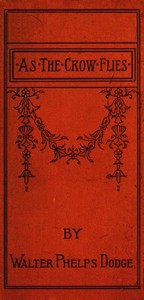
As the Crow Flies: From Corsica to Charing Cross — Key Ideas to Explore
Edition facts
This digital edition of As the Crow Flies: From Corsica to Charing Cross — Key Ideas to Explore is described by source-level measurements including 28,328 words, 2 hr 4 min estimated reading time, and 4 detected text sections.
The text analysis averages about 26.1 words per sentence, while the detected sections provide another way to judge how the source is divided.
Project Gutenberg metadata also associates the work with “Italy -- Description and travel,” connecting these edition facts with the source record’s subject description.
Calculated from edition completeness, EPUB availability, text structure and catalogue metadata. Not a user rating.
How this score is calculated
- Description quality20 pts
- Title & short description10 pts
- Source metadata20 pts
- Text length15 pts
- Chapters / structure15 pts
- EPUB file integrity20 pts
Total of 100 points, scaled to a 2.5-5.0 range. Editions with an empty description or a missing EPUB file are not scored.
Read the Text
_Aves_ and _Paters_ under its vaulted roof, for he was a native of the erst-while republic of Genoa, when that power ruled the Mediterranean and boasted, like Venice, of a Doge. There is a curious inscription above the arches which part the nave from the aisles, near the Doge's gallery, to the effect that the great-grandson of Noah founded Genoa and that the nave was restored in 1307.
But this is only one of the curious things about this curious Cathedral, for the verger who was gorgeous in his cocked hat and wand-of-office, showed us two huge pictures on either side of the high altar, which had been taken by the great Napoleon from Genoa to Paris when he conquered Italy; which had gone thence to Vienna and had finally returned to their former resting place. They showed the effect of travel, but were wonderfully well preserved. One represented the martyrdom of St. Sebastian--that ever-present product of Italian galleries, but in this case the arrows were happily absent. We saw, too, the picture of the Madonna, painted by St. Luke and alluded to by Mark Twain. It had not grown at all clearer since he saw it twenty odd years ago.
A wonderfully beautiful Byzantine tomb was shown us in John the Baptist's chapel, and was declared to contain the ashes of that saint. Certainly it must have been old, and the carving was exquisitely done. The original chains worn by John the Baptist were also shown. They were very rusty! No woman but the Queen is allowed in this little side chapel, erected to commemorate the crime of Herodias, but why Her Majesty should be excepted from the rule is not quite clear, unless we accept the theory of the divine right of Kings which Kaiser Wilhelm holds so strongly. There they also show the _sacro catina_, supposed to be made of a single emerald given by the Queen of Sheba to Solomon. This vessel formed part of the spoils of the Genoese at Cæsarea in 1101. It is brought out of the treasury three times a year for the veneration of the faithful, but no one is allowed to touch it under severe penalties. But as I was admiring this and preparing to enthuse over its associations, the verger asked if I understood Latin and immediately launched forth into the original text of the Excommunication pronounced against any female who should dare to enter that _sanctum sanctorum_ where John the Baptist reposed. But, alas, if his accent was not that I had learned at Oxford, it was still less that of Yale; and I could only guess at the meaning of most of his sonorous periods. We left the Church with this avalanche of mediæval Latin ringing in our ears. The interior, taken as a whole, is impressive. The nave and two aisles are unusually long, and standing at one end a semi-gloomy vista of respectable length is opened up. There are other Churches in Genoa, but none so rich in tradition or saintly relics. The Via Balbi is worth a visit, for there stand the famous Palazzo Rosso or Red Palace, built entirely of dark red stone; and the Galliera Palace with its magnificent collection of paintings. The Galliera family has done much for Genoa as well as for Paris. The late Duke gave £80,000 to the harbour works a few years ago, and now the city of Genoa owns the fine gallery of paintings. The Duchess, who has been dead only a short time, left her splendid house in Paris to the Austrian Emperor to be used as the permanent house of his Embassy in Paris and (as she was childless) willed her large private fortune to the clever Empress Frederick, Queen Victoria's eldest daughter, in trust for deeds of charity.
A description of one of these immense palace galleries may stand for all. Always there is a grand hall supported in part on columns leading to an arcade-surrounded court. Beyond comes the great staircase, in two ascents. All this is open to the public view, and the long perspective of halls, courts, columns and arcades is magnificent in the extreme. In a splendid suite of rooms on the second floor of this Palazzo Rosso is the largest collection of pictures in Genoa.
The Palazzo Reale or Royal Palace is interesting, having been splendidly fitted up by King Charles Albert in 1842. There are palaces innumerable in Genoa, many rich in historical interest and full of pictures by the old masters, and if one were compiling a guide book one could write quires of description about gilding that cost a million francs in one, and mosaic floors worth several fortunes in another.
But the crowning glory of Genoa is its Campo Santo or Holy Field, where the noble families of Genoa bury their dead. Imagine vast arcades surrounding an open space of several acres and these arcades crowded with wonderfully beautiful statues. Each family pays a sum (no small one) for a niche in one of these arcades with the accompanying vault beneath and then erects a life-size statue of the departed, or some symbolical figure. Some are pathetic and tender--the fairy-like child dancing on roses, for example, or the full-sized sailing boat crossing the Styx, every rope and sail wrought with wondrous grace in snowy marble. Others succeed in being only grotesque. One huge figure of Father Time sitting cross-legged on a coffin with his knee cocked up, for instance; or an unpleasantly realistic model of an old man with one foot in an open grave with his face turned over his shoulder. This was erected by an old Count, still living, when his wife died. And so on _ad infinitum_. This is a place to muse, to think grave thoughts and to reflect upon sudden death, but not a place to get up an appetite.
Genoa is an attractive city, although they say that, unlike Florence and Pisa, it is not an economical town for strangers of limited means and that lodgings are scarce.
The character of the inhabitants betrays little of the fiery valour that gave Genoa its proud position in the Middle Ages. Now its people are quiet, hard-working and practical; they take little interest in politics and are well content to live under a constitutional Monarchy, without showing any disturbing tendency toward an anarchistic Republic.
THE NAPOLEONIC LEGEND.
ROME.--Prince Napoleon, the head of the Bonaparte family and _de jure_ Emperor of the French, has died at Rome after a long and serious illness, during the course of which, faithful to his declared principles, he refused to accept a drop of medicine. His has been a strange and eventful life. Nephew of the great Napoleon, born in Trieste in 1822, he has been four times in exile. He was born in exile and he has died in exile. One of the most brilliant men who ever lived, one of the most statesmanlike, his whole life has been ruined, and the great promise of his youth spoiled, by the cynical disregard of the opinion of others which has always distinguished him. He was far the superior of his cousin, the Emperor Napoleon III., and if his advice had had more weight with the Emperor, the Republic in France would still be a hopeless dream, and the mud of Panama would not have soiled France.
Prince Napoleon had, of course no connection with the _coup d'état_ of the Second December that gave Napoleon III. the French Empire, for his claims were indisputably superior to those of the successful plotter; and although a reconciliation did take place between them, their relations were never very cordial, in spite of the fact that the Emperor placed great reliance upon Prince Napoleon's judgment. It may be safely said that if Prince Napoleon had been in Paris during the fatal days of 1870, the unfortunate war with Prussia would never have been declared. It is ancient history now that the Empress Eugénie was the cause of that war, and in private conversation often referred to it as "_Ma Guerre_."
Not long since I met the famous Doctor Cordes of Geneva, who had been called in consultation by the Emperor before he started on the fatal campaign that culminated in Sedan; and he told me that the Emperor was simply a child in the hands of the Empress, for he was, at that time, suffering the most terrible agony from stone in the bladder. At that time, however, Prince Napoleon was traveling in Spitzbergen with his _bon amis_, Ernest Renan, the clever author of the "_Vie de Jésus_," and knew nothing of passing events. A warning dispatch was indeed sent to him, but he shrugged his shoulders on receiving it and remarked that although the members of the government in France were "_imbeciles_," still they were not all fools.
But events proved that they were, and Prince Napoleon hurried back upon the declaration of war, meeting with a hostile reception on his way through Scotland, where the sympathies of the people were with Prussia. He found the French Ambassador in London, M. de la Vallette, jubilant and repeating the boomerang-like phrase, "_A Berlin_." The Prince foretold the result clearly and exactly, and after Sedan quietly devoted himself to scientific pursuits until the time for the third Empire should arrive. He had never liked the Empress Eugénie. He saw clearly the mistake the Emperor had made in not allying himself with one of the reigning houses; and in espousing the beautiful Mademoiselle de Montijo. He assumed a spiteful attitude toward the Empress whom he called "_Ni-Ni_," and once refused to drink her health in public.
M. Renan says of him that his grasp of a subject was wonderful, his wit extraordinary, and his executive ability unsurpassed. His sister, the brilliant Princess Mathilde, who shares so many of his gifts, has the only _salon_ in Paris to-day, and with her brother's death and the union of his party it will become historical.
Prince Napoleon was so reserved that he went through life without inspiring or receiving any real affection, and without meaning it he unconsciously repelled adherents who wished to become devoted. He had the misfortune of passing for a Republican under the Empire and for an Imperialist under the Republic, which was the more unfortunate as he despised all forms of government, and in his ambition to rule would have put up with any. A curious thing about him was the fact that his followers liked him better at a distance. Only the other day one of his staunchest friends exclaimed: "I never liked him so well as now, when I know I shall not see him again."
At a distance people remembered only his brilliancy, culture, eloquence and the surprising ease with which he mastered every problem, however difficult, in public affairs. He was superior everywhere and popular nowhere, and although he had the personal magnetism which enforces admiration at first sight, he had also the unfortunate power of inducing antipathy toward him on further acquaintance.
The deceased Prince's life was in all its vicissitudes an extraordinary one and is rich in anecdotes and stories. His career was a succession of false steps, and again and again the cup of power was at his lips, only to be dashed to the ground by his own mistake. A man of majestic person, high ambitions and unexcelled ability, his singular lack of tact and knack of doing the wrong thing in the right place ruined his chances of success.
Prince Jerome Napoleon, or the Emperor Napoleon the Fifth--to give him his real title--was the son of Jerome Bonaparte (the brother of the great Napoleon), King of Westphalia, by his marriage with the Princess Catherine of Wurtemburg. He was brought up in Rome, Austria and Geneva, and finished his education under the supervision of his uncle, the King of Wurtemburg, at the military school of Ludwisburg, near Stuttgart. On the establishment of the Empire, under his cousin, he took rank as Heir Apparent before the Prince Imperial's birth, after which he became Heir Presumptive, and was for some time Governor-General of Algeria. The Emperor often employed him upon various diplomatic military and scientific missions. Many people may have forgotten that at one time Prince Napoleon was a prominent rival of the Emperor. When the future Napoleon III. was indulging in various little escapades that made it seem unlikely he would ever rise to any great position, fortune favoured his more youthful cousin. Prince Napoleon had every advantage. In looks he was weirdly like the first Napoleon. I saw him here last year and instinctively looked for the cocked hat and knee breeches associated forever with "_le petit caporal_." No one who saw his massive, clean-shaven, powerful face could doubt that he stood face to face with a veritable Napoleon. He seemed to hold the winning card when the Revolution of 1848 broke out, but every day he lost ground, notwithstanding his active interference in affairs, and every day Prince Louis Napoleon gained more influence in spite of his reserve. And this illustrates French nature. It prefers a man who is impenetrable rather than one who bustles about and allows his plans to be found out. After a few pitched battles Prince Napoleon allowed it to appear that he recognized his cousin as the stronger man, and attached himself to his cause. But he had no sympathy with the men who planned the _coup d'état_. He distrusted and disliked them, and they returned the compliment. But he became Heir Presumptive, was made a general and had the Palais-Royal as a residence with £40,000 a year.
In 1859 he married Princess Clotilde, the daughter of King Victor Emanuel, and sister of the present King of Italy. He leaves three children, Prince Victor Napoleon--now Napoleon the Sixth,--Princess Letitia, widow of the Duke of Aosta, and Prince Louis, a colonel in the Russian Dragoons. And now we come to two mistakes generally made as to the dead Prince's character. He was not a coward and he was not an atheist. Ever since the Crimean war Prince Napoleon has been dogged with a reputation for cowardice and was given the nicknames of "_Plon Plon_" and "_Cringe Plomb_" by the Parisian mob. There is not a doubt, however, that he behaved with all the courage of his race at the battle of the Alma, and that his recall was not due to his own choosing, but to the intrigues of his enemies.
The report of the Marshal Commanding confirms this. But a damning story of his ill-health was circulated at the time by the semi-official papers, and the mob was ready to put the worst construction on it. Report says the Empress Eugénie was in no small degree responsible for these rumours, for she cordially disliked him and he returned the feeling with interest.
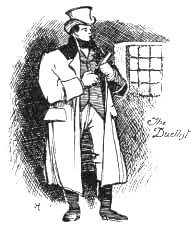
Fate was again cruel to him in the war with Prussia in 1870-'71. When he returned from Spitzbergen he was anxious to be given a responsible command in the Imperial army, but instead was sent off to Italy to keep King Victor Emanuel in a good humour. He had one more chance, before the war, of redeeming his honour, when the Duc d'Aumale challenged him to a duel, but lost it by too much conscientiousness. He hastened to the Tuilleries to ask if he ought to fight. Of course the Emperor said no, and then the Empress made her famous but ill-natured _bon mot_, "If a bullet is ever found in our cousin's body it will be that he has swallowed it."
Prince Napoleon was not an atheist. This is proved by his whole life, by his friends and by his death, and will be proved by his memoirs, for in his last moments, while still conscious, he received Extreme Unction from Cardinal Bonaparte, and he has had a religious funeral. He was an anti-clerical, and while certainly not a religious man, he inclined towards the doctrines of Rousseau.
The famous Good Friday dinner at which the Prince and his guests ate _charcuterie_ and drank a somewhat profane toast was the base of the belief respecting his religious opinions--a belief greatly magnified and spread by the Empress Eugénie. Prince Napoleon never knew when to speak and when to remain silent, although a magnificent orator, and his failing has been well summed up by a famous senator: "The Prince speaks well, he is the best of orators--but he says only too well what had best been left unsaid."
His friends were the most famous men of the day, Victor Hugo, Edmond About, Ste. Beuve and Père Hyacinthe, who sent him his blessing as he lay dying. His relations with the Emperor show many instances of his want of tact. Having been complimented by Napoleon upon two speeches delivered in the Senate against the temporal power of the Pope, he resolved to improve upon them, and then delivered his famous anti-Papal speech at Ajaccio, a speech which drew forth the following interesting letter of remonstrance from the Emperor:
"_Monsieur Mon Cousin_,--I cannot help informing you of the painful impression which I received on reading the speech you delivered at Ajaccio. When I left you in Paris with the Empress and my son and as President of the Privy Council, I hoped that you would prove yourself by your acts, conduct and speeches, worthy of the trust which I had placed in you, and that you would set the example of that unity which ever ought to exist in our family. You have raised questions which no longer concern our day. It is necessary to have borne, as I have, the responsibilities of power in order to judge how far the ideas of Napoleon I. are applicable to the present time. Before the great statue of the founder of our family, what are we but pigmies, only able to behold a part and incapable of grasping the whole? One thing, however, is certain, and that is that Napoleon exercised--first of all in his family and then in his government--that severe discipline without which all government is impossible, and without which all liberty leads to anarchy. Having said this much, my cousin, I pray God to have you in his holy keeping.
This letter was written in 1866, when the Emperor was traveling in Algeria.
After the fall of the Empire and the death of the Emperor, Prince Napoleon kept up a sort of armed neutrality with the Empress Eugénie and his young cousin, the Prince Imperial (then Napoleon the Fourth), after whom, he was the head of the Bonapartist party. When the Prince Imperial fell in Zululand in 1879, Prince Napoleon became the head of the family. But the Prince Imperial had made a foolish, boyish will in which he named his cousin, Prince Victor, the eldest son of Prince Napoleon, his heir and successor. The Empress Eugénie was only too glad to annoy her hated foe by pretending to accept this absurd arrangement, and unfortunately Prince Victor Napoleon fell into the hands of foolish advisers, quarreled with his father and set up a party of his own. For several years father and son have not spoken, each claiming to represent the Imperialist party in France. But it is now stated with authority that Prince Victor Napoleon was reconciled to his father on his death-bed, and this will do much towards wiping out the memory of his unfilial conduct. But he was strongly tempted. The Empress Eugénie urged him, all the old adherents of his great family urged him, to set up the Napoleonic standard, while his father seemed apathetic and indifferent. Then, of course, he commanded a divided allegiance. Now he stands at the head of a united party. Thousands of men who would not join Prince Napoleon on account of his anti-clerical opinions and who refused to support Prince Victor Napoleon against his father, are now rallying to the Imperial standard.
Scoffers said the Napoleonic legend was dead when the first Napoleon died. Scoffers say so now. Yet Napoleon III. proved that it was very much alive in the fifties, and it is well on the cards that Napoleon VI. may do so in the nineties. The new Emperor _de jure_, is clever, eloquent and possesses tact, above all the _sine qua non_ of one in his position. He has few enemies and many friends and will inherit the Empress Eugénie's large fortune upon her death.
And so the greatest service Prince Napoleon has ever done for his family and cause is by dying, for his death unites, while his life divided, his party.
History will judge him fairly. Brilliant, clever, witty, statesmanlike, eloquent and masterful, his life has been ruined by want of tact. His last words are significant: (I quote from the London _Times_.)
Walter Phelps Dodge opens his travelogue with a preference for a simple glass of ice-cold lemonade over a bumper of burgundy, setting a tone of unpretentious observation. His journey from Corsica to Charing Cross is less a grand tour than a series of vignettes, each place filtered through a lens of dry humor and a fondness for the peculiar. Dodge's voice is that of a companionable guide, quick to note the absurdities of resort life—the pine fetishes of Bournemouth, the high prices that frighten away all but marquises—and equally quick to appreciate a fine view or a well-turned phrase. The book, originally a collection of letters to the Hartford Post and Hartford Courant, retains the immediacy of correspondence, with each chapter a dispatch from a different station.
A Taste for the Particular
Dodge's prose is most alive when he seizes on a single, telling detail. In Bournemouth, he observes that pines are the town's fetishes: visitors breathe pine balsam, bathe in pine juice, sleep on pine pillows, and are finally laid under pine shade. The repetition builds a comic monotony that perfectly captures the place. Similarly, at Oxford, he notes the rule that students must wear caps and gowns after dark, and the fine for being caught "in mufti"—a small, concrete rule that opens a window onto the university's social code. Dodge does not generalize about national character; he reports what he sees and hears, letting the oddity speak for itself.
The Art of the Aside
Dodge's digressions are often his sharpest observations. In describing Bournemouth's lack of a theatre—the Lord of the Manor objects to worldly amusements—he notes that residents have circumvented the ban by fitting up the town hall as an amateur playhouse, where "occasional third-rate companies perform." The aside is both a factual report and a quiet judgment. Similarly, his remark that consumptives have lately hurried off to Berlin for Dr. Koch's clinic undercuts the claim that Bournemouth's climate is beneficial. These asides give the travelogue a conversational rhythm, as if Dodge is sharing gossip over that glass of lemonade.
Comparisons and Contradictions
Dodge frequently measures England against the Mediterranean, but his comparisons are never simple. The Hampshire coast, he writes, is beginning to be called the British Riviera, though the sea is less blue and the sky duller. The climate of Bournemouth, he claims, differs little from Geneva's except for more snow in Geneva and less relaxing air. These comparisons serve not to elevate one place over another but to sharpen the reader's sense of each location's particular character. Dodge is aware that his readers may know Nice or San Remo; he uses that knowledge to make Bournemouth strange again.
The Observer Observed
Dodge's own position as an American traveler in late-Victorian Europe is never far from the surface. He notes prices, social hierarchies, and the quirks of local governance with the eye of an outsider who is not easily impressed. His acknowledgment to the editors of the Hartford Post and Hartford Courant reminds us that these letters were written for a Connecticut audience, one that might appreciate a wry take on English snobbery or Corsican remoteness. Dodge does not pretend to be a native; his value lies in his detachment. He is the crow flying from Corsica to Charing Cross, seeing the landscape from a height that is neither wholly inside nor wholly out.
Dodge's travelogue rewards the reader who enjoys a companionable, slightly skeptical guide. The book's structure as a series of letters means each chapter can be read independently, but together they build a cumulative portrait of a traveler who is more interested in the particular than the picturesque. Readers should approach As the Crow Flies not as a comprehensive guide but as a collection of dispatches from a sharp-eyed observer, one who knows that a glass of lemonade can be more revealing than a bumper of burgundy.
There’s something almost conspiratorial about Dodge’s preference for lemonade in a land of burgundy—that quiet refusal to perform travel the expected way. It reminds me of another, stranger pilgrimage, the elegiac drift through a falling city in The Last Days of Pekin — Inside the Classic. Both books feel less like journeys than like slow exhales, observations held gently before they vanish.
Scarlett Nelson
2 weeks ago-
Michael Michelle Gutierrez - 3 weeks ago
{'rating': 2, 'text': 'I found this book difficult to get through. The humor feels forced and the narrative is disjointed. The author seems more interested in showing off his cleverness than in providing a coherent account of his travels. The descriptions are often superfluous, and the book lacks a strong narrative thread. Not recommended.'} -
Justin Hall - 1 week ago
{'rating': 5, 'text': "An utterly charming and witty travel narrative that follows the author's whimsical journey from Corsica to Charing Cross. The observations are sharp, the humor is dry, and the storytelling is engaging. The book offers a delightful blend of travelogue and social commentary that feels fresh even today. A true gem for lovers of classic travel writing."} -
Chris Katherine Steele - 1 week ago
{'rating': 3, 'text': "A pleasant read with moments of brilliant wit and vivid description. The author has a keen eye for detail and a humorous take on the places he visits. However, the book's structure is somewhat meandering, and the cultural references are dated. It's a decent choice for a light historical read, but not a masterpiece."}
What was your reading experience?
Capture what you thought, learned, and would like to remember.

Wyatt Adams
3 weeks ago