About 124 minutes
As the Crow Flies: From Corsica to Charing Cross — Key Ideas to Explore
Geography
28,328 recorded words. 1 minutes difference from this book's estimate.
View Gutenberg source #47213
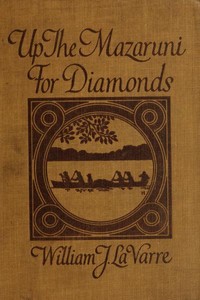
For Up the Mazaruni for Diamonds — Story, Setting & Ideas, the stored edition analysis reports 28,610 words, 2 hr 5 min estimated reading time, and 4 detected text sections.
The text analysis averages about 18.8 words per sentence, while the detected sections provide another way to judge how the source is divided.
Project Gutenberg metadata also associates the work with “Guyana -- Description and travel,” connecting these edition facts with the source record’s subject description.
Explore this collection
These alternatives are selected using recorded categories and estimated reading time.
About 124 minutes
Geography
28,328 recorded words. 1 minutes difference from this book's estimate.
View Gutenberg source #47213About 132 minutes
Geography
30,231 recorded words. 7 minutes difference from this book's estimate.
View Gutenberg source #42737About 116 minutes
Geography
26,677 recorded words. 9 minutes difference from this book's estimate.
View Gutenberg source #48156Search stored excerpts and compare books → Choose by your preferences →
Choices use stored catalog measurements. Estimates vary with reading speed. A shared category is a catalog label, not a claim that two books have the same argument or literary quality.
Search reads excerpt text stored with this catalog and links to its associated Gutenberg record. The connection is stored in the site database; this tool does not recheck that every excerpt is word-for-word identical to that external record. Excerpt search does not cover every chapter and does not verify historical publication dates.
Catalog snapshot checked: 2026-09-25. Coverage: 96 public books, 96 available source excerpts.
Calculated from edition completeness, EPUB availability, text structure and catalogue metadata. Not a user rating.
Total of 100 points, scaled to a 2.5-5.0 range. Editions with an empty description or a missing EPUB file are not scored.
Public-domain source text
The source text is kept in the dedicated reader, separate from this catalogue record and its commentary.
William La Varre's Up the Mazaruni for Diamonds (1919) is structured as a chronological travelogue, but its movement between scenes reveals a deliberate pattern: the narrator repeatedly shifts from river travel to jungle encounters to village visits, each transition marked by sensory cues. The opening chapters establish a rhythm of departure, obstacle, and arrival, while later sections introduce ethnographic observations that interrupt the mining narrative. This structure mirrors the unpredictable nature of the expedition itself.
The narrative alternates between two primary settings: the Mazaruni River and the surrounding jungle. River passages are described with attention to current, obstacles, and the labor of poling or paddling, as when La Varre notes a "fire boat" or the difficulties of navigating rapids. Jungle scenes, by contrast, emphasize stillness, heat, and the sudden appearance of animals or people. This back-and-forth creates a structural pulse that mirrors the expedition's alternating periods of exertion and waiting.
One recurring image is the "mystery gun"—the revolver that La Varre brandishes to assert authority. It appears in multiple scenes, always as a tool of psychological control rather than violence. The weapon's symbolic weight grows as the journey progresses, contrasting with the Indians' blowpipes and crude guns.
Each village visit follows a similar pattern: approach through swamp or forest, sound of a horn or dogs, arrival at a clearing, and a crowd of curious inhabitants. La Varre describes the "A-shaped roofs of reeds" and the communal house with a conical roof, noting the "mangiest, sorriest looking dogs" that howl and then hide. These set pieces allow him to contrast Indian life with American expectations, as when he imagines an American mother's reaction to babies crawling in mud.
The recurring detail of the "quevu" or tiny apron and the red loin cloth emphasizes the cultural gap. La Varre's own clothing—hat, coat, vest, trousers—becomes a source of wonder, a detail he repeats to underscore the asymmetry of curiosity.
The book opens with a foreword by Anthony Fiala, which establishes La Varre as a prepared, hardworking explorer. This external endorsement frames the narrative as instructive rather than merely adventurous. Fiala's language—"hard work and preparedness," "love of the work"—sets expectations for the reader. The foreword also mentions La Varre's age (born 1898) and his scouting background, positioning him as a youthful but serious figure.
This framing influences how the subsequent chapters are read: the mutiny, the Fourth of July celebration, and the encounters with Indians all become evidence of La Varre's competence. The foreword's claim that "his diamond hunting trip was a success" is the only explicit statement of outcome; the narrative itself avoids declaring triumph.
Throughout the excerpts, La Varre returns to images of control: the revolver, the pace of walking, the distribution of cigarettes. When Simon tries to lose him, La Varre pulls his revolver "with a great flourish" and the Indian immediately slows. The narrator's authority is maintained through these small acts of display. Yet vulnerability also surfaces: the "dismal swamp" where night falls, the "filthy ground" of the village, the babies crawling through "stagnant water."
These contrasting images—power and disgust—create a tension that runs through the narrative. La Varre is both the armed explorer and the man who shudders at what he sees. The structure of the book, moving from river to jungle to village and back, allows these moods to alternate without resolution.
Readers attentive to structure will notice how La Varre uses repetition—of setting, of gesture, of observation—to build a portrait of the Mazaruni region that is as much about the narrator's own perspective as about the landscape. The book rewards those who track these patterns rather than seeking a linear plot. The foreword and the chapter titles provide a map, but the real journey is in the details of movement and encounter.
Reading about La Varre’s slow drift along the Mazaruni, I recalled sitting on a grey porch years ago, turning pages of The Paris Sketch Book of Mr. M. A. Titmarsh; and the Irish Sketch Book while rain softened the street. Both books feel less like destinations than itineraries of noticing—the way a landscape becomes bearable when someone names its silt, its light. I wanted to stay inside that unhurried mood, where even failure casts a quiet shadow. There’s a tenderness in both expeditions, a willingness to be lost. The Paris Sketch Book of Mr. M. A. Titmarsh; and the Irish Sketch Book — A Reader’s Guide reminded me that wandering, even pointless, is its own small shelter.
Answer a few questions and save a private reflection on this device.