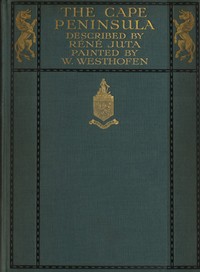
The Cape Peninsula: Pen and Colour Sketches — Edition Insights

(4 User reviews)   844
In Category - Geography
Hansard, Réné, -1940, Westhofen, W. (Wilhelm), 1842-1925 [Illustrator] Project Gutenberg 2013 Not confirmed
Cape of Good Hope (South Africa) -- Description and travel; Eastern Cape (South Africa) -- Description and travel Readers of public-domain and historical texts
Project Gutenberg digital edition en

Edition facts

Words 30,231
Reading time 132 min
Text sections 4

For The Cape Peninsula: Pen and Colour Sketches — Edition Insights, the stored edition analysis reports 30,231 words, 2 hr 12 min estimated reading time, and 4 detected text sections.

The text analysis averages about 26.8 words per sentence, while the detected sections provide another way to judge how the source is divided.

Project Gutenberg metadata also associates the work with “Cape of Good Hope (South Africa) -- Description and travel,” connecting these edition facts with the source record’s subject description.

This editorial note examines Réné Hansard's authorial choices in diction, dialogue, and description in 'The Cape Peninsula: Pen and Colour Sketches,' focusing on how the text blends travelogue, historical anecdote, and botanical observation through a distinctive narrative voice.
Share
Editorial Edition Score 4.6/5

Calculated from edition completeness, EPUB availability, text structure and catalogue metadata. Not a user rating.

How this score is calculated
  • Description quality20 pts
  • Title & short description10 pts
  • Source metadata20 pts
  • Text length15 pts
  • Chapters / structure15 pts
  • EPUB file integrity20 pts

Total of 100 points, scaled to a 2.5-5.0 range. Editions with an empty description or a missing EPUB file are not scored.

Edition quality

Read the Text

as the great form of exercise. 'The ladies of the Cape are pretty and well dressed,' says the French traveller Le Vaillant, visiting the Cape about this time--1772. He expressed great surprise at the way they dressed: 'With as much attention to the minutiæ of dress as the ladies of France, with neither their manners nor their graces.' How could they have manners and graces? With the adaptability which amounts to genius, which the women of newly-arisen cosmopolitan nations possess as Fate's compensation for depriving them of the birthright of history, tradition, and ancient habitation, they imitated the manners and fashions of the passing passengers resting a few days at the Cape on their way to India. Those belonging to the better class all played on the harpsichord and sang; they had generally a good knowledge of French, and often of English; were experts with the needle, making all kinds of lace, 'knotting' and tambour work; and they usually made up their own dresses.

The men and youths, who never mixed with the English or foreign visitors, were entirely different: phlegmatic and dull, badly dressed and badly mannered. Anne Barnard, writing Cape gossip to London, has many stories to tell of pretty Cape ladies running off with Englishmen or Frenchmen. The thanksgiving sigh of one worthy 'Koopman' is conclusive: 'Grace à Dieu, ma femme est bien laide!'

However, we must return to the house of Le Roux in the Strand Street. It is the day after the fête in the Avenue and the Governor's ball. At an old French bureau, with metal inlays, praising Monsieur Buhl in every beautiful line, this gallant Captain Cook wrote in his _Journal_ while the pretty little 'Foei toch,' with sighs of neglect, sat playing the spinet in a corner of vantage. They changed places presently--he would dictate and she should write. Two minutes passed, and Cook got up and looked over her shoulder. She had written, atrociously, a funny little French verse and signed it:

'Marion pleurt, Marion rit, Marion veut, qu'on la marie. 'MARION.'

Cook smiled and bowed. 'Me dear, you have the most adorable foot in the world, but I dare say little for your hand.' Very witty of him, but of course she wrote badly; there were no schools, only ill-paid writing masters. The parsons, all well paid by the Government, would not condescend to such a worthless occupation.

So Cook wrote his _Journal_ himself, in large, scrawling writing, with old-fashioned _s_'s, while his two ships, the _Resolution_ and the _Adventure_, anchored by stout chains instead of cables in this Bay of Storms, lay waiting for a good wind to sail away round the world. And Marion sang from her corner at the spinet:

'Marions ci, Marions ça, Mais jamais, jamais marions là.'

'THE CAPE OF GOOD HOPE, '_Monday, November 2, 1772_.

'The Cape of Good Hope, in Caffraria, or the Country of the Hottentots, is the most southern promontory of Africa.

'It is very mountainous.

'The Table Mountain is of a great height (_sic_), and the top of it is always covered with a cap of clouds before a storm. There are no harbours, though there is a sea-coast of a thousand miles. When Commodore Byron touched at the Cape he was obliged to work into Table Bay with his top sails close reefed. Indeed, the Cape is scarce ever free from storms a week together; the winds blow hard and on every side from the vast southern ocean, and the waves of the sea rise to a height never seen or experienced in any part of Europe. The Bay of Biscay, turbulent as it is, has no billows that mount like those on this extensive ocean; the stoutest vessels are tossed and almost lifted to the skies. A number of rich ships have perished on this coast; the Dutch have lost whole fleets even at anchor before the Town.

'The climate is very healthy, the country is fine, and it abounds with refreshments of every kind. The Company's garden is the most ravishing spot.'

(He read this to Mademoiselle Marion, who had found Mr. Pickersgill, his Third Lieutenant, a good second when the gallant Captain, with his tongue in his cheek and a wink at Marion, escorted the fat wife of Governor Van Plettenberg round the most ravishing Gardens.) The Captain went on with his diary:

'The garden produces all the most delicious fruits of Asia and Europe. It is guarded from the winds and storms by hedges of bay, very thick and high, affording a most refreshing shade in the hottest season. It abounds with peaches, pomegranates, pineapple, bananas, citrons, lemons, oranges, the pears and apples of Europe, all excellent in their kind, and the crimson apple of Japan, appearing through the green leaves, of all the most beautiful. The Dutch have large plantations of almond-trees, and many sorts of camphor-trees, and there is scarce a cottage without a vineyard to it. Their cabbages and cauliflowers weigh from thirty to forty pounds, their potatoes from six to ten, raised from seed brought from Cyprus and Savoy. Their corn is ripe in December, and our Christmas is the time of their harvest. In January they tread out their corn, and in February the farmers carry it to the Company's magazines.

'They sow every kind of grain but oats. Lions, tigers, leopards, elephants, and the rhinoceros are to be found here; the elephants are very large; their teeth (_sic_) weigh from sixty to one hundred and twenty pounds. The Dutch keep up a body of regular forces, and have a strong garrison at the Cape; they have also a militia, a corps of men in all nations formidable in themselves, most dreadful to an enemy, and, when called out for service, spreading destruction all around them in the heights of their ungovernable fury. They are of so robust a disposition, and so naturally inclined for war, that, like the Devonshire and Northamptonshire champions in England, they are ever ready to solicit employment, even against the principles of their own institution.'

Next day the Governor, the English Consul, the Fiscal, Marion and her father, together with a large party, boarded the _Resolution_, to see them make fresh water out of salt water; and when they left, and before the _Resolution_, firing fifteen guns, and the _Adventure_ nine, sailed away round the world, Mr. Pickersgill and Marion had found time to fall in love. Marion at her spinet that evening shed very salt little Dutch tears when she came to the lines, 'Mais jamais, jamais marions là.'

There is a charming poem by Ian Colvin which Marinus thinks might be inspired by Marion and her Lieutenant.

In the Museum at the top of the old Company's gardens lies a little English shoe of surprising smallness--surprising, for not only Anne Barnard remarked on the size of the Cape ladies' feet: there is that nice story of the enterprising merchant who chartered a large shipload of out-sizes in ladies' shoes, and the ladies sent their slaves in the dark to buy them!

'There's a tiny English shoe Of morocco, cream and blue, Made with all a cobbler's skill By Sam Miller in Cornhill.

'Many a story, quaint and sweet, Of the lady fair, whose feet Twinkled with a charm divine Beneath her ample crinoline, Making her tortured lovers dream That heaven itself was blue and cream.'

The story tells of how this dainty creature walked down the 'Heerengracht,' followed by the tortured lovers:

'Van der Merwe, Jacques Theron, The Captain of the garrison, Petrus de Witt, or Van Breda, Or Cloete of Constantia. And then the Fiscal--fat and old-- What matters? he had power and gold, Coffers of dollars, and doubloons, Gold mohurs, pagodas, ducatoons, And in his cupboards stored away The priceless treasures of Cathay.'

Then it tells of how she loved this English sailor, how he left to sail to many strange lands, and asked her what she wished to have.

'And she, although her cheeks were wet, Was in a moment all coquette: "Your English fashions would, I fear, But ill become my homely sphere; Besides, you know not how to choose-- Bring me instead a pair of shoes."'

So the English lover sailed away, and the Fiscal became a menace to the poor little cream and blue 'Jonge Vrouw,' and the wedding-day arrived:

'From Signal Hill to Witteboom, From Kirstenbosch to Roodebloem, With cannon, bugle, bell and horn, They ushered in the wedding morn.'

But the English lover and the shoes arrived just in time; the bride was missing; the wedding-party and the storming Fiscal rushed down to the sea-shore--'a ship in a cloud of sail was riding out of the Bay in a favouring gale.'

'They heard above the ocean's swell Ring faint and clear a wedding bell; And where the boat put off, they found A tiny shoe upon the ground.'

'Marions ci, Marions ça, Et jamais, jamais marions là.'

A charming idyll to amuse us as we climbed up the hill to Riebeek Square, where the flat-roofed houses and the old Slave-Market with a few wind-twisted pines have so much of the 'old order' in their keeping.

Behind the square were the old brickfields, where poor Lieutenant Schut's duties lay. The Slave-House stands in the middle of the square.

This energetic young man disappears from the pages of the _Journals_ and presumably from society.

'Lieutenant Schut is expelled from the Council, because he has passed a deed of reclamation to the widow of the late Reverend Wachtendorp for libellous words uttered by him behind her back, and to her injury.

'The Council should keep itself free from obloquy, and unpolluted.'

Praiseworthy sentiments, but they must have suffered for them. I find no mention of another paragon who was able to accept the responsibilities imposed upon Schut.

Indiscriminate gossip or libel was most severely punished at the Cape, the desire to be free from obloquy not being confined to the Council.

In 1663 Teuntje Bartholomeus, wife of the burgher, Bartholomeus Born, is banished for six weeks to Dassen Island for having libelled a certain honest woman. A perfect rest-cure! Six weeks on Dassen Island! alone with Nature, wind, sea, rock-rabbits, and seals!

There is no official mention of her return from exile.

'For there is no country in the world where slaves are treated with so much humanity as at the Cape,' writes Le Vaillant in 1780, but in reading through the old day-books of Van Riebeek, Hackius, Borghorst, Isbrand Goski, and the Van der Stels, the punishments inflicted on slaves might have been inspired by those old, over-praised painters, who gloried in an anatomical dissection of a poor wretch whose miserable body possessed no anatomy at all. The Mozambique, Madagascar, and Malay slaves were keel-hauled; they were tied in sacks and thrown into the Bay; they were tortured. Here is the sentence of one: 'Bound on a cross, when his right hand shall be cut off, his body pinched in six places with red-hot irons, his arms and legs broken to pieces, and after that to be impaled alive before the Town House on the Square, his dead body afterwards to be thrown on a wheel outside the town _at the usual place_, and to be left a prey to the birds of the air.' Could any torture of the Inquisition be worse? But these tortures were in 1696, years before the enlightened days of Le Vaillant. The half-breed slaves of the early days were a source of worry to the ruling council; several times in the _Journals_ one may come across a case of a freeman or burgher marrying his emancipated slave:

'"Maria of Bengal," a Hindoo woman, set the fashion, and the famous interpretress, Eva, during her extraordinary career of diplomatic and immoral episodes within the walls of the Fort, where she wore garments made by kind Maria van Riebeek, or outside the walls, where she wore the filthy skins of her own people, the Hottentots, beguiled the senior surgeon to such lengths that he was granted permission to marry her. He fortunately was killed during an expedition to Madagascar, but not before he had had sufficient time to regret the beguilings of Eva.'

Many of the slaves were children of convicts sent from Batavia and the Malay Settlements. Here is the case of a half-breed girl, which was sent to Batavia for judgment:

'Regarding the half-breed girl, you order that she is to serve the Company until her twenty-second year, when she is to be emancipated on condition that she makes profession of the Christian faith, and, moreover, pays R. 150 for her education. We are well aware that this rule is observed in the case of _slave children having Dutch fathers_, but whether it applies to children of _convict women_ by Dutch fathers, as in the case of this girl, would like to hear from you.'

When Le Vaillant wrote, all these rules had changed, though even he talks with some mystery of a runaway slave having received a _slight correction_. When slaves landed at the Cape, they cost from a hundred and twenty to a hundred and fifty dollars (_i.e._, rix-dollars) each, that being about £22 10s. to £27 10s. The negroes from Mozambique and those of Madagascar were the best labourers; the Indians were much sought after for service in the house and in the town. Malays were the most intelligent and the most dangerous. Barrow, in whose days (1798) the price of slaves had gone up considerably, tells a story showing the revengeful spirit of the Malay. A slave, thinking that he had served his master sufficiently long and with great fidelity, and having also paid him several sums of money, was tempted to demand his liberty. He was met with a refusal. He straightway went and murdered his fellow-slave. He was taken up and brought before the Court, acknowledged that the slave he had murdered was his friend, but said that the best form of revenge he could think of was not to murder his master, but to deprive him of a slave worth the value of a thousand rix-dollars (_i.e._, £187 10s.) and of another thousand by bringing himself to the gallows!

The Creole slaves were sold for a higher price than the others, and were often 'acquainted with a trade,' when their price became exorbitant. They were clothed properly, but went barefooted. Twenty to thirty slaves were generally found in one house. 'That insolent set of domestics called _footmen_,' writes the French explorer, 'are not to be seen at the Cape; for pride and luxury have not yet introduced these idle and contemptible attendants who in Europe line the ante-chambers of the rich, and who in their deportment exhibit every mark of impertinence!' The abolition of the Rack and Torture was responsible for an extraordinary occurrence: the public executioner made an application for a pension in lieu of the emoluments he used to receive for the breaking of legs and arms; the second hangman upon inquiry learnt that not only did the English of this new régime abolish the Rack and Torture, but that they were not thinking of establishing breaking on the wheel; this was more than he could bear, and, fearing starvation, he went and hanged himself! Strange irony of fate.

In every family a slave was kept whose sole duty was the gathering of wood. It was strictly forbidden to gather any fuel, scrub, or bush on the Downs or Flats, so the slave would go out every morning up the mountains, and would return at night with two or three small bundles of faggots--the produce of six or eight hours' hard labour--swinging at the two ends of a bamboo carried across his shoulder. In some families more than one slave was kept for this purpose, and this gives a very good idea of the scarcity of wood at the Cape as late as 1798. From the diaries of that time one gathers that, though wood was only used for cooking purposes--as only the kitchen possessed a fireplace--yet the cost of fuel for a small household amounted to forty or fifty pounds a year.

IN THE BLUE SHADOW OF TABLE MOUNTAIN

The blue shadow of Table Mountain falls straight across the 'Flats,' or the sandy isthmus of the Cape Peninsula--a long, intensely blue line stretching from one ocean to the other.

In 1653 this shadow meant something more than a beautiful shade; it was a boundary-line; it meant safety and shade within its depth, war and barbarians beyond.

Along its borders were dotted small forts and watch-houses; there were even the beginnings of a canal running parallel with the definite shade, to intensify its significance.

The Dutch East India Company's long-suffering and harassed Commander, Van Riebeek, with infinite undertaking of dangers and difficulties, wild beasts, Hottentots, and quicksands, rode across it, and fixed its boundaries as proper limits to the Settlements, which its most honourable directors were pleased to call 'Goode Hoop.'

The blue shadow begins on the other side of the Wind Mountain or Devil's Peak, and we will go where it leads.

In 1663 there was a narrow road running close up to the mountain rather higher up than the present dusty main road. It ran as far as Rondebosch, or 'Rond die Bostje,' whose round-wood traditions are untraceable, Van Riebeek having given orders that only the outer bushes should be preserved as a convenient kraal for cattle. Along this narrow road a small ox-cart rumbled every day from the fort in Cape Town, dragging home logs of wood from the almost unknown land beyond; its driver running momentary risk of meeting in the narrow way the lions, tigers, or rhino, that roamed the mountain slopes.

One end of the shadow falls into the sea at Maitland or Paarden Island, and covers some stretches of beach, small houses, and railway workshops. There the rivers meet--the Diep River from Milnerton, the Liesbeek and the Black Rivers from across the Flats. They join and form the Salt River, a wide, overflowing stream that is constantly flooding the green lands between the sea and the old Trek road to the north.

In the old days, this beach between Salt River and Milnerton was the setting of tragedies: backed in on the north and east by the Blaauwberg Mountains and the Stellenbosch Ranges, and on the south-east by the Hottentot's Holland.

From behind the Blaauwberg, or Blueberg, came that long thin stream of Saldanhas from the north, lighting their fires among the rushes of the Diep River and the Salt Pans near the Tigerberg or Leopard Mountains, which are the green, corn-sown hills of Durbanville and Klipheuvel.

They brought with them, past the outpost 'Doornhoop' on the Salt River, to the very gates of Van Riebeek's Fort, then standing where the railway station now is, cattle and sheep and wonderful stories of rich countries to the north and north-east, where kings lived in stationary stone houses and had much gold, their wives loaded with bracelets and having necklaces of sparkling white stones! The little dysentery-stricken settlement, growing thin and determined on a carrot and a snack of rhinoceros, opened the gates, bought the scurvy cattle, believed the stories, and had visions of reaching the fabulously renowned river 'Spirito Sancto.' They dragged their waggons and their precious oxen and horses over the scrub and sand-dunes; and now one may see the fruits of these brave but small expeditions in carefully compiled but imaginative maps and plans, telling of how one or another reached the banks of the Orange River and found 'a great desert,' but found no great kings, no gold, no cities.

Lying close to the shore are many wrecks, an old order which has changed but slowly.

This corner of the bay was a dangerous roadstead before the year 1653.

A scurvy gang of bastard natives called 'Watermen' or 'Beach Rangers,' crawling like mammoth cockroaches among the seaweed and wreckage, had eked out their monstrous living long before the _Harlem_ dragged her anchor and stranded at the mouth of the Salt River.

A grand string of names in the records of these old wrecks; no cheap sloops, galleots, or second-rate pirating-hulks, but big, stately merchantmen: one, from France, _La Maréchale_, with a Bishop on board who is uncommonly like the man who became a Cardinal during the reign of 'Le Roi Soleil.' He was on his way to Madagascar with something political behind his mad-sounding schemes for church-building (on such a sparsely inhabited island) and for personally endowing the buildings to the tune of hundreds of thousands; it may be heresy, but there was something politically consequent in the extraordinary story of this wreck of _La Maréchale_ and the energy of the French seal-fisheries at Saldanha Bay.

Réné Hansard's The Cape Peninsula: Pen and Colour Sketches opens with a dedication from Robert Louis Stevenson that sets the tone for a work concerned with seeing—not merely looking, but interpreting landscape, history, and human presence. The text, illustrated by W. Westhofen, presents itself as a series of sketches, both visual and verbal, traversing the Cape Peninsula from Table Bay to False Bay. Hansard adopts a narrator who, alongside a companion named Marinus, moves through the region on horseback, blending personal observation with archival fragments. The prose is deliberately literary, often shifting between present-tense immediacy and historical retrospection, as when the narrator describes the Bosheuvel hill and its layered associations with Van Riebeek's era.

A Narrative Voice Between Eras

Hansard's narrator speaks in a cultivated, slightly arch tone that frequently addresses the reader directly. The opening chapters introduce 'two slightly sentimental travellers, in modern dress, generally riding-clothes,' a framing that allows the author to juxtapose contemporary (1910) experience with seventeenth- and eighteenth-century history. The diction is ornate but precise: the narrator refers to 'the shining, Ancient Inhabitants of the Bosheuvel'—protea bushes—and describes their evolution as 'distinctly traceable in the soft grey silkiness on the back of the leaves.' Such phrasing reveals a writer attentive to botanical detail yet inclined to personify the natural world. The voice also carries a self-deprecating humor; the narrator admits to 'more inquisitiveness than respect' when exploring private gardens. This blend of erudition and playfulness distinguishes the prose from a straightforward guidebook.

Historical Layers in the Landscape

Hansard frequently embeds historical documents and anecdotes within the travel narrative. In the chapter on the Bosheuvel, the narrator recounts that Marinus 'produced a small piece of paper' and read a 1650s peace scheme signed by Van Riebeek and the Council, recommending 'a fence of bitter almonds' to be planted across the hill. The text reproduces the scheme's language, including the redoubt name 'Hout den Bul' (Hold the Bull). This technique—having a character literally read from a historical source—creates a sense of discovery. The narrator also notes that remnants of the almond hedge can still be found 'in the overgrown garden of a thatched house,' linking past policy to present-day flora. The author does not simply describe the landscape; she treats it as a palimpsest, with each hill and river bearing traces of colonial conflict, agricultural schemes, and indigenous presence.

Botanical Precision and Lyricism

The text's descriptive passages about plants are among its most distinctive features. Hansard catalogues species with a naturalist's eye: 'the yellow giants with their pink-tipped cousins, the sugar-bushes—the treasure caves of the bees and tiny, brilliant, green sugar-birds.' The prose moves from scientific observation to metaphor, as when the Keurboom is called 'half acacia, half pea.' The narrator also notes that 'this tribe of plant alone might imitate in their leaves every genus of the vegetable world,' a quotation attributed to an unnamed source. Such passages reveal an author who consulted botanical knowledge but filtered it through a literary sensibility. The description of 'fields of yellow mustard flower, tall blue reeds, and wild-geraniums' in middle summer grounds the lyricism in specific seasonal observation. This attention to plant life serves both as aesthetic pleasure and as evidence of the region's ecological character.

The Role of the Companion and Dialogue

Marinus functions as more than a silent sidekick; he is the reader's surrogate within the narrative, occasionally producing documents or making observations that advance the historical thread. When the pair reaches the 'Grey Hen' rock formation, Marinus reads the peace scheme aloud, a moment that transforms a scenic viewpoint into a site of historical reenactment. The dialogue between the two travellers is sparing but pointed, often consisting of Marinus quoting from a source or the narrator responding with a wry remark. This dynamic allows Hansard to incorporate archival material without breaking the travelogue frame. The narrator also engages with imagined historical figures, such as Van Riebeek 'walking up from his farm below' and seeing his outpost burning. These speculative vignettes, grounded in journal entries, give the landscape a dramatic, almost theatrical quality.

Readers approaching The Cape Peninsula should attend to the interplay between the narrator's present-tense observations and the historical documents embedded in the text. Hansard's prose rewards careful reading: botanical descriptions carry ecological and historical weight, while the narrator's cultivated voice mediates between the 1910 traveller and the colonial past. The book is neither a dry geographical account nor a purely impressionistic sketch; it is a hybrid work that uses literary techniques to explore how place accumulates meaning over time.

The rain drummed on the window while I lingered over Réné Hansard's delicate sketches, her voice threading travelogue and quiet botanical notes so seamlessly. That unhurried closeness to place stayed with me, and later, almost by accident, I pulled down the old copy of Cathedral Cities of France — Story, Setting & Ideas. Different stones, yes, but the same gentle intimacy, as if landscape could, eventually, whisper a pattern into memory.

Evelyn Rodriguez
4 weeks ago

Emma Roberts
3 weeks ago

Sofia Martinez
1 month ago

Leo Harris
3 weeks ago

5
5 out of 5 (4 User reviews )

Add a Review

Your Rating *
  • ...
    Antonio Sherman - 4 weeks ago
    This book is a visual and literary delight. The pen sketches are exquisite, capturing the unique beauty of the Cape Peninsula with a charming, old-world style. Each chapter presents a different locale, and the accompanying descriptions are poetic yet precise. It is clear the author has a deep love for the region, and that passion shines through every page. Whether you know the Cape or not, this book is a wonderful keepsake that evokes the serene landscapes and coastal vibes. Highly recommended.

  • ...
    Ashley Gutierrez - 3 weeks ago
    A lovely little book that combines pen-and-ink illustrations with descriptive prose about the Cape Peninsula. The sketches are the standout feature, evoking a nostalgic atmosphere, but the written content is somewhat brief and occasionally lacking in useful detail. It feels more like a tourist souvenir than a comprehensive guide, which may be fine for some. It is a pleasant read, though I wish there were more in-depth narratives about the places and their histories.

  • ...
    Thomas Thomas - 2 weeks ago
    This book is mostly an exercise in style over substance. The pen sketches are fine, but they become repetitive, and the accompanying text is often flimsy and romanticized without offering real cultural or historical insights. It feels like a lightweight travelog that never digs deep. The author seems more interested in showcasing his drawing skills than providing a substantive account of the Cape Peninsula. As a result, the book is quickly forgettable. There are far more informative and engaging books on the region.


Reader reflection

How did this book work for you?

Your answers remain private and are stored only in this browser.

Your progress 0 / 10
1

Have you finished this book?

2

How did the book work for you overall?

3

Is this a title you would suggest to others?

4

How much effort did this book require?

Related eBooks