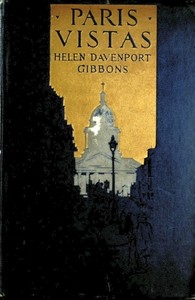
Paris Vistas — Text and Context

(1 User reviews)   361
In Category - Geography
Gibbons, Helen Davenport, 1882-1960, Hornby, Lester G. (Lester George), 1882-1956 [Illustrator] Project Gutenberg 2012 Not confirmed
Paris (France) -- Social life and customs; Paris (France) -- Description and travel; World War, 1914-1918 -- France Readers of public-domain and historical texts
Project Gutenberg digital edition en

Edition facts

Words 92,155
Reading time 401 min
Text sections 9

Paris Vistas — Text and Context can be approached with a clearer sense of reading commitment from its source measurements: 92,155 words, 6 hr 41 min estimated reading time, and 9 detected text sections.

The text analysis averages about 15.8 words per sentence, while the detected sections provide another way to judge how the source is divided.

Project Gutenberg metadata also associates the work with “Paris (France) -- Social life and customs,” connecting these edition facts with the source record’s subject description.

Helen Davenport Gibbons blends memoir and travelogue in a series of vignettes about Paris during and after World War I, focusing on domestic life, apartment hunting, and the city's familiar vistas, illustrated by Lester G. Hornby.
Share
Editorial Edition Score 4.8/5

Calculated from edition completeness, EPUB availability, text structure and catalogue metadata. Not a user rating.

How this score is calculated
  • Description quality20 pts
  • Title & short description10 pts
  • Source metadata20 pts
  • Text length15 pts
  • Chapters / structure15 pts
  • EPUB file integrity20 pts

Total of 100 points, scaled to a 2.5-5.0 range. Editions with an empty description or a missing EPUB file are not scored.

Edition quality

Read the Text

y at the door. When he opened it we ducked down into the basket, and were not seen until the valet dumped us out on the bed.

My first memory of a negro was in Paris. Probably they were common enough in Philadelphia not to have made an impression and I had forgotten that there were black men. I was paralyzed with fear, thinking I saw Croqueminot _en chair et en os_. Marie saved me by teaching me on the spot to stick out my index and little fingers, doubling over the two between. This charm against evil helped and comforted me greatly. I found it useful later when I saw suspicious-looking beggars in Rome. Only, although the gesture was the same, it was _jettatura_ and not _faire les cornes_ in Italy, and the charm was more efficacious if concealed. I was glad my dress had a pocket.

Mama and Marie took us to the Louvre. I was filled with anticipation. For had I not heard some one say at our _pension_ that she had bought things there for a song? Why spend Papa's money if just a song would do? I could sing. Marie had taught me a pretty song about "La Fauvette." I was willing to sing if I could get a doll's trunk. I'd sing two or three songs for a pair of gloves with white fur on them. But when I sang "La Fauvette" they only smiled at me. I asked the saleslady to take me to the toy counter, as I could sing again for things I wanted. I had to explain a whole lot to Mama and Marie and the saleslady. I suppose I cried with disappointment. Then a man in black with a white tie came along and heard the story. He gave me a red balloon and Mama consoled me by buying me a blue velvet dress.

A few months before the war I was walking in the Rue Saint-Honoré with an old American friend who was doing Paris. He was brimming over with French history. Your part was to mention the name of the place you showed him. He would do the rest with enthusiasm and a wealth of detail.

"What is that church?" he asked.

"Saint-Roch," I answered.

"Saint-Roch! Saint-Roch! Saint-Roch!" he cried in crescendo. "Of course, OF COURSE, because this is the Rue Saint-Honoré. The Rue Saint-Honoré!" Beside himself with excitement, he rushed across the street, and up on the steps. I followed, mystified. My friend was waving his cane when I reached his side. "It was here," he announced, as if he had made a wonderful discovery, "right on this spot."

"In Heaven's name what?" I queried.

"The beginning of the most glorious epoch of French history, the birth of the Napoleonic era."

And then he told me the story of how young Bonaparte, called upon to prevent a mob from rushing the Tuileries, put his guns on the steps of Saint-Roch, swept the street in both directions, and demonstrated that he was the first man since '89 who could dominate a Parisian crowd. "You wouldn't have thought there was anything interesting about this old church, would you?" he ended triumphantly.

My eyes filled with tears, and my lips trembled. It was his turn to be mystified, and mine to lead. I took him inside the church, and back to the chapel of Saint Joseph. "Here," I said, "on Christmas Eve I came with my father when I was five years old. It was the first time I remember seeing the Nativity pictured. Good old Joseph looked down on the interior of the inn. The three wise men were there with the gifts. Le petit Jésus was in a real cradle, and I counted the jewels around the Mother's neck. My father tried to explain to me what Christmas means. He died when I was a little girl. I brought my firstborn here on Christmas Eve and the others as they came along. I never knew about Napoleon's connection with Saint-Roch before. And you asked me whether I would have thought there was anything interesting about this old church!"

The same place can mean so many different things to so many different people. Paris was Babylon to my grandfather who never went there. And to those who go there Paris gives what they seek, historical reminiscences, esthetic pleasure, intellectual profit, inspiration to paint or sing or play, a surfeit of the mundane, a diminution or an increase of the sense of nationality, pretty clothes and hats and perfumes, "rattling" good food and drink or a "howling" good time. You can be bored in Paris just as quickly and as completely as in any other place in the world. You can fill your life full of interesting and engrossing pursuits more quickly and completely than in any other place in the world. Best of all you make your home in Paris, with no sense of exile, and enjoy what Paris alone offers in material and spiritual values without being abnormal or living abnormally.

My childhood vistas seem fragmentary when I put them down on paper. But they have meant so much to me that I could choose for my children no greater blessing than to know Paris as home at the beginning of their lives.

The family was abroad for the summer, one of those delightful May-first to October thirty-first summers when school is missed at both ends. The itinerary was supposed to be planned by letting each member drop into a hat slips of paper indicating preferences. Mother was astonishingly good about considering the wishes of all. But as the trip was undertaken for education as well as vacation, the head of the family did not intend to make it aimless rambling. Although, to get full benefit of the strawberry season, we took our cathedrals from south to north in England, none were omitted. By the time we reached Edinburg, Roman, Saxon, Early Norman and Gothic were as mixed up in the head of the sixteen-year-old member of the party as they were in the buildings inspected. "Inspected"--just the word for an educational tour! Later visits to East Coast cathedrals have not conquered the instinctive desire to avoid going inside. Impressions of places were vivid enough. But I fear Canterbury meant London the next stop; Ely a place near Cambridge; Peterborough the view from the top of the tower; Lincoln tea-cakes that crumbled in one's mouth; York a mean photographer who never sent me films I left to be developed; and Durham a batch of long-delayed letters from boys at home.

At sixteen strawberries do not satisfy hunger: cathedrals do not feed the soul.

No, cathedrals and history and the origin of the political institutions under which I lived interested me very mildly. At sixteen one is too young to have love affairs that interfere with the appetite, and too sophisticated to cling to the dream of a cloistered convent life that followed giving up the hope of being a chorus-girl. The mental effort of preparing for college (which the tour abroad was to stimulate) could not claim me to the exclusion of clothes and an engrossing interest in the doings of the group of boys and girls who formed my "crowd." The trip abroad was going to give me something to talk about at dinner-parties and the advantage of wearing clothes bought in Paris. One never looks forward to the coming winter with as keen anticipation as during the sixteen-year-old summer. Hair would be put up, and dances and dinners were a certainty for every Friday and Saturday evening.

If you believe in the value of first impressions and are in a mood to love Paris, plan your introduction to the queen of the world for an evening in June. Do not worry about your baggage. Send a porter from the hotel afterwards for your trunks. Find a _fiacre_ if you can. An _auto-taxi_ is second-best, but be sure that the top is off. _Baisser la capote_ is a simple matter, done in the twinkling of an eye. Of course the _chauffeur_ will scold. But handling _cochers_ and _chauffeurs_ in Paris requires the instinct of a lion-tamer. If you let the animal get the better of you, you are gone. You will never enjoy Paris. Mastery of Parisian drivers, hippomobile and automobile, does not require a knowledge of French. Your man will understand "put down the top" accompanied by the proper gesture. Whether he puts it down depends upon your iron will and not upon your French!

Best of all stations for the first entry to Paris is the Gare de Lyon. But that good fortune is yours only if you are coming from Italy or Spain or if you have landed at Marseilles. The Dover and Boulogne routes bring you to the Gare du Nord and the Dieppe and Havre and Cherbourg routes to the Gare Saint-Lazare. In any case, ask to be driven first to the Pont-Neuf, then along the _quais_ of the Rive Gauche to the Pont-Alexandre Trois, then to the Avenue des Champs-Elysées. Only when you have gone over this itinerary and have passed between the Grand Palais and the Petit Palais are you ready to be driven to your hotel. It is the difference between seeing a girl first at a dance or a garden-party or running into her by accident in her mother's kitchen when the cook is on a strike.

How often, in the decades that have passed since June, 1899, have I wished that the return to Paris had included this program, not only initially but for every June and July evening of our weeks there. But it did not. The passionate love of Paris, my home city, that was born in me as a child, that was re-awakened and deepened in maturity, did not manifest itself when I was a school-girl as it should have done. The change from regular lessons to the governess-controlled days of sightseeing was not as amusing at the time as it seems in retrospect. Madame Raymond and I were not made for each other. It wasn't incorrigibility on my part or severity in a nasty way on hers. We just pulled in different directions, and shocked each other. It began on the first day. She found that I spoke French well enough not to call for the usual effort she had to make with American girls and that I did not need to be told the names of _monuments_ and _jardins_ and _avenues_. The memories of infancy had been carefully kept alive by word and picture. Mother had seen to that. Paris meant to me my father. Consequently, I suppose Madame Raymond's conscience stimulated her to lay stress upon history and art. She wanted to earn her money.

Mutual lack of comprehension began immediately. My first reading under Madame Raymond's direction was a volume of Guy de Maupassant's stories, with markers to show which could be read and which were forbidden. Next day Madame was horrified to see the markers gone and to learn that I had sat up late reading without censorship. She told me that a well-bred _jeune fille_ ought to be ashamed of reading certain things, and refused to argue about it when I asked her why a _jeune fille_ should be ashamed of reading the stories she had indicated to be skipped.

"To-day," said Madame Raymond, "I intend to take you to the Cluny Museum, and then we shall begin the Louvre."

"But," I protested, "I want to go first to Morgan Harjes."

"What for? Madame your mother gave me fifty francs this morning."

"She gave me a hundred and fifty. It isn't for money. I want my letters."

"If there are any letters for you, Madame your mother will give them to you if it is good for you to have them!" snapped Madame Raymond.

"Fiddlesticks! My mother doesn't read my letters."

"Letters written to a _jeune fille_ of sixteen years can easily wait. They are not important. Your education is. Anyway, who would write to you over here?"

"Well, there is Bill. I'm crazy to know if he passed his examinations for Yale and how he liked going to the dance at the Country Club with Margaret when he asked me first. Joe and Charlie went off on a fishing trip to Canada before I sailed, and I've been waiting a month to know if they caught anything. Then Harold. He's an older man. You can talk to him about serious things and his advice is pretty good. Naturally, it would be--Harold is a member of the bar and knows lots."

"But," said Madame, "you mean to say you write to men and men write to you?"

"Certainly. Just ask mother. Here, I know how to fix it. You seem to be in a hurry to go to the Museum. If it interests you, go right along. I'll take a cab to the bank and follow you later. Meet you at the Cluny in an hour."

"Alone!" cried Madame; "my conscience would not allow it. Your mother trusts me."

Madame Raymond hailed a cabby.

"To the Cluny Museum," said she, with finality.

In its setting, the Cluny Museum is one of the most delightful spots in Paris. On the Boulevard Saint-Michel and the Boulevard Saint-Germain one has the life of Paris of to-day. Looking out from the little park with its remains of Roman baths and archæological treasures of old Lutetia scattered around in the shrubbery, one sees a fascinating _carrefour_ of the Latin Quarter, noisy, bustling, ever-changing. It is a contrast more striking than any that Rome affords. On the other side, where one enters the Museum, you have the atmosphere of the middle ages, with the old well and the court yard and the fifteenth-century façade. Across the street, the great buildings of the Sorbonne and Collège de France seem to be carrying on the traditions of the past. But if you had to go inside with a governess who insisted on showing you everything in every room, you would rebel as I did.

Madame Raymond did not have it all in her head. She peered down over the glass cases and read the descriptions in a high voice, adding pages out of a guide book from time to time. She was near-sighted. As she droned along, I plotted a scheme for kidnapping her spectacles. When we left, I had seen embroideries and laces and carriages and cradles and slippers of famous people and stolen stained-glass windows to _her_ heart's content.

We went to Foyot's, opposite the Luxembourg Palace, for lunch. After the meal was ordered, the waiter brought the _carte de vins_.

"A bottle of Medoc," said Madame. "I prefer red wine, don't you, my dear?"

"Plain water for me. No mineral water. _Eau fraîche_ out of a carafe," said I.

"Extraordinary!" cried Madame.

"I think it is dreadful to drink wine," I protested, half in earnest and half in joke. "The Bible says strong drink is a mockery. The first thing I remember about Sunday school is that text."

"Ridiculous," said Madame, "table wine is not alcohol."

"Yes," I continued, "but it is the first steps toward strong drink. You are going to order a _fine champagne_ with your coffee. You cannot tell me that brandy is not strong drink."

"Here in France," said Madame, "everybody takes a drink and nobody gets drunk. You must understand, my dear child, that we have a different point of view."

"Maybe _you_ don't get drunk," said I, "but how about what one sees in Brittany?"

"You lack respect," answered Madame. She ignored Brittany. In France, one is not accustomed to argue with a sixteen-year-old girl. Questioning the judgment of one's elders is impertinent. Since I have brought up my own children in France, I am more than half won over to French ideas. The strong individualism of the American child shocks me now in somewhat the same way as my "freshness" must have shocked Madame Raymond. I was ready to contest her belief that American girls had no manners. I have not taught my children to courtesy--for the simple reason that it is no longer the fashion in France. But I am far from believing now, as I told Madame Raymond, that courtesying is affectation. And I fear that my children have had the example of French children in regard to wine. I am trying to put down here how I was at sixteen. When, after years in America, I returned to France, my point of view was different.

But about some things maturity has not changed the opinion of a pert young American _miss_. French ideas of sex relationship between adolescents seem to me now as they did then, absurd and false. Nor have I revised my opinion about high heels and tight corsets, powder and paint.

It was Madame's duty to take me to the dressmaker's. Before my dress appeared in the fitting room, I was put into my first pair of corsets. When they were laced up, I rebelled, took a long breath, and stretched them out again. Madame Raymond and the fitting woman shook their heads and assured me that my dress would not fit. My governess sided with the girl, when she remonstrated against my stretching the lacings. I showed little interest, too, in Madame Raymond's suggestion concerning the purchase of a box and a pretty puff with a silk rose-bud for a handle, which was to contain pink powder.

"I never make up," I declared. "If you put powder and other stuff on your face when you are young, you are not far-sighted. Ugh! I loathe pink powder."

One day we went to a _foire_, one of those delightful open-air second-hand markets that never cease to fascinate Parisians. A man darted out from a booth and offered to sell me a wedding gown.

"How much is that dress?" I inquired.

"Two hundred francs, Mademoiselle."

"Let me see. I wonder if it is big enough for me. I'm getting married next week. This would save me the bother of having one made, _n'est-ce pas?_"

"Certainly, Mademoiselle," cried the merchant delighted.

He pulled out his tape-line and was preparing to measure me when Madame dragged me away.

"It is not _convenable_, what you are doing," she exclaimed heatedly. "You must not speak lightly of marriage."

"Oh, it comes to us all like death or whooping-cough."

I must not give the impression that my mind at sixteen was absolutely insensible to historical sight-seeing and the art treasures of Paris. I always have loved some of the things in the Louvre, and after the Great War broke out, I discovered what a privation it was not to be able to drop in when I passed to look at something in the Luxembourg or the Louvre. But I did not like overdoses. And I have never gotten accustomed to crowds of pictures all at once in the field of vision or cabinets and glass-covered cases filled with a bewildering variety of _bibelots_. How I came to enjoy the Musée du Louvre will be told in a later chapter of the decade after Madame Raymond. Why should I not confess frankly that at sixteen I was more interested in the Magazin du Louvre, even though I knew I could no longer hope to purchase what I wanted there "for a song"? The best thing I took away from Paris in 1899 was an evening-dress with a low neck--my first to go with hair put up. It was in the middle tray of my trunk, packed with tissue paper and sachet. I can see now the different colored flowers woven into the soft cream of its background in such a way that, according to the girdle you chose to put on, your color effect in night light could be lavender, blue or rose.

Ten years before my father had taught me to love to ride on the top of an omnibus, on the _impériale_, as the French called it. Alas that I should have to use the past tense here. _Impériales_, still the fashion on Fifth Avenue and Riverside Drive, disappeared from Paris before the war. I shall tell later of the last horse-driven omnibus. The auto-buses started out with _impériales_, but banished the upstairs in 1912 and 1913. They were still the vogue in 1908. Madame Raymond objected to the _impériale_. She hated climbing up and down the little stairs, especially when carrying an umbrella prevented proper circumspection in regard to gathering in skirts. And by riding inside one avoided a _courant d'air_.

Gibbons opens her account not with a monument but with a definition: a vista is 'a view, especially a distant view, through or between intervening objects.' She immediately rejects a literal guidebook approach, warning that her book offers no substitute for Baedeker or photographs. Instead, she proposes that memories can serve as 'intervening objects,' making vistas as much temporal as spatial. The Arc de Triomphe, the Madeleine, and the Palais Bourbon become as familiar as 'your mother's face in the doorway of the childhood home.' This personal framing sets the tone for a work that intertwines the city's landmarks with the author's own domestic routines and wartime experiences.

The Apartment as a Lens

Gibbons devotes considerable attention to the practicalities of renting in Paris, turning the search for housing into a recurring motif. She describes the three-month term system, the horror of the inventory, and the meticulous French habit of 'biting a penny.' The lease itself becomes a document of cultural difference: clauses forbid pets and business, yet children are more likely to be refused than dogs. Her account of furnishing an unfurnished apartment—buying simple pieces, selling them at year's end without great loss—reveals a transient, pragmatic approach to home. These details ground the narrative in the material realities of expatriate life, where even a villa rental involves arm's-length sheets recording the state of walls, carpets, and mattresses.

War and the Familiar Skyline

The war intrudes obliquely. Gibbons mentions a Zeppelin floating over the Gare Saint-Lazaire, and notes that Paris has been 'overcrowded' during the conflict. Yet she does not dwell on battles or politics; instead, she observes how the city's landmarks persist unchanged. The obelisk in the Place de la Concorde 'always has been' there, and the Arc de Triomphe looks exactly as it should. This insistence on continuity amid upheaval gives the book its distinctive tone. The vistas she describes—Sacré Coeur seen from apartment-house-lined streets, the Invalides from Pont Alexandre III—are not just views but anchors of normalcy. Her prose moves between the intimate scale of a three-room kitchen and the grand perspective of a city under strain.

Sketches and Words in Parallel

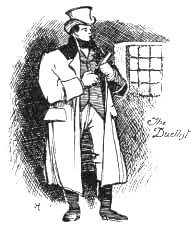
Lester G. Hornby's sixteen illustrations accompany the text, and Gibbons explicitly links her verbal vistas to his visual ones. She writes that 'vistas in words can no more convey the impression of things seen than Lester Hornby's sketches,' establishing a partnership between image and narrative. The illustrations are not decorative but integral: they share the same selective, impressionistic approach. Where a photograph would tick off monuments by name, Hornby's sketches and Gibbons's prose both aim to evoke a feeling of familiarity. This synergy extends to the book's structure, which moves from scene to scene without the systematic coverage of a guide. The reader is invited to see Paris through a double lens—the author's memory and the artist's line.

The Autobiographical Thread

Gibbons acknowledges that her own life keeps coming to the front, and she does not apologize for it. She recounts being lost as a child at the Gare Saint-Lazaire, saying goodbye to her husband there, and raising her family in a series of rented apartments. These personal anecdotes are the 'intervening objects' that shape her vistas. The book is as much about the rhythms of domesticity—finding a suitable apartment, dealing with the concierge, heating costs from November to March—as about the city's famous views. By grounding her observations in the mundane, Gibbons offers a portrait of Paris that is intimate and specific. The reader who expects a conventional travelogue will be redirected instead to the texture of daily life during and after the Great War.

Gibbons's Paris is not a collection of postcard scenes but a lived-in city, measured in leases, inventories, and the familiar silhouette of Sacré Coeur. Readers should approach this book as a memoir of place rather than a guide, letting the author's domestic details and wartime asides accumulate into a composite portrait. The illustrations by Hornby reinforce this personal geography, offering visual echoes of the text's selective, memory-infused views.

Funny how a city's ordinary corners can hold so much weight once the world shifts. Helen's Paris lingers that way, small apartments and quiet streets carrying an entire era. I felt something similar reading Across the Andes — Context and Discussion, where landscape becomes memory too. Some books simply stay with you, like a familiar view you keep returning to. This one does that.

Dylan King
1 week ago

5
5 out of 5 (1 User reviews )

Add a Review

Your Rating *
There are no comments for this eBook.

Reader reflection

What was your reading experience?

Capture what you thought, learned, and would like to remember.

Your progress 0 / 10
1

Which reading stage best describes you?

2

How did the book work for you overall?

3

Would you pass this book on to a friend?

4

How easy was the book to follow?

Related eBooks