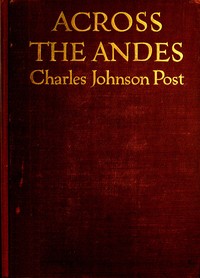
Across the Andes — Context and Discussion

(3 User reviews)   971
In Category - Geography
Post, Charles Johnson, 1873-1956 Project Gutenberg 2015 Not confirmed
Bolivia -- Description and travel; Andes -- Description and travel; Amazon River Readers of public-domain and historical texts
Project Gutenberg digital edition en

Edition facts

Words 70,577
Reading time 307 min
Text sections 9

The catalog record for Across the Andes — Context and Discussion provides practical reading context through 70,577 words, 5 hr 7 min estimated reading time, and 9 detected text sections.

The text analysis averages about 27.7 words per sentence, while the detected sections provide another way to judge how the source is divided.

Project Gutenberg metadata also associates the work with “Bolivia -- Description and travel,” connecting these edition facts with the source record’s subject description.

An illustrated 1912 travelogue by Charles Johnson Post, recounting his journey across the Bolivian Andes and into the Amazonian jungles. The narrative blends vivid descriptions of landscapes and indigenous peoples with a wry, self-deprecating tone, focusing on the Lecco tribe's unique customs and the physical challenges of river travel.
Share
Editorial Edition Score 4.7/5

Calculated from edition completeness, EPUB availability, text structure and catalogue metadata. Not a user rating.

How this score is calculated
  • Description quality20 pts
  • Title & short description10 pts
  • Source metadata20 pts
  • Text length15 pts
  • Chapters / structure15 pts
  • EPUB file integrity20 pts

Total of 100 points, scaled to a 2.5-5.0 range. Editions with an empty description or a missing EPUB file are not scored.

Edition quality

Read the Text

Rapids of the Ratama (_facing page_) 264 The Tacana brides, adjusted for themselves comfortable niches in the cargo 314 At the tiller presided a huge Tacana 316 Never was such an exhibition in the history of firearms 319 But it was monkey that furnished them with the greatest delicacy 323 Often we pass a little shelter of palm leaves 326 Night camp on the Rio Beni on the way out (_facing page_) 328 It was only the shack of a lonely rubber picker 330 In the thin blue smoke, it at once turned a pale yellow 332 Justice is administered according to the standards of his submissive domain 333 The bolachas of rubber are threaded on long ropes 348 Dragging a batalon around the portage of the Madeira Falls 351

CHAPTER I OLD PANAMA, AGAMEMNON, AND THE GENIAL PICAROON

It was in Panama—the old Panama—and in front of the faded and blistered hotel that I met him again. A bare-footed, soft-voiced mozo had announced that a person, a somebody, was awaiting me below. Down in the broken-tiled lobby a soured, saffron clerk pointed scornfully to the outside. Silhouetted against the hot shimmer that boiled up from the street was a jaunty figure in a native, flapping muslin jacket, native rope-soled shoes, and dungaree breeches, carefully rolling a cigarette from a little bag of army Durham. It turned and, from beneath the frayed brim of a native hat, there beamed upon me the genial assurance of Bert, one time of the Fifth Army Corps, Santiago de Cuba, and occasionally of New York; and within my heart I rejoiced. Without, I made a signal that secured a bottle of green, bilious, luke-warm native beer and settled myself placidly for entertainment.

A panicky quarantine stretched up and down some few thousand miles of the West Coast that left the steamer schedules a straggling chaos. For fifteen dull, broiling days I had swapped hopes and rumors with the polyglot steamship clerk or hung idly over the balcony of the Hotel Marina watching the buzzards hopping about the mud flats or grouped hopefully under the quarter of a slimy smack. Once I had inspected the Colombian navy that happened to be lying off the Boca and observed a bran-new pair of white flannels go to their ruin as a drunken Scotch engineer teetered down an iron ladder with a lidless coal-oil lamp waving in discursive gestures; once I had met a mild, dull, person who had just come up Magdalena River way with a chunk of gold that he assured me—without detail—had been hacked off by a machete, but here his feeble imagination flickered out and he wrapped the rest in a poorly wrought mystery until finally he fluttered over to Colon for the next steamer of innocent possibilities.

With these the respectable amusements were exhausted and I therefore rejoiced as I confronted that cheerful, raconteuring adventurer under the battered Panama. A ship’s purser, a drummer of smoked hams, a Coney Island barker, a soldier, a drifter, and always a teller of tales, he had lain in the trenches on Misery Hill before Santiago in support of Capron’s Battery with a gaunt group around him as he wove the drifting thread of adventure from the Bowery to the Barbary Coast in a series of robust anecdotes. And they bore the earmarks of truth.

Now, in the genial silhouette framed against the tropic glare, I realized that whatever days of waiting might be in store they would no longer be dull. A true rumor had put him in a lone commercial venture somewhere down these coasts and here at my elbow was to be placed all the shift and coil of petty adventure, whimsical romance, and the ultimate results of two years of adroit piracy in and out of the Spanish Main that had ended, as I observed, in dungaree breeches, rope-soled _alpargatas_, and a battered Panama hat.

Therefore through the ministrations of an occasional bottle of the native bilious beer and other transactions that shall remain private, the days sped themselves swiftly and unheeded guided by the adept hand of Romance. Again, as in the trenches, I viewed the world under Asmodean influences, but what I heard has no place in these pages; it is worth an endeavor all its own. Then, one morning, the news spread that at last the _Mapocho_ lay at the Boca and the hour of departure for the first stage to the interior of South America was at hand; the night before was the last I saw of my genial friend. In the morning he did not appear, and it was strange, for I had expected to do the proper thing, as I saw it, realizing that dungarees and _alpargatas_ are poor armor and that our consulates offer but a desperate and prickly hospitality.

In the afternoon I went aboard, crawling down a gangway that dropped to the deck like a ladder where, in the morning, it had reared itself with equal steepness against the _Mapocho’s_ sides. Such are the Pacific tides at the Boca. Agamemnon, the shriveled little Barbadoes darky, scuttled about importantly, stowing our baggage and giving an occasional haughty order to some steward in a nondescript patois that passed mainly as Spanish and that often served, as I learned, better than the purest Ollendorfian Castilian. Later it appeared that Agamemnon had left one of these same steamers under a cloud—a trifling matter of a few sheets and pillow cases—and now to return clothed with trust and authority over “de fixin’s an de baggage of gent’mens” swelled him with an inarticulate triumph.

In the long months that followed none could have given more faithful service or loyalty than this skimpy Barbadoes darky. That is within his limitations, for he could no more resist liquor than a bear can honey, but nevertheless when he had transgressed, his uncertain legs would bring him back to his duties, speechless perhaps, but with arms wavering in gestures of extenuation.

Also to Agamemnon wages meant nothing; a shilling now and again—sometimes even the equivalent of a whole dollar—advanced him with the specific understanding that it was for gambling and not for liquor. Once, in La Paz, he won a hundred and fifty dollars, Mex, and became an impossible animal until it had been frittered away. In the same city he went to the bull fight and joined in the play against the final bull that is “dedicated to the people” and fought so cleverly that we became prominent by reflection and gave a party at the _corrida_ the following Sunday to see Agamemnon’s promised performance.

By this time Agamemnon had become a character and a score of little boys scrambled over the barrier eager to hold his hat, his coat, and his cuffs. With a flourish he handed each to its eager guardian and then, with a coat held as a _capa_, gave a flourish and advanced toward the bull. The crowd applauded. Agamemnon made a bow and a flourish and waggled the coat. The bull snuffed briskly and charged. Alas! The hand had lost its cunning, for Agamemnon shot ten feet skyward, turned an involuntary somersault at the apex of his flight, and then sprawled back to earth. A half dozen of the _toreros_ drew off the bull; the small boy custodians flung his garments at him scornfully, while the Bolivian audience laughed itself hoarse as the dusty, dishevelled figure hobbled out of the ring and away from the crowd.

For himself Agamemnon asked but little although where he felt that the dignity of his position was involved he became a tower of strength. It was in the same city that he felt the hotel people were not treating him fairly, as they were not, and his remonstrance was met by a Cholo mozo who hurled a sugar bowl at his head and followed it up with a knife. Agamemnon dodged and beat down the Indian with a chair; on the instant a half dozen Cholos poured at him and the kitchen was in a riot. Backing away, he denuded the dining tables of service and used it as a light artillery fire. By the aid of an earthenware jar, some handy crockery, and a chair he was able to retreat safely across the patio and up the stairway that led to our rooms. A water pitcher laid open a skull and a wash-bowl stopped the rush long enough for him to grab a gun from the pillow when we arrived, together with some stubby Bolivian police and the bony Russian proprietor; order was restored, fortunately, for it might have been serious.

Agamemnon explained satisfactorily and incidentally showed only a minor bump or so, but his Cholo and Aymara antagonists bore most proper marks of the conflict. That night in the midst of his shoe-polishing and packing he remarked briefly: “If you gent’mens hadn’t er-come jes’ den I cer’nly would have licked dem fellers, bahs!” Apparently no victory was complete to his mind until he had accomplished a massacre.

At another time he waded into a crowd of Cholos in the interior and took from them their machetes and shot-guns, acting on his own initiative, because he knew that in that far interior laborers were too precious to waste by their own fighting. From our tent we heard two shots and the rising yells of a small riot and then, before there was time to grab a gun or gather the few white men, the figure of Agamemnon staggered up the crest of the river bank with his arms full of the commandeered machetes and trade-guns.

There was the time when a balsa upset in a boiling eddy and Agamemnon jumped in as a faithful rescuer only to still further complicate matters; also when—but it is useless, Agamemnon is a story in himself. Tireless, uncomplaining, honest, loyal, yet of the aimless tribe of bandar-log, apparently only merely the mouse of a man in a wrinkled black skin and yet the paragon of retainers. Peace be to him wherever he has drifted.

At the table that evening on the _Mapocho_ the few passengers looked each other over in the customary, stand-offish way,—a couple of fresh faced young Englishmen adventuring to clerkships, a German commercial traveler—an expert in those Latin countries who makes one blush for the self-complacent, brusque, greaser-hating jingoes that are only too typical of our export efforts—three mining engineers, a returning Peruvian diplomat for whose presence we later blessed him and a couple of native Ecuadorean families, wealthy _cacao haciendados_, who flocked by themselves in a slatternly, noisy group.

But by the next evening, drawn together by the prospect of a tedious, uncertain voyage through erratic quarantines, we were one large family. We lay back in our canvas chairs under the galvanized iron roof of the upper deck—so generally peaceful are those seas that the awning is permanent—and watched the Southern Cross flickering dimly above the southern horizon. The cigars glowed in silence for, though it was the hour for yarning, each bashfully hung back. Then an engineer started. The Philippines, Alaska, the boom camps, Mexico rose in successive backgrounds and then the talk shifted round to our respective objectives down this long coast. One was for the nitrate fields, one for the Peruvian silver mines, and one for the rich placer banks of the far interior. The one who was bound for an examination of Peruvian silver mines—a mountain of a man—finally made a confidence:

“Gold,” he remarked as an obvious preliminary, “gold—or silver, I’m a Bryan man—is generally good enough for anyone, but if I had my choice I don’t mind saying that I’d rather have a coal mine down here in South America than either or anything!”

The others sighed enviously. A coal mine in South America where there is no coal except that from Australia and Wales and where a couple of hundred miles from the coast it is worth twenty dollars, gold, a ton! A coal mine—well—it is the stuff of which dreams are made in South America.

“Yessir,” he went on raptly, “coal is the thing. And I don’t mind admitting that I’ve got it.”

He hauled a black object from his pocket and held it out. Eagerly it was snatched from his hand. There it was, hard, shiny, black, varying in no way from those in the kitchen scuttle at home—a splendid sample of anthracite coal! It was too good. They laughed.

“Bring it from home?” they asked pleasantly.

The mountainous engineer chuckled contentedly. “That’s anthracite and as fine a specimen as I ever saw. I don’t mind talking a little freely since I’ve got it covered in an iron-clad contract.

“You see,” he went on good-naturedly, “I’m always wide awake and the morning we left the Boca a young chap came aboard—American, too, and right pleasant spoken—where I was sort of loafing and we got acquainted. To make a long story short, he’d been wandering around up in the back country of Colombia and had located this coal. He didn’t have any special idea of what coal meant down these ways—he was from Pennsylvania, son of a pit boss or something and coal was as common to him as water to a duck—but when he pulled out a couple of these samples you bet I froze fast. He tried to be mighty quiet and mysterious when he saw I was interested—you know how such a chap is when he thinks he’s got a good thing, and he was sort of on the beach, down on his luck you know—but I pumped him all right.

“He had a fool idea of going home as best he could and then taking the family sock and combining it with other family socks and coming back and opening up his coal mine.” The big engineer chuckled again. “Why there’s a king’s fortune in that mine, so your Uncle Jim stepped right in and tied him up close. I cabled my principals and I’ll get a cable when we reach Callao. This coal makes their silver look like thirty cents. Of course, I wasn’t going to take any chances at this stage—it might be phony—but that fellow is on the level. Said he wouldn’t take any money down—not that I’d have given it by a long shot—but after I got back he’d join me and come back into Colombia. He gave me a map of the location in case of accident.”

“Gave him no money—poor fellow, art for art’s sake?” asked one.

“Well, yes,” the big man nodded good-humoredly, “thirty dollars—enough to take him back to the States steerage—I felt almost ashamed. Said he didn’t need any more to get home with—that sounded on the level, didn’t it? He’d had a tough time all right—fever, grub and etcetery back in the country—and was down to dungaree breeches, rope-soled shoes, and one of these slimpsey native calico jackets.”

“And he could roll a cigarette with one hand better than most can with two?” I asked.

The big engineer paused for an instant’s thought and then suddenly sat up. No wonder my friend of the Fifth Army Corps and the dungaree breeches, alpargatas, and battered Panama and muslin jacket had suddenly disappeared. Thirty large, golden dollars of real money, good at par in the States or for three pecks of local paper collateral anywhere on the Mosquito Coast! And all that for one paltry little yarn.

CHAPTER II THE FIGHTING WHALE AND CHINAMEN IN THE CHICKEN COOP

The hot days drifted by in easy sociability, dividing themselves into a pliant routine. The morning was devoted to golf on the canvas covered deck over a nine-hole course chalked around ventilators, chicken-coops and deck-houses. Crook-handled canes furnished the clubs and three sets of checkers were lost overboard before we reached the Guayas River, the little round men skidding flatly over the deck with a pleasing accuracy only at the end to rise up maliciously on one ear and roll, plop, into the sea. In the white-hot afternoon, when the scant breeze would quite as likely drift with us, the hours were sacred to the siesta, and the evenings were devoted to standardizing an international, polyglot poker.

A rope stretched across the after-deck marked off the steerage. There was no second class as a thrifty French tailor, a fine young man, and his soft-voiced Mediterranean bride found out. They had bought second class through to Lima and at the Boca were flung in aft among the half-breeds, a squabbling lot of steerage scum, together with a gang of Chinamen. A line of piled baggage ran lengthwise, on one side of which were supposed to be the bachelors’ quarters, though somewhere between decks were hutches where, if one really insisted on privacy, the tropical night could be passed in a fetid broil.

Through a surreptitious connivance this couple were allowed quarters forward and evening after evening the little bride would bring her guitar out and play—and such playing! She had been on the stage, it seemed, and from opera to opera she drifted and then off into odd, unheard folk songs, or the vibrant German or Russian songs. Never before or since have I heard such playing of a guitar or felt its possibilities. For us the guitar is an instrument lazily plunked by the end man against two mandolins. Yet there was a time when Paganini deemed it worthy of mastery.

She was playing late one afternoon and we were all gathered around in the dining hall. There came a rush of feet overhead and a shrill, excited chattering. We broke for the deck, expecting a mutiny among the Chinamen at the very least, and there in full view, not five hundred yards away, was a battle between a whale and three thrasher sharks. In a great circle the sea was churned to a foam, boiling with the stroke of fin and fluke as the sharks outflanked and harried the whale.

In a steady succession the sharks would shoot high out of the water in a graceful, deadly curve and, as they fell back, suddenly stiffen in a whip-lash bend that instantly straightened at the moment of impact, sending a flying mass of spray like that when a solid shot ricochets in gun practice. A few such blows and even a bulky, blubber-coated whale would feel it. Sometimes a shark would strike fair, though more often he would waste his energy on the empty water as the whale dove.

But the steadiness of the battering attack, sometimes all three sharks in the air as though by a signal, sometimes a steady procession pouring up from the sea in a wicked arc as regular as a clock’s ticking, and sometimes the frantic whirling of the whale showed the submarine strategists at work, while only a single shark shot up in a well-aimed, whip-lash stroke. In desperation the whale would stand on its head and beat the air in terrific blows with its flukes while the sharks would merely wait till the flurry was over and then renew their steady, wearing, pounding battle.

Off at one side of the circle of beaten foam was a little dark patch that paddled nervously about and that we had overlooked—a whale-calf. And now it was apparent why the fight was fought in the diameter of a ship’s length; always the bulk of the grim old mother was between the attack and her clumsy baby; there was the reason why she did not make a running fight of it that would have given her a more even break—for the speed of a squadron is that of its slowest ship. All the advantage lay with the sharks; it was easy to see they were wearing the whale down. Less often she stood on her head to batter the foam hopefully with her ponderous flukes; the sharks redoubled their efforts until they curved in a steady, leaping line.

Charles Johnson Post’s Across the Andes (1912) opens with a poem that sets a conflicted tone: the tropics are both a “soft-lilting rhythm” and a “slow-burned scar.” This tension between allure and hardship runs through the entire narrative. Post, an American traveler and illustrator, describes his journey from the Pacific coast of Bolivia over the high Andes and down into the Amazon basin. The book is structured as a series of episodes—quarantine, desert marches, pack-train treks, and river voyages—each revealing the region’s physical extremes and the diverse peoples who inhabit them.

The Lecco Tribe: Drunkenness as an Inalienable Right

Post devotes several chapters to the Lecco people, whom he portrays with a mix of ethnographic curiosity and wry humor. He notes that the Lecco “will not work to any good purpose if kept sober”; they regard intoxication as an “inalienable right” and will deliberately wreck a raft if denied it. Unlike other indigenous groups, Post claims, the Lecco become more genial, not treacherous, when drunk. This observation is paired with detailed descriptions of their clothing—tight white tucuyo breeches and gaudy shirts—and their daily habit of changing into clean clothes carried in a chipa bag, even while navigating muddy rivers. The Lecco’s aquatic skill is emphasized: they swim rapids that would be “fatal for a white man,” and one anecdote recounts a family and a mule surviving a dangerous passage in a balsa raft. Post’s tone is admiring but also condescending, framing the Lecco as a “cheery, indeed hilarious” people doomed to extinction.

River Travel: Callapos, Rapids, and the Constant Threat of Water

The journey down the Rio Mapiri and Rio Kaka is the book’s central adventure. Post describes the callapos—rafts made of balsa logs—and the constant danger of rapids and whirlpools. The water is so muddy that it “soils everything it touches,” forcing the Lecco to change clothes daily. Post recounts a near-disaster when a drunken Lecco guide runs the raft onto a rock; the crew swims to shore “like otters,” leaving the author to fend for himself. The narrative is punctuated by moments of slapstick: a Lecco slipping overboard is greeted with “yells of delight,” and the victim’s sheepish grin when he surfaces is described as “irresistibly funny.” Yet Post also conveys the real peril: whirlpools that form below rapids, and the impossibility of a white man swimming in such conditions. The river chapters balance technical detail about raft construction and river navigation with a sense of precarious humor.

Indigenous Peoples: Between Passive Hope and Cheerful Resilience

Post contrasts the Lecco with other South American Indians he encountered, particularly the Aymarás of the highlands. He writes that the Aymarás gave him “the impression of inert, passive races,” waiting for the return of legendary days but dimly aware of their “doom of ultimate extinction.” The Lecco, by contrast, are “by no means a despondent specimen.” This comparison reveals Post’s broader view of indigenous cultures as either resigned or exuberant, but always in decline. He notes the Lecco’s huts—one-room structures of charo bamboo lashed with mora strips, with steep palm-thatched roofs—and their peaceful nature: “He is pre-eminently a man of peace.” Yet Post’s observations are filtered through his own cultural lens; he does not claim deep understanding of Lecco beliefs or social structures. The excerpts suggest a traveler more interested in anecdote than systematic ethnography, but one who records details—like the Lecco’s preference for red shirts as “most aristocratic”—with a reporter’s eye.

Post’s narrative is best approached as a personal travelogue rather than a scientific account. His illustrations, mentioned in the front matter, likely complement the text’s visual descriptions of landscapes and people. Readers should note that the author’s perspective is that of an early 20th-century American outsider, and his characterizations of indigenous groups reflect the attitudes of his time. The book’s strength lies in its specific, often humorous vignettes of travel in a little-documented region.

That rainy afternoon, Post’s muddy river stays with me—how patient he was with the Lecco, how gently he laughed at his own soaked boots. Later, I found myself thinking of ruins instead, and picked up The Mentor: Among the Ruins of Rome, Vol. 1, Num. 46, Serial No. 46 — Context and Discussion. Different stones, same quiet wonder at what time buries and what it spares.

Theodore Jones
1 week ago

Grayson Nelson
4 weeks ago

Owen Young
3 weeks ago

5
5 out of 5 (3 User reviews )

Add a Review

Your Rating *
  • ...
    Ryan Blanchard - 4 weeks ago
    An exhilarating journey through the Andes! The author's vivid descriptions of the landscape and the people made me feel like I was trekking alongside them. The blend of adventure, history, and personal insight is masterful. A truly inspiring read for anyone interested in South America or epic travel stories.

  • ...
    David Curtis Nelson - 2 weeks ago
    While the author clearly has a passion for the subject, the book suffers from a lack of focus. The narrative jumps between personal anecdotes, historical facts, and geographical descriptions without a clear thread. It reads more like a collection of notes than a polished travelogue. Some readers may find it difficult to stay engaged.

  • ...
    Lisa Wang - 1 week ago
    This book offers a decent overview of the Andes and its cultures, with some beautiful prose. However, the pacing can be uneven, and certain sections feel a bit dated. Still, it's a valuable read for those who enjoy travel narratives with a historical perspective.


Reader reflection

What was your reading experience?

Capture what you thought, learned, and would like to remember.

Your progress 0 / 10
1

Which reading stage best describes you?

2

How much did you enjoy the reading experience?

3

How likely are you to recommend this book?

4

What was the reading difficulty like?

Related eBooks