The Mentor: Among the Ruins of Rome, Vol. 1, Num. 46, Serial No. 46 — Context and Discussion
Edition facts
For The Mentor: Among the Ruins of Rome, Vol. 1, Num. 46, Serial No. 46 — Context and Discussion, the stored edition analysis reports 10,551 words, 46 min estimated reading time, and 7 detected text sections.
The text analysis averages about 19.5 words per sentence, while the detected sections provide another way to judge how the source is divided.
Project Gutenberg metadata also associates the work with “Rome (Italy) -- Description and travel,” connecting these edition facts with the source record’s subject description.
Calculated from edition completeness, EPUB availability, text structure and catalogue metadata. Not a user rating.
How this score is calculated
- Description quality20 pts
- Title & short description10 pts
- Source metadata20 pts
- Text length15 pts
- Chapters / structure15 pts
- EPUB file integrity20 pts
Total of 100 points, scaled to a 2.5-5.0 range. Editions with an empty description or a missing EPUB file are not scored.
Read the Text
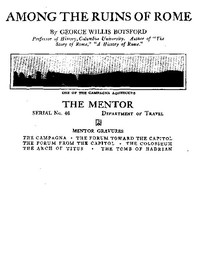
The Mentor, No. 46, Among the Ruins of Rome
AMONG THE RUINS OF ROME
By GEORGE WILLIS BOTSFORD
_Professor of History, Columbia University. Author of “The Story of Rome,” “A History of Rome.”_
SERIAL NO. 46 DEPARTMENT OF TRAVEL
THE CAMPAGNA · THE FORUM TOWARD THE CAPITOL · THE FORUM FROM THE CAPITOL · THE COLOSSEUM · THE ARCH OF TITUS · THE TOMB OF HADRIAN
Entered as second-class matter March 10, 1913, at the postoffice at New York, N. Y., under the act of March 3, 1879. Copyright, 1913, by The Mentor Association, Inc., New York.
Shortly after sunset the express train, speeding north from Naples, emerges from the mountains and begins winding its way down grade. The expectant visitor to the Eternal City sees below him through the car window a broad expanse of plain, sloping imperceptibly on the left to the sea, in front to the Tiber River. It is an ocean of green, here quietly level, there billowed in ridges or headed up in round hillocks.
This is the Campagna, the broad flat belt which borders the Tiber on the left. At first sight it reveals to us its solitude. In early Roman times it had swarmed with peasants who owned the lands they tilled. As the city grew wealthy the district fell into the hands of lords, who covered it with their luxurious villas, peopled by multitudes of slaves. Still later, when Rome was declining, these villas fell to ruins, the slaves disappeared, and Malaria stalked lonely and terrible over the beautiful country she had made her own. Even now she rules it, scarcely weakened by modern progress. The dwellings of her few wretched tenants are miles apart. Herds of sheep and of fierce long-horned cattle pasture on the abundant grass, and along the well-made roads that span the plain an occasional ox-team wearily drags an awkward cart.
But the Campagna has its attractions. It fascinates imaginative tourists and draws them to its heart. Three or four together, their knapsacks filled with food and drink, often take long trips through this wild region, whose eternal quiet speaks peace to the weary mind, whose delicate, ever-changing tints of sky and field appeal to the taste for natural beauty, whose ruined villas and towns awaken historical memories of the rise of Rome from a little settlement on the Tiber to a worldwide power and a fame that cannot die.
The most impressive features of the Campagna as we view it from the car window or in a stroll along either the old Appian Way or the modern Appian Way, are the ruins of aqueducts. The one here illustrated is the Claudia, named after Emperor Claudius, who completed it. Its sources were more than forty miles distant; while crossing the Campagna the water flowed in a channel supported by a series of gigantic arches. It provided Rome not only with her best water, but her most abundant supply, amounting to more than 400,000 cubic meters daily. All the aqueducts together poured into the city each day more fresh water than the Tiber now empties into the sea.
As we view this work of great utility, we naturally wonder what sort of man was the builder. At the time of his accession he was fifty years old, and had devoted his earlier life zealously to study and writing. Grotesque in manner and eccentric in his habits, he was generally considered a learned fool; and yet he made an admirable ruler. When acting as judge he often slept during the pleas of the lawyers, waking at the close of the trial to give his decision in an equitable and humane spirit. It was unfortunate for the case, however, if he chanced to smell anything good cooking in a neighboring restaurant; for he would adjourn court to refresh himself. He was far more liberal than his predecessors in bestowing Roman citizenship on subject peoples.
To keep the city population supplied with cheap food, he subsidized and insured grain ships at the cost of the government; and his activity in erecting public works is illustrated by the completion of this magnificent aqueduct. It is a fact of great importance that the early emperors, whatever their private characters, almost uniformly devoted themselves to the public good. Personal service to the empire was their chief title to office and the basis on which successive rulers built up their power.
The city of Rome itself abounds in places and objects of interest more easily reached than the Campagna. It requires at least a teaspoonful of information to appreciate the features of Rome; and to those who are mentally equipped no spot furnishes keener enjoyment than the Forum. An impressive view can be had looking eastward from the Capitol, one of the “seven hills” on which the early city sat. It can be seen that the Forum lies in a valley nearly surrounded by hills. In the tenth and ninth centuries B. C. these hilltops were occupied by villages and the valleys between them were marshes. In the eighth century the villages united to form one city,--Rome,--and the marshes were gradually drained by means of sewers. The low area became at that time the Forum, “marketplace” of the new city. It is an approximate oblong, on the north side of which one of the kings marked off a space,--the comitium (assembly-place),--in which all the citizens met to vote on questions of public importance. Adjoining the comitium was the senate-house. King (afterward two consuls), senate, and popular assembly constituted the government. The Forum was therefore the political center of Rome, and from this circumstance it derives all its interest. When one reflects that for nearly five centuries after the downfall of the kings (509-27 B.C.) Rome was a republic, that during that time she conquered and organized in her empire practically the whole Mediterranean basin, we begin to understand that this spot must have been the scene of stupendous political conflicts, the birthplace of far-reaching legislative and administrative measures. Here worked the brain of the best organized and most enduring empire the world has known.
An essential feature of the Roman government was religion, which the senate and magistrates well knew how to operate for practical ends. It is not surprising, therefore, to find about the Forum the ruins of many temples. There is the temple of Saturn, now only a group of columns. It rests on an unusually high foundation. Within this basement were chambers which contained the treasury of the state. It was largely by the control of the treasury that the senate long maintained its political supremacy.
A few steps from the temple is the pavement of a great oblong building, of whose superstructure there are but scant remains. This was the Basilica Julia, erected by Julius Cæsar, and rebuilt, after a destructive fire, by Augustus. A basilica was used for law courts and for business purposes. The style of building was borrowed from Greece; but the architect at Rome wrought in the spirit of her people. He left the exterior plain and unattractive, to devote his whole attention to the interior. It is essentially a vast hall, with aisles separated from nave by a row of arched piers in this case, in other basilicas by colonnades. The designer molded, as it were, the interior space, so as to express in the language of art the grandeur of the empire, and in the severe harmony of the lines the orderliness and symmetry of Roman law. No other architectural type so well embodied the imperial idea.
Of the other buildings connected with the Forum the most conspicuous is the temple of Castor and Pollux, just beyond the Basilica Julia. The ruins consist of three slender columns, standing on a high foundation and supporting a fragment of the entablature. These remains belong to the reconstruction of the temple under Augustus. The worship of the twin gods, Castor and Pollux, patrons of cavalry, had been introduced from Greece into Rome in the early republic. The front porch of the temple often served as a platform for party leaders while addressing the crowd in the Forum. On such occasions it sometimes became the center of violent political conflicts out of keeping with the beauty of the surroundings. This temple and nearly all others at Rome are of the Corinthian order of architecture, distinguished by the capital of clustered acanthus leaves surmounting the graceful fluted column. It is one of the best of its class; and the three columns with their entablature form the most beautiful architectural fragment still preserved from classical Rome.
The present level of the Forum is many feet lower than that of its immediate surroundings. During the three thousand years that separate us from the beginnings of the city the valleys have been gradually filling through the accumulation of debris of ruined buildings, the washings of earth from the surrounding hills, and various other means. Recently scholars have excavated nearly the whole Forum down to the earliest level, laying bare the lower parts of buildings, the earlier pavements, altars, a primeval cemetery, and many other objects. Nearly everything found has been identified and clothed in the historical imagination with the associations of the time when it had a purpose and a meaning. But the spot, once the abode of intense life, is now still; it seems the burial place of a dead society and government; state officials keep drowsy guard over the remains. Tourist and scholar walk undisturbed through this sepulcher of a mighty empire, their senses awakened to the ancient life only by the rush of waters through the subterranean Cloaca Maxima, and to the life of our day by the roses, geraniums, and wild Italian flowers that grow luxuriantly wherever a bit of soil is left.
Beyond the Forum and on the summit of the ridge known as the Velia is the Arch of Titus. We can read the inscription: SENATUS POPULUSQUE ROMANUS DIVO TITO DIVI VESPASIANI F. VESPASIANO AUGUSTO (The senate and people of Rome (dedicated this arch) to the deified Titus Vespasianus Augustus, son of the deified Vespasianus.) Consider this inscription. Both the Greeks and the Romans propitiated the spirits of the dead with sacrifice and prayer. The founder of a city or any specially great benefactor of the community they venerated after death as a hero, a being intermediate in dignity and power between man and the gods.
It was with this idea that the senate by decree deified (more strictly, heroized) a deceased emperor who seemed to that body to have been a specially worthy ruler. Thus they had deified Vespasian, and after him his son and successor Titus. This arch, therefore, was dedicated by the senate and people to the memory of Emperor Titus after his death. A monument of the kind commemorated a victory so great as to entitle the general to a triumph,--a procession of the victorious commander and his army along the Sacred Way, past the Forum, and up the Capitol to the temple of Jupiter on the summit. The spoils of war were carried in the procession, while games and other festivities rejoiced the hearts of the populace.
This arch is a memorial of the war waged by Titus against the Jews, in which he besieged and destroyed Jerusalem, their holy city. During the conflict the Jews resisted with superhuman energy; and when everything was lost they killed one another and their wives and children as the lot determined, in order not to be slaves. The fame of their heroism is as imperishable as the military renown of the conqueror. The triumphal arch, accordingly, represents the slaughter of innocent people, the crushing of national liberty, the brutal sacking of cities, the merciless sale of captives into slavery. While casting this gloomy shadow, it reflects on the sunlit side the glory of victory and the extension and solidification of Roman power.
This immense amphitheater was built by Vespasian and dedicated by Titus. It is a gigantic oval four stories in height. From the north side, which is still nearly intact, the first three stories present simply a series of arcades; the fourth story is a closed wall. Four entrances lead into the arena; seventy-six others into vaulted corridors, whence the spectators passed up various stairways to their seats, which extended in tiers from near the floor to the top of the highest story. The seats have disappeared, but careful measurement places the capacity at 45,000, with standing room for perhaps 5,000 more. Hidden from view were the cages of wild beasts and the cells for gladiators, and beneath the arena were machines for elevating animals to the surface.
The dedication in 80 A. D. was accompanied with games lasting through a hundred days. A Roman “game” involved a contest; and those offered by Titus at the dedication included the baiting and slaughter of savage beasts, fights of gladiators, and a sham naval battle, the arena being flooded for the purpose. It is difficult to understand how a ruler such as Titus, who abhorred bloodshed and would condemn no man to death during his administration, provided the city populace with this bloody, brutalizing sport. But love of popularity has always been a powerful motive among men; and some emperors and patriotic citizens tried to excuse the sport on the foolish supposition that it fostered the military spirit. As a matter of fact, the populace who attended these shows grew more and more unwilling and unfit to defend their country and homes against invading barbarians.
It was not till some years after Titus that the spectators began to experience a new kind of pleasure in seeing Christians thrown living to the wild beasts of the arena. Many thus perished as witnesses of a better faith and a higher morality. When, however, Christianity triumphed and became the religion of the empire, an effort was instituted, first by Constantine, to stop the degrading shows. But the people were so frantically addicted to them that they were scarcely abated by government edicts till Emperor Honorius succeeded in abolishing gladiatorial fights in 404. Long afterward the hunting of wild beasts continued. The massive structure remained scarcely impaired by time till about the middle of the fourteenth century, when the greater part of the southern half collapsed, probably through an earthquake. The ruin piled up a “mountain of stone,” which for the next five centuries served the Roman nobles as a quarry.
THE GRANDEUR OF THE COLOSSEUM
Some of the most imposing palaces which lend dignity to the modern city have been built with this material. Although fully half the stone has been thus removed, the part of the structure which still remains is the most impressive of all the ruins of the city--a monument of the grandeur and of the moral degradation of Rome. It is an especially rich experience to visit the Colosseum by moonlight, where, seated on a stone at the edge of the arena, we may in imagination, with the aid of the tranquil light, reconstruct the vast interior and repeople it with a Roman multitude breathlessly awaiting the opening of the games or exulting over the triumph of a popular favorite. On certain nights the municipal authorities illuminate the interior with colored lights, whose weird spell awakens the imagination to sights of bloody conflict amid a yelling, savage mob.
The most versatile and perhaps the ablest of all the emperors--an artist, poet, philosopher, general, and statesman--- was Hadrian. Two-thirds of his reign of twenty-one years (117-138 A. D.) he devoted to travel throughout his vast empire. The object of these journeys was not, like that of our presidents, to explain policies and secure votes for reëlection to a second term; for the emperor’s lease of power was lifelong. His purpose was rather to discover and meet the needs of his people. We find him accordingly improving the organization, equipments, and discipline of the army, fortifying exposed points of the frontier, negotiating treaties of alliance with border states, building roads, providing the cities he visited with temples, theaters, and aqueducts, carefully overseeing the complex system of administrative officers, or finding relaxation in conversation with architects, authors, and philosophers.
In the period of the decline the tomb was converted into a fortress, and this character it has retained to the present day. During the Middle Ages and early modern times, a period of fifteen hundred years, it was the center of nearly all the factional strife and of the civil and foreign wars that raged in and about the city. During this time it experienced the greatest changes in appearance by the removal of decorations and facings and the substitution of ramparts, turrets, and other elements of military defense.
Its present name, Castle of Sant’ Angelo, was given it in the time of Pope Gregory the Great. The story is told that in 590, when leading a procession to Saint Peter’s in an attempt to check by prayer a dreadful pestilence, “as he was crossing the bridge, even while the people were falling dead around him, he looked up at the mausoleum and saw an angel on its summit, sheathing a bloody sword, while a choir of angels around chanted with celestial voices the anthem since adopted by the Church in her vesper service.” In commemoration of the miracle a statue of the Holy Angel Michael stands on the summit with wings outspread.
This castle unites the memories of nearly two thousand past years with the living present. Having stood as a fitting tomb of a noble emperor, and again as the storm center of divisional strife, let it bide henceforth as a durable monument of Italian unity and freedom.
SUPPLEMENTARY READING
HISTORY OF THE ANCIENT WORLD--_G. W. Botsford._
(The Macmillan Co.) It includes a brief history of Rome.
TOPOGRAPHY AND MONUMENTS OF ANCIENT ROME--_S. B. Platner._
(Second edition, Allyn & Bacon.) The best treatment of the subject in English.
RUINS AND EXCAVATIONS OF ANCIENT ROME--_Rudolfo Lanciani._
(Houghton, Mifflin Co.) By the greatest living authority on Roman topography.
THE ROMAN FORUM--_C. Huelsen._
(Stechert & Co.) By a great scholar.
THE ART OF THE ROMANS--_H. B. Walters._
(The Macmillan Co.) Treatment of the elements by a well known authority.
ROME DESCRIBED BY GREAT WRITERS--_Editor, Esther Singleton._
(Dodd, Mead & Co.) Instructive and inspiring sketches by Maeterlinck, Crawford, Dickens, and other famous authors who have visited Rome.
A SOURCE BOOK OF ANCIENT HISTORY--_C. W. & L. S. Botsford._
(The Macmillan Co.) Extracts from ancient writers relating to the Romans.
The Mentor Association, INC.
381 Fourth Ave., New York, N. Y.
The present number of The Mentor is the last of the calendar year--not that of The Mentor year, for that will end in February next. The turn of the calendar year, however, brings with it the inevitable moment of retrospection. This is merely a habit of the human mind, for the New Year is only a human establishment. In a sense it may be said that every day is the beginning of a new year and the ending of an old year. The real new year for a human being, it seems to us, begins with his birthday, for that is the beginning of all things for him. Our new year will begin with the number of The Mentor on which we print for the first time Volume II--and that will be next February. But, indulging for a moment in the mood of retrospection that the season brings, we look back to that day last February when we sent out the first number of The Mentor to our readers. We had readers even then, for the mere announcement of the publication brought a gratifying response. Many thousands, attracted by the plan, invited The Mentor to their homes before the first number had been printed.
We thank these early readers, for they showed us that there was a public ready for The Mentor. These first friends have stayed by us from the beginning, and we hope that during the months gone by we have gained in their esteem. Their number has been many times doubled since our first number appeared, but our hearts are warm toward them, for they took our word for the plan before we had any publication to show. And it means a great deal to us to note that they have stayed with us through the weeks of our growth.
George Willis Botsford opens his 1913 Mentor essay not with a monument but with a train ride: the express from Naples winding down toward the Campagna. The view through the car window becomes a framing device, turning the reader into a traveler arriving at dusk. Botsford’s prose shifts between the panoramic and the particular, describing the plain as “an ocean of green, here quietly level, there billowed in ridges.” This choice of language—borrowing from seascape to describe land—signals a writer attentive to texture and movement. He does not simply list ruins; he stages an approach, letting the landscape speak first.
The Campagna as a Living Palimpsest
Botsford treats the Campagna not as a static backdrop but as a layered historical document. He traces its transformation from peasant smallholdings to slave-worked villas to a malarial emptiness. The phrase “Malaria stalked lonely and terrible” personifies the disease as an active agent, a rhetorical choice that heightens the sense of abandonment. His description of “her few wretched tenants” and “fierce long-horned cattle” reinforces a landscape both beautiful and hostile. The aqueducts, he notes, are “the most impressive features,” and he singles out the Claudia, named after Emperor Claudius, whose sources were “more than forty miles distant.” This specificity grounds the essay in concrete detail rather than vague antiquity.
The Forum: Crowded with Statues and Stories
Botsford’s account of the Roman Forum emphasizes congestion. He reports that at one time “Rome was said to have two equal populations, one in flesh and blood, the other in bronze and marble.” This epigrammatic claim, almost certainly drawn from ancient sources, encapsulates the Forum’s overabundance. He describes the space as an oblong 690 feet long and 240 feet wide, yet notes that it “does not seem to be this large” because of the monuments. The detail of square holes in the pavement for awnings and a network of passages three feet below the surface shows his interest in the practical infrastructure of public life. The story of Marcus Curtius leaping into a chasm in 362 A.D. is presented without skepticism, as a received legend that illustrates Roman values.
Capitoline Hill: Refuge and Quarry
Botsford’s treatment of the Capitoline Hill blends myth and later history. He recounts Romulus’s “Asylum,” a depression where fugitives were granted citizenship, and notes that the hill was “undermined with large and excessive artificial caverns,” mostly from medieval quarrying. This juxtaposition—a sacred founding site hollowed out by later labor—is typical of his method. He also mentions Petrarch’s coronation as poet laureate in 1341 and the siege of 1251 under Brancaleone. These later events anchor the ancient site in a continuous timeline, reminding readers that ruins are not frozen in one era.
Diction and the Rhetoric of Decline
Botsford’s word choices consistently evoke decay and loss. The Campagna is “solitary,” the villas “fell to ruins,” the slaves “disappeared.” He uses “stalked” for Malaria, “weary” for ox-teams, and “wretched” for tenants. Yet he also acknowledges the Campagna’s “attractions” for “imaginative tourists,” who find “peace” and “delicate, ever-changing tints.” This tension between desolation and beauty is central to his descriptive strategy. His sentences vary from short, declarative statements (“This is the Campagna”) to longer, periodic constructions that mirror the winding approach. The essay’s voice is that of a knowledgeable guide who assumes an educated reader, but avoids academic jargon.
Botsford’s essay is best read as a travel sketch that uses historical anecdote to animate ruins. He does not argue a thesis but invites the reader to see Rome as a sequence of transformations—from marsh to forum, from villa to quarry. Pay attention to his verbs: they often imply agency in landscapes and diseases. The Mentor format, with its gravures and short chapters, suits his concise, image-driven style. This is a work meant to be looked at as much as read, and the prose rewards a slow, attentive eye.
There’s something about Botsford lingering on those broken aqueducts that makes me think of quiet afternoons elsewhere, where ruins aren’t the point at all—just old stones holding warmth. I came across The spell of the heart of France: the towns, villages and châteaux about Paris — A Reader’s Guide the same way, half by accident, and it had that same unhurried whisper of places that outlast us.
Anthony Harris
1 month agoOliver Nelson
3 weeks agoNoah Garcia
2 weeks agoCharlotte Miller
1 week ago-
Jerry Williams - 1 month ago
The Mentor Among The Ruins Of Rome is a masterpiece of educational travel writing. It transports you to ancient Rome through vivid descriptions and gorgeous illustrations. The way the author connects the ruins to historical events and personalities is brilliant. It's like having a knowledgeable guide walking you through the Forum and Colosseum. A perfect blend of history and visual beauty. Highly recommend for any armchair traveler or history lover. -
Charles Clark - 2 weeks ago
This volume offers a solid overview of Rome's ancient landmarks, accompanied by classic artwork. The narrative is engaging, and the historical facts are accurate. However, the formatting is a bit old-fashioned, and some chapters feel too brief. A good starting point for Roman history, but don't expect in-depth analysis. -
George Walters - 1 week ago
The Mentor Among The Ruins Of Rome is a thin publication that provides only a superficial look at the ruins. While the illustrations are nice, the text is overly simplistic and lacks scholarly depth. The 'mentor' persona feels patronizing. I'd recommend a modern guidebook with more archaeological context. This feels like a relic better left on the shelf.
Record your reading impressions
A brief reflection can help important ideas stay with you longer.

Avery Perez
4 weeks ago