About 46 minutes
The Mentor: Among the Ruins of Rome, Vol. 1, Num. 46, Serial No. 46 — Context and Discussion
Geography
10,551 recorded words. 1 minutes difference from this book's estimate.
View Gutenberg source #49923
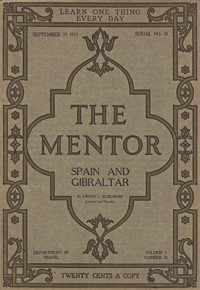
This digital edition of The Mentor: Spain and Gibraltar, Vol. 1, Num. 31, Serial No. 31, September 15, 1913 — Themes and Context is described by source-level measurements including 10,347 words, 45 min estimated reading time, and 7 detected text sections.
The text analysis averages about 18.5 words per sentence, while the detected sections provide another way to judge how the source is divided.
Project Gutenberg metadata also associates the work with “Spain -- Description and travel,” connecting these edition facts with the source record’s subject description.
Explore this collection
These alternatives are selected using recorded categories and estimated reading time.
About 46 minutes
Geography
10,551 recorded words. 1 minutes difference from this book's estimate.
View Gutenberg source #49923About 43 minutes
Geography
9,743 recorded words. 2 minutes difference from this book's estimate.
View Gutenberg source #50384About 52 minutes
Geography
11,750 recorded words. 7 minutes difference from this book's estimate.
View Gutenberg source #55713Search stored excerpts and compare books → Choose by your preferences →
Choices use stored catalog measurements. Estimates vary with reading speed. A shared category is a catalog label, not a claim that two books have the same argument or literary quality.
Search reads excerpt text stored with this catalog and links to its associated Gutenberg record. The connection is stored in the site database; this tool does not recheck that every excerpt is word-for-word identical to that external record. Excerpt search does not cover every chapter and does not verify historical publication dates.
Catalog snapshot checked: 2026-09-25. Coverage: 96 public books, 96 available source excerpts.
Calculated from edition completeness, EPUB availability, text structure and catalogue metadata. Not a user rating.
Total of 100 points, scaled to a 2.5-5.0 range. Editions with an empty description or a missing EPUB file are not scored.
Public-domain source text
The source text is kept in the dedicated reader, separate from this catalogue record and its commentary.
The Mentor issue on Spain and Gibraltar opens with a blunt assessment: 'Gone is the ancient glory of Spain. To the visitor it appeals chiefly as a country of a splendid past.' This framing sets the tone for Dwight L. Elmendorf's travelogue, which balances architectural description with historical anecdote. The text is part of a series designed to 'learn one thing every day,' and the excerpts reveal a focus on Moorish and Christian landmarks in Seville, Madrid, and Granada. The catalog subjects—'Spain—Description and travel' and 'Gibraltar—Description and travel'—are accurate, but the excerpts emphasize interiors and legends over broader geography.
The Alcázar at Seville is described as standing 'tranquilly amid its gardens that glow with roses and orange blossoms,' a phrase that captures the blend of natural beauty and historical endurance. Elmendorf notes that the palace 'replaces an old Gothic castle, which had been erected on the foundations of a Roman villa,' illustrating layers of occupation. The text recounts the legend of the 'Court of Maidens,' a tribute story that 'history does not show' ever occurred, yet the name persists. King Pedro the Cruel is linked to the Alcázar through tales of his disguised wanderings; one anecdote describes him testing candidates for a judge's position by asking what floats in a pool. The correct answer—'Half an orange'—earns the appointment. These details show how the author weaves fact and folklore, treating the building as a repository of stories rather than a mere structure.
Elmendorf presents Madrid as a modern city that has 'been from the beginning a center of art and literature.' He cites Velasquez, Cervantes, and Lope de Vega as key figures. The claim about Lope de Vega is striking: 'more than a hundred of his plays were written so quickly that it took only twenty-four hours from the time he started to compose each one of them until it had been produced on the stage.' The author adds that Lope 'wrote 1,800 plays' and 'printed 21,300,000 lines,' a figure that strains credulity but is presented without skepticism. This section reveals the Mentor's educational style: it offers memorable, sometimes exaggerated, facts to engage readers. The text also mentions that 'scientific forestry can probably redeem the error that was committed centuries ago' regarding deforestation, a rare nod to environmental change that goes beyond simple description.
The catalog includes 'Gibraltar—Description and travel,' but the provided excerpts contain no substantial discussion of Gibraltar. The title page lists 'Gibraltar' as a topic, and the table of contents mentions it, but the text excerpts break off before reaching that section. This gap between catalog subjects and available evidence is significant: readers expecting coverage of Gibraltar will not find it in these passages. The excerpts instead focus on Seville, Madrid, and the Alhambra (mentioned in the list of illustrations). The absence of Gibraltar material underscores the importance of consulting the full text. Based solely on the excerpts, the work is primarily about southern Spain's Moorish heritage and Madrid's cultural history, with Gibraltar remaining a promised but undelivered subject.
Readers should approach this Mentor issue as a period piece that reflects early 20th-century travel writing. The text is designed for quick, enjoyable learning, with anecdotes that prioritize entertainment over strict accuracy. The catalog subjects are a reliable guide to the intended scope, but the excerpts show that the actual content may be unevenly distributed. For a complete picture, the full text—including the missing Gibraltar section—would be necessary. This edition preserves the original 1913 formatting and illustrations, offering a window into how American audiences were introduced to Spanish landmarks and legends.
I remember reading this old travelogue on Spain and Gibraltar late one autumn, and it felt like walking through rooms where history hasn't quite left. The same quiet ache came over me years ago with Trip to the West and Texas comprising a journey of eight thousand miles, through New-York, Michigan, Illinois, Missouri, Louisiana and Texas, in the autumn and winter of — Inside the Classic—that sense of a place holding its secrets while you merely pass through.
Create a short personal record of your experience with this book.