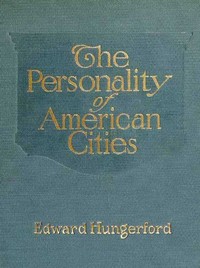
The Personality of American Cities — Themes and Context

(1 User reviews)   334
In Category - Geography
Hungerford, Edward, 1875-1948 Project Gutenberg 2012 Not confirmed
United States -- Description and travel; United States -- Social life and customs -- 1865-1918; Cities and towns -- United States Readers of public-domain and historical texts
Project Gutenberg digital edition en

Edition facts

Words 113,355
Reading time 493 min
Text sections 14

Before opening The Personality of American Cities — Themes and Context, the edition data offers a quick orientation: 113,355 words, 8 hr 13 min estimated reading time, and 14 detected text sections.

The text analysis averages about 22.5 words per sentence, while the detected sections provide another way to judge how the source is divided.

Project Gutenberg metadata also associates the work with “United States -- Description and travel,” connecting these edition facts with the source record’s subject description.

Edward Hungerford's 1913 travelogue examines fourteen U.S. cities through their physical layout, transit systems, and daily rhythms, using specific details like Pittsburgh's hill-climbing trolleys and New York's skyscraper congestion to reveal each city's character.
Share
Editorial Edition Score 4.9/5

Calculated from edition completeness, EPUB availability, text structure and catalogue metadata. Not a user rating.

How this score is calculated
  • Description quality20 pts
  • Title & short description10 pts
  • Source metadata20 pts
  • Text length15 pts
  • Chapters / structure15 pts
  • EPUB file integrity20 pts

Total of 100 points, scaled to a 2.5-5.0 range. Editions with an empty description or a missing EPUB file are not scored.

Edition quality

Read the Text

Clarke had disappeared and it was doomed a few months later to such attractions as the booking syndicates might allot it, but its row of exterior lamps still blazed in Tremont street: until in June, 1903, it rang down its green baize curtains and closed its historic doors for the last time.

And yet Boston has not changed greatly in twenty years--not in outward appearance at least. When she builds anew she builds with reverent regard for her ideals and her past traditions. Her architects must be steeped in both. Nearly twenty years ago she builded her first skyscraper--a modest and dignified affair of but twelve stories--and was then so shocked at her own audacity that she promised to be very, very good for ever after and never to do anything of that sort again. So when she found that a new hotel going up near Copley Square had overstepped her modest limit of seven stories--or is it eight?--she showed that she could have firmness in her determination. She chopped the cornice and the upper story boldly off the new hotel, and so it stands today, as if someone had passed a giant slicing-knife cleanly over the structure.

So it is that Boston still holds to her attractive sky-line, the exquisite composition of such distinctive thoroughfares as Park street from the fine old church at Tremont street up the hill to Beacon street, the pillared, yellow front of the old State House; still keeps her meeting-houses with their delicate belfried spires standing guard upon her many hilltops; maintains the rich traditions of her history in the infinite detail of her architecture--in some bit of wall or section of iron fence, in the paneling of a door, the set of a cupola, the thrust of a street-lamp, and even in the chimney-pots that thrust themselves on high to the attention of the man upon the pavement. She cherishes her memories. And when she builds anew she does not forget her ideals.

She never forgets her ideals. And if at times they may lead her to regard herself a bit too seriously, they make for the old town one of the things that too many other American towns lack--a real and distinctive personality. For instance, take her public houses, her taverns and inns. They are notable in the fact that they are distinctive--and something more. In a day and age when the famous American hotels of other days and generations and the things for which they stood, have been rather forgotten in the strife to imitate a certain type of New York skyscraper hotel, the Boston hotels still stand distinctive. Not that the New York type of skyscraper is not excellent. It must have had its strong points to have been so copied across the land. But if all the hotels in every town, big and little, are to be fashioned in the essentials from the same mold what is to become of the zest for travel? You travel for variety's sake, otherwise you might as well go to the local skyscraper hotel in your own town and save railroad fare and other transportation expenses.

But no matter what may be true of other towns, the Boston hotels are different. "I like the Quincy House for its sea-fud," said an old legislator from Sandisfield more than forty years ago, and as for the Tremont House, turn the pages of your "American Notes" and recall the praise that Charles Dickens gave that not-to-be-forgotten hostelry. It was one of the very few things in the earlier America that did not seem to excite his entire contempt.

The Tremont House has gone--it disappeared under the advance of modernity in the serpent-like guise of the first subway in America, creeping down in front of it. But other hotels of the old Boston remain a'plenty, the staid Revere House, Parker's, Young's, the Adams House,--ages seem to have mellowed but not lessened their comforts to the traveler. Where else can one find a catalogue of the hotel library hanging beside his dresser when he retires to the privacy of his room, not a library crammed with "best-sellers" like these itinerant institutions on the limited trains, but filled with real books of a far more solid sort--where else such wisdom on tap in a tavern--but Boston? And if the traveler fails to be schooled to such possibilities, we might ask where else in Christendom can he get boiled scrod, or Washington pie, or fish balls, or cod tongues with bacon, or that magna charta of the New England appetite, that Plymouth rock from which has come all the virtues of its sturdy folk, baked beans with brown bread? Eating in Boston is good. In these things it is superlative. And it is pleasing to know that Boston's newest hotel--the Copley-Plaza--perhaps the finest hotel in America, since it has discarded new-fashioned details for the old--observes the traditions of the town in which it truly earns its bread and butter.

And if the traveler have magic sesame, the clubs of the old town may open to him, clubs with spotless integrity and matchless service, all the way from the stately Somerset and the Algonquin through to the democratic City Club--with its more than four thousand enthusiastic members. This last is perhaps the most representative of Boston clubs. Its old house--unfortunately soon to be vacated--stands in Beacon street, within a stone's throw of King's Chapel and Tremont street. It is a rare old house; two houses in fact, lending tenderly to the Boston traditions of delicate bow fronts and severity of ornament. Its rooms are broad and long and low, filled with hospitable tables and comfortable Windsor chairs. In its great fireplace hickory logs crackle and the New England tradition of an ash-bank is preserved to the minutest detail. Its dun-colored walls are lined with rare prints and old photographs--pictures for the most part of that old Boston which was and which never again can be. The dishes that come out from its kitchen are from the best of traditional New England recipes. And as your host leads you out from the dining-room he delves deep into a barrel and brings out two bright red apples. He hands you one.

"We New England folk think that most of the real virtues of life are seated in red apples," he says--and there is something in his way of saying it that makes you believe that he is right.

Another day and he may lead you to still another club--this one down under the roof of one of those solid old stone warehouses with steep-pitched roofs that thrust themselves abruptly out into the harbor-line. It is a yacht club, and its fortress-like windows, shaped like the port-holes of a ship, look direct to a brisk water highway to the open sea. Underneath those very windows is the rush and turmoil of one of the busiest fish markets in the land. There is nothing on either coast, no, not even down in the picturesque Gulf that can compare with this place, which reeks with the odors and where the fishermen handle the cod with huge forks and paint the decks of their staunch little vessels a distinctive color to show the nationality of the folk who man it. We remember that the Portuguese have a whimsical fancy for painting the decks of their little fishing schooners a most unusual blue.

Of Boston harbor an entire book might easily be written--of the quaint craft that still tie to its wharves, the brave show of shipping that passes in and out each day, of Boston Light and that other silent, watchful sentinel which stands upon Minot's Ledge; of the Navy Yard over in Charlestown at which the _Constitution_, most famous of all fighting-ships, rusts out her fighting heart through the long years. And looking down upon that old Navy Yard from Boston itself is Copp's Hill burying-ground, a rich grubbing-place for the seekers of epitaphs and of genealogical lore. We remember once winning the heart of the keeper of the old cemetery and of being permitted to descend to the vault of one of the oldest of Boston families. In the dark place there were three little groups of bones and we knew that only three persons had been buried there.

Above, the sunshine beat merrily down upon Copp's Hill, with its headstones arranged in neat rows along the tidy paths and the elevated trains in an encircling street fairly belying the bullets in the stones--shot there from Bunker Hill a century and a quarter before.... There are many other such burying-grounds in Boston--in the very heart of the city the Granary and King's Chapel burying-ground where a great owl sometimes comes at dusk and opens his eyes wide at the traffic of a great city encircling one of God's acres. And a soul that revels in these things will, perchance, journey to Salem, seventeen miles distant, and see the moldering seaport that once rivaled Boston in her prosperity and that sent her clipper ships sailing around the wide world. There are many delightful side-trips out from Boston--the sail across the tumbling bay to Provincetown, which still boasts a town crier, down to Plymouth or up to Gloucester, with its smart, seaside resorts nearby. And back from Boston there are other moldering towns, filled with fascination and romance. Some of them have hardly changed within the century.

Even Boston does not change rapidly. Thank God for that! She keeps well to the old customs and the old traditions, holds tightly to her ideals. Only in the folk who walk her awkward streets can the discerning man see the new Boston. The old types of Brahmins are outclassed. Some of them still do amazingly well in the professions but these are few. Long ago the steady press of immigration at the port of Boston took political power away from them. Yet the old guard stands resolute. And the impress of its manners is not lost upon the Boston of to-day.

For instance, take the vernacular of the town. Boston has a rather old-fashioned habit of speaking the English language. It came upon us rather suddenly one day as we journeyed out Huntington avenue to the smart new gray and red opera house. The very colorings of the _foyer_ of that house--soft and simple--bespoke the refinement of the Boston to-day.

In the Metropolitan Opera House, New York, in every other one of the big opera houses that are springing up mushroom-fashion across the land, our ears would have been assailed by "Librettos! Get your librettos!" Not so in Boston. At the Boston Opera House the young woman back of the _foyer_ stand calmly announced at clock-like intervals:

"Translations. Translations."

And the head usher, whom the older Bostonians grasped by the hand and seemed to regard as a long-lost friend, did not sip out, "Checks, please."

"Locations," he requested, as he condescended to the hand-grasps of the socially elect.

"The nearer door for those stepping out," announces the guard upon the elevated train and as for the surface trolley-cars, those wonderful green perambulators laden down with more signs than nine ordinary trolley-cars would carry at one time, they do not speak of the newest type in Boston as "Pay-as-you-enter cars," after the fashion of less cultured communities. In the Hub they are known as Prepayment cars--its precision is unrelenting.

All of these things make for the furthering of the charm of Boston. They are tangible assets and even folk from the newer parts of the land are not slow to realize them as such--remember that man from the Middle West who makes a journey once or twice each year to be in the very heart of civilization. There was another Westerner--this man a resident of Omaha, who sent his boy--already a graduate of a pretty well-known university near Chicago--to do some post-graduate work at Harvard. A few weeks later he had a letter from his son. It read something after this fashion:

"It seems absurd, Dad, but Harvard does have some absurd regulations. In fine, they won't let me go out in a shell or boat of any sort upon the river without special written permission from you. Will you fix me up by return mail and we will both try to forget this fool undergraduate regulation, etc...."

That regulation struck Daddy about as it had hit Sonny. But he hastened to comply with the request. When he had finished, he felt that he had turned out quite a document, one that would be enjoyed in the faculty and perhaps framed and hung up in some quiet nook. It read:

"To all whom it may concern:

This is to certify that my son, John Japson Jones, is hereby authorized and permitted to row, swim, dive or otherwise disport himself upon, above or under the waters of the Charles river, Massachusetts bay and waters adjacent to them until especially revoked. Given under my hand and seal at the city of Omaha in the state of Nebraska, on the ....th day of October, 19....

(Signed) JAMES JONES."

Then James Jones awaited the consequences. It was not long after that the letter came from John Japson.

"--How could you do it, Dad?" he demanded. "You don't know these folks. They're not our sort. They don't know humor. They're afraid of it. The only man I dared to show that awful thing to was the janitor and he stuck up his nose. 'Guess your pop must have been a little full,' was his comment."

James Jones decided to come to Boston forthwith. He wanted to see for himself what sort of a community John Japson had strayed into. He did see Boston, Cambridge too, to his heart's content. Boston was his particular delight. Two of its citizens took the gentleman from Omaha well in hand. They showed him the Frog Pond--it was just before the season when they remove the Frog Pond for the season and put down the boardwalks in the Common--and they showed him the crookedest streets of any town upon the American continent. They filled him with beans and with codfish, tickled his palate with the finest Medford rum. He mingled and he browsed and before they were done with him his barbaric soul became enraptured.

"Boston is great," he admitted, frankly. Then, in an afterthought, he added:

"I think that I should like to call her the Omaha of the East."

The owl still comes on cloudy, troubled nights and sits in a high tree-limb above the quiet graves in the graveyard of King's Chapel. When he comes he sees the tardiest of the Boston men, carrying the green bags, that their daddies and their granddaddies before them carried, as they go slipping down the School street hill. He is a very old owl and he loves the old town--loves each of its austere meeting-houses with their belfried towers, loves the meeting places behind the rows of chimney-pots, the open reaches of the Common and the adjoining Public Gardens, where children paddle in the swan-boats all summer long. He loves the tang and mist of the nearby sea, but best of all he likes the tree-limb in the old graveyard, the part of Boston that stands changeless through the years--that thrusts itself into the very face of modernity with the grimy stone church at its corner and seems to say:

"I am the Past. To the Past, Reverence."

And in Boston Modernity halts many times to make obeisance to the Past.

Before the dawn, metropolitan New York is astir. As a matter of far more accurate fact she never sleeps. You may call her the City of the Sleepless Eye and hit right upon the mark. For at any time of the lonely hours of the night she is still a busy place. Elevated and subway trains and surface cars, although shortened and reduced in number, are upon their ways and are remarkably well filled. Regiments of men are engaged in getting out the morning papers--in a dozen different languages of the sons of men--and another regiment is coming on duty to lay the foundations of the earliest editions of the evening papers. There are workers here and there and everywhere in the City of the Sleepless Eye.

But before the dawn, New York becomes actively astir. Lights flash into dull radiance in the rows of side-street tenement and apartment houses all the way from Brooklyn bridge to Bronx Park. New York is beginning to dress. Other lights flash into short brilliancy before the coming of the dawn. New York is beginning to eat its breakfast. And right afterwards the stations of the elevated and the subway, the corners where the speeding surface cars will sometimes hesitate, become the objects of attack of an army that is marching upon the town. Workaday New York is stretching its arms and settling down to business.

Nor is the awakening city to be confined to the narrow strip of island between the North and East rivers. Over on Long island are Brooklyn, Long Island City, Flushing, Jamaica and a score of other important places now within the limits of Greater New York. Some folk find it more economical to live in these places than in the cramped confines of Manhattan, and so it is hardly dawn before the great bridges and the tubes over and under the East river are doing the work for which they were built--and doing it masterfully.

The Brooklyn bridge is the oldest of these and yet it has been bending to its superhuman task for barely thirty years. In these thirty years it has been constantly reconstructed--but the best devices of the engineers, doubling and tripling the facilities of the original structure, can hardly keep pace with the growth of the communities and the traffic it has to serve. So within these thirty years other bridges and two sets of tunnels have come to span the East river. But the work of the first of all man's highways to conquer the mighty water highway has hardly lessened. The oldest of the bridges, and the most beautiful despite the ugliness of its approaches, still pours Brooklynites into Park Row, fifty, sixty, seventy thousand to the hour.

The overloading of the Brooklyn bridge is repeated in the subway--that hidden giant of New York, which is the real backbone of the island of Manhattan. Built to carry four hundred thousand humans a day, that busy railroad has begun to carry more than a million each working day. How it is done, no one, not even the engineers of the company that operates it, really knows. The riders in the great tube who have to use it during the busiest of the rush hours are willing to hazard a guess, however. It is probable that in no other railroad of the sort would jamming and crowding of this sort be tolerated for more than a week. Yet the patrons of the subway not only tolerate but, after a fashion, they like it. You can ask a New Yorker about it half an hour after his trip down town, sardine-fashion, and he will only say:

"The subway? It's the greatest ever. I can come down from Seventy-second street to Wall street in sixteen minutes, and in the old days it used to take me twenty-six or twenty-seven minutes by the elevated."

There is your real New Yorker. He would be perfectly willing to be bound and gagged and shot through a pneumatic tube like a packet of letters, if he thought that he could save twenty minutes between the Battery and the Harlem river. No wonder then that he scorns a relatively greater degree of comfort in elevated trains and surface cars and hurries to the overcrowded subway.

Edward Hungerford opens The Personality of American Cities with a frank admission: the book took nearly four years to prepare, and he visited each city multiple times—except Charleston, New Orleans, and the three North Pacific cities. This hands-on approach shapes his method. Rather than offering a booster's tour, he focuses on how a city's geography, transit, and architecture create its distinctive flavor. The preface lists cities he wished he could have included—Portland, Detroit, Milwaukee, Indianapolis, Cincinnati, Louisville, Omaha, Kansas City, and three Canadian cities—making clear this is a selective, personal survey, not an encyclopedia.

Structure as a Window into Character

Hungerford organizes his book as a series of fourteen chapters, each devoted to a single city or cluster. The table of contents moves from Boston (“Our Ancient Hub”) through New York, Philadelphia, Baltimore, Washington, Richmond, Charleston, Rochester, Pittsburgh, Cleveland, Chicago, St. Louis, and the Pacific Northwest. This sequence is roughly geographic but also thematic: older eastern cities come first, then industrial centers, then western ones. Within each chapter, Hungerford typically begins with the city's physical setting—its rivers, hills, or harbor—then moves to its business district, residential areas, and transit systems. The Pittsburgh chapter, for example, opens with the city's location at the junction of two rivers forming the Ohio, then describes the narrow flat-land business center, the suburban exodus, and the extraordinary commuter rail service. This consistent structure lets readers compare cities on the same terms.

Recurring Images: Transit as a City's Pulse

Throughout the excerpts, transit systems serve as Hungerford's primary lens for understanding a city's personality. In Pittsburgh, he devotes several paragraphs to the streetcars: “It takes big cars to climb those hills,” he writes, and notes that when New Yorkers see them, “they are chariots of steel, hardly smaller than those that thread the subway.” He also reports that Pittsburgh has the fourth-largest suburban train service in the country, with four hundred passenger trains arriving and departing from a single terminal daily, ninety-five percent for commuters. This focus on transit is not mere description; it reveals social and political dynamics. The Pittsburgh streetcar conductors, he claims, are tied to the political machine, making it dangerous to “talk back” to them. In contrast, he notes that Cleveland, though larger in population, has “not a single distinctive suburban train run in or out.” These contrasts make transit a shorthand for each city's governance, class structure, and daily life.

Movement Between Scenes: From Business to Suburb

Hungerford frequently shifts between downtown and residential areas, using movement as a structural device. In Pittsburgh, he describes the business center as a “narrow spit of flat-land” comparable to lower Manhattan, then notes that “no one lives in Pittsburgh itself, unless under absolute compulsion.” The suburbs—Sewickley, East Liberty, and dozens of smaller communities—house the better part of the population. This movement is not just geographic; it carries social weight. The commuter trains and trolleys become the arteries that connect work and home, and their inadequacy (congestion, political interference) becomes a measure of the city's problems. Hungerford also moves between scales: from the broad view of the city's setting to the specific detail of a streetcar conductor's profanity. This oscillation between panorama and anecdote keeps the prose grounded while conveying a sense of place.

The Voice of the Observer: Specificity and Restraint

Hungerford's authorial voice is that of a seasoned traveler who trusts his own observations. He does not rely on statistics or secondhand accounts; instead, he reports what he has seen and heard. In the Pittsburgh section, he includes a direct anecdote: a lifelong resident protested to a conductor and was met with “a volley of profanity.” A bystander warned the passenger to keep quiet to avoid arrest. Hungerford presents this as evidence of the political machine's grip, not as hearsay. He also uses comparative references to anchor his descriptions: Pittsburgh's business center “exactly corresponding with Manhattan island below the City Hall and of even less area.” This habit of comparison—Pittsburgh versus New York, Cleveland versus Pittsburgh—gives the reader a familiar benchmark. Yet he avoids sweeping claims about the cities' futures or importance, sticking to what he has witnessed. The result is a travelogue that feels reportorial rather than promotional.

Hungerford's method rewards readers who pay attention to the physical details he selects: the width of streets, the size of streetcars, the number of commuter trains. These concrete facts, not abstract praise, carry his argument about each city's personality. The book is best read as a series of snapshots from 1913, each framed by the author's clear-eyed curiosity. Readers interested in urban history or the evolution of American transit will find a wealth of specific, usable detail.

I often think how Hungerford's trolleys in Pittsburgh climbed like stubborn thoughts, and that same stubbornness lives in With Sack and Stock in Alaska — Background and Themes, where the land itself refuses to be hurried. Both books share a patient ear for place, listening to wheels and footsteps, to rivers and trails, until the geography whispers its own quiet biography.

Victoria White
3 weeks ago

5
5 out of 5 (1 User reviews )

Add a Review

Your Rating *
There are no comments for this eBook.

Reader reflection

Record your reading impressions

A brief reflection can help important ideas stay with you longer.

Your progress 0 / 10
1

Which reading stage best describes you?

2

Was reading this book enjoyable?

3

Would you pass this book on to a friend?

4

How easy was the book to follow?

Related eBooks