About 610 minutes
The Gates of India: Being an Historical Narrative — Background and Themes
Geography
140,193 recorded words. 7 minutes difference from this book's estimate.
View Gutenberg source #42970
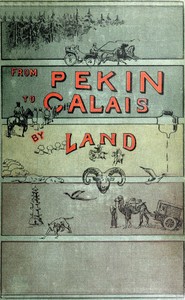
From Pekin to Calais by Land — Context and Discussion can be approached with a clearer sense of reading commitment from its source measurements: 141,895 words, 10 hr 17 min estimated reading time, and 21 detected text sections.
The text analysis averages about 24.2 words per sentence, while the detected sections provide another way to judge how the source is divided.
Project Gutenberg metadata also associates the work with “China -- Description and travel,” connecting these edition facts with the source record’s subject description.
Explore this collection
These alternatives are selected using recorded categories and estimated reading time.
About 610 minutes
Geography
140,193 recorded words. 7 minutes difference from this book's estimate.
View Gutenberg source #42970About 609 minutes
Geography
140,041 recorded words. 8 minutes difference from this book's estimate.
View Gutenberg source #52290About 631 minutes
Geography
144,960 recorded words. 14 minutes difference from this book's estimate.
View Gutenberg source #52763Search stored excerpts and compare books → Choose by your preferences →
Choices use stored catalog measurements. Estimates vary with reading speed. A shared category is a catalog label, not a claim that two books have the same argument or literary quality.
Search reads excerpt text stored with this catalog and links to its associated Gutenberg record. The connection is stored in the site database; this tool does not recheck that every excerpt is word-for-word identical to that external record. Excerpt search does not cover every chapter and does not verify historical publication dates.
Catalog snapshot checked: 2026-09-25. Coverage: 96 public books, 96 available source excerpts.
Calculated from edition completeness, EPUB availability, text structure and catalogue metadata. Not a user rating.
Total of 100 points, scaled to a 2.5-5.0 range. Editions with an empty description or a missing EPUB file are not scored.
Public-domain source text
The source text is kept in the dedicated reader, separate from this catalogue record and its commentary.
Harry De Windt opens his travelogue with a disclaimer: the journey from Peking to Calais is 'sadly devoid of interest,' and he hopes his book will deter others from following his example. This self-deprecating tone, however, belies a narrative rich in specific, often absurd, encounters. The excerpt of a late-night drinking party with Russian officers—featuring a duel over the logistics of a three-cornered fight from Mr. Midshipman Easy—showcases De Windt's eye for comic detail and his willingness to depict his own discomfort. He notes the absence of water, the forced consumption of port, and a professor found 'slowly but surely throttling' another under a piano. Such scenes ground the travelogue in lived, unglamorous experience.
De Windt's preface establishes a distinctive, almost apologetic narrative stance. He writes that he publishes only because Englishmen in Shanghai receive letters asking for route information, and he fears 'the general reader will find little to interest him.' This framing is not mere modesty; it shapes the book's tone as a practical warning rather than a boastful adventure. The author repeatedly emphasizes hardship and monotony, yet his descriptions—like the 'weird and melancholy country' of Siberia—reveal a keen sensitivity to atmosphere. The voice is that of a seasoned traveler who finds the journey more tedious than thrilling, a perspective that lends credibility to his observations of discomfort.
De Windt's prose dwells on the physical realities of travel: the lack of water, the ubiquity of salt fish, the forced drinking of 'brandy, vodka, and white port.' In the party scene, he catalogues the toasts—'the Czar, the army, the navy, the Queen of England, and all reigning potentates'—until the officers fall back on themselves. The detail that he 'must have drunk at least three bottles of port' conveys the excess without hyperbole. Such passages ground the narrative in sensory specifics: a throat 'like a lime-kiln,' a head 'spinning like a teetotum.' The author's discomfort becomes a lens through which the reader experiences the journey's rigors.
De Windt sketches his companions through their actions and speech. The Cossack captain, for instance, is 'all for blood' and wants the professors to 'fight it out with pistols in the morning.' The mathematician and chemist, drunk, argue over the triangular duel until one tries to strangle the other. De Windt reports the incident with dry understatement: 'The thing had been done so gently that neither Lancaster nor myself had noticed it.' The dialogue is minimal but telling—the captain's offer to 'make a third' in the duel reveals a casual brutality. These vignettes give the reader a sense of the social dynamics without explicit character analysis.
The excerpt from Chapter I moves from a general statement of impossibility ('From China to France overland! Why, surely it’s impossible.') to a specific, prolonged scene. De Windt uses a chronological structure, marking time with details: 'Madame Wormoff retired to rest shortly after midnight,' 'by the time we left the table... my throat was like a lime-kiln,' 'it was broad daylight when we separated.' This pacing creates a sense of duration and exhaustion. The author also weaves in literary references—Mr. Midshipman Easy, the French epigraph—that hint at a wider reading, but the focus remains on the immediate, often absurd, reality of the journey.
Readers should approach this travelogue as a record of impressions rather than a comprehensive guide. De Windt's strength lies in his ability to render the specific discomforts and oddities of the road—the forced toasts, the endless salt fish, the strange camaraderie of fellow travelers. The book rewards those who appreciate a narrator willing to admit his own misery and laugh at it. Look for the small, telling details: the absence of water, the professor under the piano, the Cossack's eagerness for a duel. These moments, not the grand landscapes, define the journey.
There’s something about De Windt’s weary, laughing account of frozen roads and bad vodka that stays with you, long after the train moves past those landscapes. I find myself returning to that same quiet ache elsewhere, in the fading streets of a city he only glanced at. Constantinople, v. 2 (of 2) — Context and Discussion holds a similar half-light, a place where every parting feels like a memory already forming. It felt familiar, like an old photograph gone soft at the edges.
A brief reflection can help important ideas stay with you longer.