1

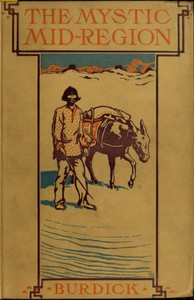
The Mystic Mid-Region: The Deserts of the Southwest — Inside the Classic
(0 User reviews)
1451
Project Gutenberg
2013
Not confirmed
Southwest, New -- Description and travel; Deserts
Readers of public-domain and historical texts
Project Gutenberg digital edition
en
Edition facts
Words
32,276
Reading time
141 min
Text sections
6
For The Mystic Mid-Region: The Deserts of the Southwest — Inside the Classic, the stored edition analysis reports 32,276 words, 2 hr 21 min estimated reading time, and 6 detected text sections.
The text analysis averages about 21.7 words per sentence, while the detected sections provide another way to judge how the source is divided.
Project Gutenberg metadata also associates the work with “Southwest, New -- Description and travel,” connecting these edition facts with the source record’s subject description.
Source:
Project Gutenberg record #42361
This editorial note examines Arthur J. Burdick's 1904 travelogue on the Southwest deserts, focusing on its poetic opening, shifting narrative pace from lyrical to reportorial, and use of quoted experts to convey both wonder and economic promise.
Editorial Edition Score
4.7/5
★★★★★
★★★★★
Calculated from edition completeness, EPUB availability, text structure and catalogue metadata. Not a user rating.
How this score is calculated
- Description quality20 pts
- Title & short description10 pts
- Source metadata20 pts
- Text length15 pts
- Chapters / structure15 pts
- EPUB file integrity20 pts
Total of 100 points, scaled to a 2.5-5.0 range. Editions with an empty description or a missing EPUB file are not scored.
Edition quality
Read the Text
is was before the Colorado River had cut its way through the mountains to the sea, forming that magnificent chasm known as the Grand Cañon. For endless centuries the great river has been eating out the heart of the continent, pulverizing the rock and earth, and bearing it in its turbid tide down from the mountains and tablelands to the lower plains and to the sea.
A part of its burden of silt was laid down over the northern portion of the gulf, and a part of it was carried by the force of the current far down into the great body of water and was piled up ninety miles below the present boundary line between Mexico and the United States. This bank was about sixty miles long, extending in an easterly and westerly direction. Along the right side of the current was formed a lateral embankment, which eventually shut off the river from its former inlet into the gulf and directed it to its present mouth, some two hundred miles lower. This, joining with the sixty-mile embankment, severed one portion of the gulf from the main body and left an inland sea where now is the desert. Then the thirsty sun drank up the waters of this sea and left the land of desolation. How long ago all this happened is a matter of conjecture.
There are many places on the boundaries of the desert where the ancient beach-line may be traced long distances. Here are found numerous shells and corals. Many of the shells are unbroken, and one might almost believe, to look upon them, that they were tossed there by the restless waves no longer ago than yesterday. The varieties of shells and of sea relics correspond very closely with those now abounding in the sea.
There are evidences that the desert has been dry land many centuries. Upon its breast are found Indian pottery and implements of a style and pattern antedating those in use at the time the white man reached this country. Then, too, as far back as the sixteenth century, when the earliest exploration of that region was made, the desert-dwelling tribes seem to have been thoroughly established in the territory once occupied by the gulf. It doubtless required centuries, after the waters were cut off from the region, to dry up the inland sea and make it possible for man to enter in and occupy the territory.
It is the belief of some scholars that the land was submerged when the first Spanish explorers reached the coast. In support of this theory they point to certain maps which show the gulf as covering that region.
A map of the early navigators recently in the possession of General Stoneman of the United States Army, which was obtained by him in the City of Mexico, shows the Gila River as entering the gulf, whereas the Gila River now enters the Colorado River ninety miles north of the present mouth of the Colorado.
A map of California, published in 1626 by N. Sanson d'Abbeville, geographer to the King of France, pictures the Gulf of California as extending along the entire eastern boundary of the State, and connecting with the Pacific Ocean on the north. This map was made from sundry drawings and accounts furnished by the early navigators, and is glaringly incorrect. It is certain that the gulf did not then, or at any time, extend to the Pacific. The early explorers and map-makers conveniently guessed at matters upon which they could get no information.
When the "tenderfoot" first strikes the desert country he is surprised to learn that he is expected to pay for the water he uses for himself and for his beast. A little later he becomes indignant upon finding himself unable to purchase even a small quantity of the necessary fluid because of the extreme caution of the proprietor of some desert well where he has expected to replenish his stock of water.
It is not an unusual happening for the desert traveler, who has toiled hours over the burning sands after his supply of water has been used up, to find the desert-dweller unwilling to spare a drop of his scanty supply. Not all desert wells are dependable, and sometimes the solitary dweller of the oasis finds his supply exhausted; he then has to haul all the water he uses forty or fifty miles until such time as the winter rains come to replenish the vein which feeds his well.
Arthur J. Burdick's The Mystic Mid-Region: The Deserts of the Southwest (1904) opens not with a traveler's log but with a poem—a formal, rhyming meditation that personifies the desert as a keeper of secrets, a realm of "burning, stern, relentless sky." This prefatory verse sets a tone of awe and dread that the prose chapters alternately sustain and undercut. The book's structure moves between lyrical description, natural history, and boosterish accounts of mineral wealth, creating a hybrid work that is part nature study, part economic prospectus.
Poetic Frame and Descriptive Voice
The opening poem, signed "A. J. B.," establishes a vocabulary of personification and paradox: the desert is a "kingdom of solitude" that "guardest" secrets, its "smile is death." This elevated diction carries into early chapters, where Burdick writes of "teaming in Death Valley" and describes landscapes as "mute appeal unfruitful lie." Yet the voice shifts quickly into a more factual register. In chapter headings like "Curious Plants which Live in the Desert" and "Strange Dwellers of the Desert," the tone becomes taxonomic, almost pedagogical. The juxtaposition suggests a writer uncertain whether to enchant or inform, and the resulting tension gives the prose an uneven, exploratory quality.
Pace Shifts: From Meditation to Reportage
Burdick's pacing varies markedly between chapters. The early sections on desert plants and animals move at a deliberate, observational tempo, cataloging adaptations with a naturalist's patience. But in chapters on mining—"The Story of a Streak of Yellow" and "Desert Borax Mines"—the prose accelerates into a near-journalistic urgency. He quotes a mining engineer who declares the Mojave "more talked about in the financial centers of the East than Alaska," and describes borax deposits as lying in "the most desolate, dangerous, and terrifying locality in the United States." These passages read like dispatches from a boomtown, complete with nugget discoveries and speculation about future rushes. The shift from contemplative to commercial is abrupt, and the book never fully reconciles the two impulses.
Quoted Authorities and the Texture of Evidence
Throughout the text, Burdick relies on embedded quotations from experts—mining engineers, prospectors, and local officials—to lend authority to his claims. For instance, he reproduces a long passage from an engineer about a placer strike near Needles, including the detail that nuggets were found "imbedded in the pine" of a split pile. These quoted voices introduce a polyphonic quality, but they also fragment the narrative: the reader must navigate between Burdick's own descriptive prose and the reported speech of others. The effect is a layered, sometimes disjointed account that mirrors the desert's own mixture of allure and hazard.
Readers attentive to narrative voice will find in The Mystic Mid-Region a document of its era's competing attitudes toward the desert—as sublime wilderness and as resource frontier. Burdick's shifts in pace and register, from poem to prospectus, from natural history to news report, reveal an author struggling to contain a subject that resists easy classification. The book rewards those who read not only for information but for the tensions embedded in its style.
Sometimes I think about Burdick wandering those desert stretches, how his awe slowly turns to inventory. It reminds me of another old travelogue, one that lingers quietly long after reading, where a city’s layers unfold like that—first mystical, then measured. The same patient shifting of tone stayed with me there. Constantinople, v. 2 (of 2) — Context and Discussion holds that particular hush between wonder and record, exactly. A gentle echo, nothing more.
There are no reviews for this eBook.
There are no comments for this eBook.
Reader reflection
What did you think of this book?
Answer a few questions and save a private reflection on this device.
Your progress
0
/
10
2
Was reading this book enjoyable?
3
How likely are you to recommend this book?
4
Did the language feel accessible?
5
How distinctive were its ideas or approach?
6
Did any part of the book feel personally relevant?
7
How much did the book move you?
8
Did you gain anything practical from the text?
9
What changed or sharpened your thinking?
10