Sketch-Book of the North — Story, Setting & Ideas
Edition facts
This digital edition of Sketch-Book of the North — Story, Setting & Ideas is described by source-level measurements including 51,062 words, 3 hr 43 min estimated reading time, and 36 detected text sections.
The text analysis averages about 26.9 words per sentence, while the detected sections provide another way to judge how the source is divided.
Project Gutenberg metadata also associates the work with “Scotland -- Description and travel,” connecting these edition facts with the source record’s subject description.
Calculated from edition completeness, EPUB availability, text structure and catalogue metadata. Not a user rating.
How this score is calculated
- Description quality20 pts
- Title & short description10 pts
- Source metadata20 pts
- Text length15 pts
- Chapters / structure15 pts
- EPUB file integrity20 pts
Total of 100 points, scaled to a 2.5-5.0 range. Editions with an empty description or a missing EPUB file are not scored.
Read the Text
James, bursting into rage at his taunts and at his refusal to abandon the treasonous compact, suddenly cried, “By Heaven, my Lord, if you will not break the league, this shall!” and, drawing his dagger, stabbed Douglas to the heart.
This deed brought the family fortunes to a climax, and for three years Scotland was blackened by the raging of the Douglas Wars. From Berwick to Inverness the country was wasted by the struggles of the partisans. Stirling and Elgin were burned, and, amid famine and pestilence, the troubles of the wars of Edward seemed come again on Scotland: so great had grown the power of these Border lords. At last, however, the King and the Earl came face to face. Each led an army of forty thousand men, and only the small river Carron ran between them. By the combat of the morrow, it seemed, would be known whether James Stuart or James Douglas should wear the Scottish crown. But the Earl’s heart was seen to fail, and on the morrow, when he awoke, he found his camp deserted. Of all his host of the previous day not a hundred followers remained. Nothing was left him but flight; and, turning his back, as a Douglas had never done before, he made his way to England. Twenty years later, having been captured by one of his own vassals in a petty skirmish on the Border, he was sent to end his days as a monk in the Fifeshire Abbey of Lindores.
Thus ended the great line of the Earls of Douglas, a race whose history for three hundred years had been the history of Scotland, and whose foot had twice, at least, been set upon the step even of the throne. From the house’s latter days of turbulence and ambition there is pleasure in turning back to those earlier years when the Good Lord James rode at the Bruce’s saddle-bow, and the patriotism of groaning Scotland rallied round the coupled names of Douglas and the King. No later deed can dim the lustre of those years, and nothing in history can outshine the last scene in the life of the Knight who strove to carry the Bruce’s heart to the Holy Land. Himself hemmed round by the Moors on that Spanish plain, in his effort, it is said, to succour a friend, the Earl took from his neck the casket containing the King’s heart. “Pass first in fight,” he cried, “as thou wert wont to do! Douglas will follow thee, or die!” Then, throwing the casket far among the enemy, he rushed forward to the place where it fell, and was there slain. Well would it have been for the race of Douglas had they ever remained true as that ancestor to the service of their King!
IN THE SHADOW OF ST GILES’.
Night in Edinburgh! The traveller may have seen the sun set over the lagoons of Venice; he may have watched the moon rise behind the Acropolis of Athens; but he has seen nothing finer or more inspiring than is shown him by the sparkle of the frosty stars in this grey metropolis of Scotland. From the terraced pavement of Princes Street, that unmatched boulevard of the modern city, looking across the dark chasm where once surged the waters of the North Loch, he sees the form of the Old Town rise, from Holyrood Palace low in the eastern meadows to the castled rock high at the western end, a dark mass all against the southern sky. Yellow lines of light mark the modern bridges spanning the abyss below, and windows still glowing--dim loopholes in the perilously high old houses beyond--bespeak the inhabitants there not yet all asleep. But these are forgotten in the witchery of the sight, when the clouds part, and the silvery starlight is shaken down upon the ancient city; when behind the broken sky-line of roofs and gables the clear moon comes up, and hangs, a lustrous jewel, among the pinnacles of St Giles’.
Nor is it only the magic of the sight that stirs strange pulses in the blood. Standing at night in the Roman Coliseum, it seems still possible to hear majestic echoes of an older world. But the Scotsman under the shadow of “high Dunedin” is moved, as nowhere else, by memories of old glory and old sorrow. Here to a Scottish heart the past comes back. Here sighed the fatal sweetness of Rizzio’s lute. Here rang the wild clan-music of Lochiel. Among these old walls, however, something more is to be remembered than the deeds of high fame. Ever and again, it is true, amid the gloom of half-forgotten centuries, there is caught the glitter of some historic pageant. Out of the silence about the Cathedral one seems to catch the chime of fuming censers and the roll of coronation litanies, with, perchance, the sonorous accents of a Gavin Douglas, poet-bishop of Dunkeld; and one thrills again to hear the boom of the Castle cannon as the Fourth James rides gallantly away to his death. But behind all this a more tender interest touches the heart. What of the real inner life of those centuries bygone--the loves and sorrows, burning once, and poignant as ours are to-day, which have passed out of sight among the years, and been forgotten? Of some of these, indeed, Sir Walter Scott has written the story on the dark curtain of the past with a pen of fire. But for countless others there is not even the poor consolation of a recorded name. Occasionally, however, amid the seething of history, or in some half-remembered old song, a reference occurs, and a glimpse all too brief is had into some tender and mournful story. And so one sees that, behind the glitter of a Stuart chivalry, of brave and splendid deeds before the world, sometimes there lay a shadow, the sigh of a breaking heart, the stain of unavailing tears.
Who knows the early history of that Lady of Loch Leven, mother of the Regent Murray? Grimly enough she is painted by Scott in her old age as the keeper of Queen Mary. Yet assuredly once she was lovely and young, and had strange beatings of heart as she listened to the whispers of her Royal lover, that all too gallant James V. What was their parting like, when the parting came? Was there the last touch of regretful hands, a remorseful caress from the royal lips, a passionate farewell? Or was there only the cruel news by alien mouths that her place was filled by another, that she had been forsaken? No one can tell us now.
Then what of the Lady Anne Campbell of Argyle, at one time betrothed to Charles II.? The youthful Prince, aged twenty, had been crowned gorgeously, after the ancient manner of the Scottish Kings, at Scone. But King only in name, with England still under the iron rule of Cromwell, and only a faction in Scotland devoted to his cause, his immediate fortunes were entirely in the hands of the Scottish leader, the crafty, covenanting Marquis of Argyle. Reaching ever higher in ambition, and dazzled by the weird vision of the race of MacCallum More mounting the throne, Argyle proposed that Charles should marry his daughter. Needy and reckless, and eager to attach Argyle to the Royalist cause by the golden bands of hope, the King pretended consent. Alas for the Lady Anne! What maiden could keep still her heart when wooed by so royal a lover? For wooing there must have been, to keep up the pretence of betrothal, and how was the maiden to know that those words and looks, and, it may have been, those warmer caresses, were all no more than a diplomacy? And when the crash came, with Cromwell’s defeat of the covenanting army at Dunbar, and the revelation that she had given up her all and had been deceived--how bitter, how cruel the discovery! The contemporary Kirkton relates circumstantially that “so grievous was the disappointment to the young lady, that of a gallant young gentlewoman, she lost her spirit, and turned absolutely distracted.”
Then there is a pitiful little song, unprinted and all but forgotten,[A] sung to a quavering, pathetic old tune, and relating in quaint ballad fashion something of the story of one Jeanie Cameron, an adherent of Prince Charles Edward in the rebellion of 1745. It narrates how the maiden, having fallen sick, not without a suspicion of its being heart-sickness, and all cures of the leeches failing, was prescribed “ae bricht blink o’ the Young Pretender.” So she sate her down and wrote the Prince “a very long letter, stating who were his friends and who were his foes.” This letter she had closed, and was just “sealing with a ring,” when, as used to happen in ballad story, “ope flew the door, and in came her King.” Poor young lady!--
She prayed to the saints and angels to defend her, And sank i’ the arms o’ the Young Pretender. Rare, oh, rare! bonnie Jeanie Cameron!
Nor is this pretty romance merely an invention of the poet’s brain. One of the family by whom the song has been preserved happened, it seems, in the latter part of last century, to be buying snuff in a shop in Edinburgh, when a beggar came in. Nothing was said before the stranger; but the shopkeeper, as if it were an accustomed dole, handed the beggar a groat. Afterwards, in reply to a remark of his customer as to the delicacy of the beggar’s hand which had received the coin, the shopkeeper revealed the fact that the recipient of his charity was no man, but a woman, and no other than Jeanie Cameron, a follower of the Chevalier. Her story, so far as he knew it, was sad enough. She had followed the Prince to France, hoping, no doubt, poor thing! to resume there something of the place she had believed herself to hold in his affections. Alas! it was only to find herself, like so many others, forgotten, cast off, an encumbrance to a broken man. And then, with who can tell how heavy a heart, she made her way home, only to discover that her family had shut their door upon her, and cut her adrift. So, for these many years, she had wandered about forlorn and lonely, supported by a few charitable bourgeois in the streets of Edinburgh--she who could look back upon the day when she had loved and been loved by a Stuart Prince.[B]
[A] It has now been included in “Ancient Scots Ballads with their Traditional Airs.” Glasgow: Bayley & Ferguson, 1894.
[B] This account of the latter days of “Mrs Jean Cameron” finds corroboration in a footnote to the second volume of Chambers’s “Traditions of Edinburgh.”
Such are some of the stories which find no place in history, but whose consciousness sheds a tragic and tender interest about this grey old capital of the North. Who will say that they are not as well worth thought as the trumpetings of herald pursuivants and the clash of warlike arms?
Out of the way, in this quiet hollow of the Ayrshire hills, something remains yet of the life of a hundred years ago. Elsewhere the puffing of steam may have taken the place of toil by hand, but here in the long summer days, from morning till night, the click-clack of the looms is still to be heard, and within every second window up the length of the village street, the dusty frames are to be seen moving regularly to and fro. Pots of geranium and fuchsia are set sometimes in these windows, and through the narrow doorways the cottage gardens can be seen behind, carefully kept, and ablaze just now with wallflower borders and pansies. Sadly, however, is the place decayed from its prosperity of old. Little traffic comes now to the wide, empty street. The carrier’s waggon is an object of interest when it puts in an appearance. The baker’s van may be the only vehicle of an afternoon; and twice a week only comes the flesher’s cart. Butcher meat, it is to be feared, is but seldom seen on some of the village tables; and, when work is more than usually scarce, many must put up with but “muslin-broth.” Here and there a roofless ruin, breaking the regular line of dwellings, tells of a decaying industry. In the sunny inn-door at the head of the village the brown retriever may rouse himself, once in the afternoon, to inspect the credentials of some vagrant terrier; and, but for the faint click-clack of the looms all day, and the appearance, once in a while, of a woman with a pair of stoups to draw water at the village well, the place might seem asleep.
Yet a hearty trade once throve on the spot. Every house had its loom going, sometimes two; and there was always work in plenty. Weavers’ wives could go to kirk then in black-beaded bonnets and flowered Paisley shawls, and the Relief Kirk minister got his stipend of eighty pounds a year nearly always paid. In those times the carrier’s cart used to have business in the village every day; merchants from Glasgow came bidding against each other for work in a hurry; and four of the weavers at once have been known to have sons at college studying for the ministry. Those were the days when the village kept a watchful eye upon the religious and political movements of the country. Before the Stamp Duty was removed from newspapers, the weavers subscribed in clubs and took out their weekly sheet, which was passed from shop to shop, read and digested, and thoroughly threshed out in the door-step debates, when a knot of neighbours would gather between the spells of work. In this way the great Reform Bill was fully discussed and settled here long before it passed the House of Commons; and the absorbing question of the Disruption, which gave birth to the Free Church, was thoroughly argued and thought out on its merits.
True to the traditions of their craft, of course, most of the weavers were the reddest of Radicals, and the progress of the Chartist movement excited the keenest interest among them. The work at the looms was to a great extent mechanical, and while they pushed the treadles and pulled the shuttles to and fro, the weavers had time to think; and shrewd thinkers and able debaters many of them became, ready at the hustings with questions on the Corn Laws, the freeing of the slaves, and the Irish grievances, which were apt to put a political candidate to some trouble. He had not their advantage of the daily “argufying” and the Saturday night debates at the village inn. There was a tradition that in the room where this club met, the poet Burns had once spent an evening, and the fact lent an additional zest to his song, which they never tired of quoting,--“A man’s a man for a’ that.”
A king can mak’ a belted knight, A marquis, duke, and a’ that; But an honest man’s aboon his might, Guid faith he maunna fa’ that.
The industry of the village has died hard. Amid decaying trade the weavers kept to their looms, and many a pinch was suffered before one after another laid down his shuttle. Their feelings are not difficult to understand. As boys they had played about the village well. As young men they had wandered with their sweethearts--that delicious time--down the woodland roads around. Memories had grown about them and their old homes during the long years of work. In the kirkyard not far off lay the ashes of mother or wife or child. But the merchants had ceased to come to the village, and it was a weary walk for the poor weavers to carry their webs all the way to Glasgow, to hawk them from warehouse to warehouse, and sometimes to have the choice at last of accepting a ruinous price for them, or of taking them home again.
It was after a bootless errand of this sort that old John Gilmour was returning to the village one night in late October some forty-three years back. Honest soul, through all his straits he had never owed a neighbour a penny. That night, however, his affairs had come to a critical pass, and the morrow held a black look-out for him. His web was still on his back, not an offer having been got for it in town, though he knew the workmanship to be his best. Upon its sale he had depended to pay for the winter’s coals, and the necessaries of the morrow; for on the day previous the last of his carefully guarded savings had been spent. Moreover, his wife and he were growing old, and could hardly look forward to increased energy for work. And he was bringing home bad news. Their second son (the eldest had run away to sea eleven years before) had broken down in his attempt to teach, and, at the same time, push his way through the Divinity Hall, and had been ordered by the doctor to stop work for the winter altogether. How was the old man to break all this disastrous news to his wife? The web was heavy, but his heart was heavier.
He had reached the fork of the road close by the old disused graveyard of the parish, and was thinking a little bitterly of the reward that remained to him from his long life of hard work, and of how quiet and far from care those were who lay on the other side of the low dyke under the green sod, when a hackney carriage came up behind, and the driver stopped to ask the way to ----.
“Keep the left road,” said the old man, and was resuming his walk, when a bearded face appeared at the carriage window.
“That seems a heavy bundle you are carrying. Are you going my way?”
Once inside, the old weaver found his companion looking at him intently.
“You have had a long walk this day, surely? Have you no son to carry so heavy a load for you?”
Ay, he had two sons, Gilmour said: but one was lost at sea, and the other was struggling at college.
“You live alone, then?” asked the questioner, tremulously.
No, thank God! he had a kind wife at home, who had been his consolation through many a dark hour.
“Thank God!” echoed the younger man.
The carriage rolled on and entered the village. The weaver pointed to his house, and they stopped there. The stranger helped him out with his web, and entered the house with him.
“It’s just the web back, guidwife,” he said. “But dinna look sae queer like. I’se warrant I’ll sell it the morn. An’ here’s a gentleman has helpit me on the road. Hae ye onything i’ the hoose to offer him?”
But the wife was not thinking of the web or the distress of the morrow. Her eyes were on the stranger, and the corners of her lips were twitching curiously. He had not spoken, but as he removed his hat she sprang towards him.
“It’s Willie!” she cried; “it’s Willie!” And her arms were about his neck, and, half laughing and half crying, she buried her face on his breast.
It was Willie. He was the first who came back to the village from the gold-fields of Ballarat.
WHERE THE CLANS FELL.
What richer picture could the eye desire than this sunlit glory of harvest colour amid the Highland mountains? The narrow sea-loch itself below gleams blue as melted sapphire under the radiant and stainless sky; around it, on the rising slopes, the corn-fields, rough with fruitful stooks, spread their yellow ripeness in the sun; amid them shine patches of fresh soft green where the second clover has been cut; while above hang the sheltering woods, like dark brown shadows; and, over all, the surrounding hills, bloom-spread as for a banquet of the gods, raise their purple stain against the blue. Only far off, above the dim mountains of amethyst in the North, lies a white argosy of clouds, like some convoy of home-bound India-men becalmed on a summer sea.
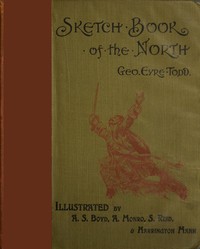
George Eyre-Todd’s Sketch-Book of the North (1903) is a collection of thirty short pieces that blend travel writing, local history, and pastoral observation. Despite its catalog subjects—Scotland’s description and travel, and its history—the excerpts show a work that often subordinates historical narrative to sensory, scene-based description. The opening sketch, “A Roman Road,” begins not with the road itself but with a painterly view of “moor and woodland and meadow” under “mild radiance of early spring,” only later noting that “history marks with a crimson stain the field of many a battle.” This tension between landscape and historical incident runs through the book.
Landscape Before Narrative
The excerpts consistently prioritize setting over story. In “A Roman Road,” the Roman road is almost incidental to the panoramic description of the Border landscape. Similarly, “From a Field-Gate” devotes most of its length to the sensations of a midsummer afternoon—the “sweet breath of the clove-pinks,” the “faint gurgle of the river,” the “blue butterfly lazily opens and shuts its wings”—before any historical or folkloric content appears. The narrator’s pocket copy of “gentle Allan Ramsay” is the only explicit literary reference. This pattern suggests that Eyre-Todd’s method is to immerse the reader in a place’s atmosphere before introducing its associations.
Illustrations as Narrative Partners
The book includes four illustrators—A. S. Boyd, A. Monro, S. Reid, and Harrington Mann—whose work is listed in a separate illustration index. The excerpts do not include the images, but the captions hint at their dramatic content: “Signal of Death,” “The Death of Keppoch,” “Massacre of Glencoe,” “Murray’s Curse.” These titles suggest that the illustrations often depict the violent historical episodes that the text itself may treat more obliquely. For example, the text of “A Roman Road” mentions battles only as a “crimson stain,” while the illustration list includes no image for that sketch. The visual and verbal narratives may thus complement or contrast with each other.
Recurring Sensory Motifs
Certain sensory details recur across the excerpts. Light is frequently described as “soft,” “mild,” or “dazzling”; sounds are “faint” or “murmur”; scents of clover, sweetbrier, and clove-pinks are noted. The narrator often positions himself at a threshold—a field-gate, a ruined tower, the edge of a wood—from which he observes both near and far. This framing device creates a consistent observational stance. The excerpts also share a tendency to personify nature: a river “gleams like a shining serpent,” the sky “sheds peace upon the heart.” These motifs unify the collection despite its varied subjects.
Readers approaching Sketch-Book of the North should expect a work that is more descriptive than narrative, more atmospheric than event-driven. The sketches reward attention to their sensory detail and to the interplay between text and the absent illustrations. The catalog subjects of travel and history are present, but they are filtered through a lyrical, scene-based sensibility that often leaves historical events in the background.
That rainy Glaswegian afternoon, Eyre-Todd’s sketches blurred weather and folklore until I couldn’t tell the mist from the legend. Then, almost by chance, my hand fell on The Personality of American Cities — Themes and Context, and I felt the same quiet trick—streets turning into voices, strangers into neighbours, only with a different rain.
Lucas Jones
1 week agoGrayson Thompson
1 month agoNoah Allen
3 weeks agoGrayson Rodriguez
3 weeks ago-
Cheryl Nelson - 1 month ago
While the concept is promising, the execution leaves much to be desired. The sketches feel rushed and lack detail, and the text is disjointed. It reads more like a personal diary than a polished publication. If you're seeking insightful commentary or refined art, this book may disappoint. It might appeal to die-hard fans of the region, but others should look elsewhere. -
Richard Gabrielle Garcia - 2 weeks ago
This sketchbook is a beautiful tribute to the North's rugged landscapes and resilient communities. The sketches are evocative, capturing the interplay of light and shadow on mountains and fjords with surprising depth. As a lover of Nordic culture, I found the accompanying notes both informative and poetic. It's a perfect addition to any collection that celebrates the raw beauty of the northern regions. -
Tyler Stewart - 2 weeks ago
The sketches are charming and offer a unique glimpse into the northern scenery, but the lack of color makes some pieces feel a bit flat. The accompanying text is engaging, though occasionally too sparse for my taste. Still, it's a worthwhile purchase for those interested in artistic impressions of the North.
What was your reading experience?
Capture what you thought, learned, and would like to remember.
Joseph Rivera
1 week ago