About 91 minutes
In Tamal Land — A Reader’s Guide
Geography
20,878 recorded words. 7 minutes difference from this book's estimate.
View Gutenberg source #56061
For Oxford — Context and Discussion, the stored edition analysis reports 22,354 words, 1 hr 38 min estimated reading time, and 4 detected text sections.
The text analysis averages about 21.7 words per sentence, while the detected sections provide another way to judge how the source is divided.
Project Gutenberg metadata also associates the work with “Oxford (England) -- Description and travel,” connecting these edition facts with the source record’s subject description.
Explore this collection
These alternatives are selected using recorded categories and estimated reading time.
About 91 minutes
Geography
20,878 recorded words. 7 minutes difference from this book's estimate.
View Gutenberg source #56061About 116 minutes
Geography
26,677 recorded words. 18 minutes difference from this book's estimate.
View Gutenberg source #48156About 124 minutes
Geography
28,328 recorded words. 26 minutes difference from this book's estimate.
View Gutenberg source #47213Search stored excerpts and compare books → Choose by your preferences →
Choices use stored catalog measurements. Estimates vary with reading speed. A shared category is a catalog label, not a claim that two books have the same argument or literary quality.
Search reads excerpt text stored with this catalog and links to its associated Gutenberg record. The connection is stored in the site database; this tool does not recheck that every excerpt is word-for-word identical to that external record. Excerpt search does not cover every chapter and does not verify historical publication dates.
Catalog snapshot checked: 2026-09-25. Coverage: 96 public books, 96 available source excerpts.
Calculated from edition completeness, EPUB availability, text structure and catalogue metadata. Not a user rating.
Total of 100 points, scaled to a 2.5-5.0 range. Editions with an empty description or a missing EPUB file are not scored.
Public-domain source text
The source text is kept in the dedicated reader, separate from this catalogue record and its commentary.
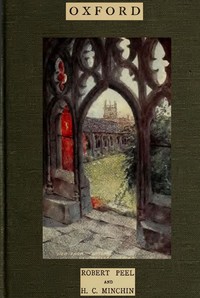
This volume, published in 1906, explicitly states it is not a formal guidebook but a showcase of Oxford's chief beauties through colour illustrations. The authors, Robert Peel and H. C. Minchin, provide a running commentary that explains the pictures and highlights points of interest. The work draws on earlier histories by Alexander Chalmers, Andrew Lang, and J. Wells, but the text remains secondary to the visual record. Most illustrations are by living artists of the time, notably W. Matthison, with only six reproduced from Ackermann's earlier work. The result is a hybrid: part art book, part architectural sketch, part institutional chronicle.
The preface makes clear that this book does not aim to compete with existing guides. Instead, it selects scenes that have appeared to several artists and offers notes that are slight but, the authors believe, accurate. This framing shapes the entire work: the reader is not given a systematic tour but a curated sequence of views. The text often lingers on visual details—the spire of Exeter Chapel seen from Turl Street, the cedar roof of Lincoln College Chapel—while the historical notes remain concise. The authors trust the illustrations to carry much of the descriptive burden.
The entry on New College reveals a pattern: the authors trace a founder's original intentions, then note how those intentions were later modified. William of Wykeham's motto, 'Manners Makyth Man,' is cited, and the text explains that his plan for an exclusive connection with Winchester College eventually became a disadvantage. In 1857 half the fellowships were opened to public competition. The authors remark that Wykeham, 'shrewd and liberal-minded,' would likely approve. Similarly, a privilege that allowed Wykehamists to evade university examinations—originally meant to impose a stricter test—was voluntarily surrendered in 1834. These observations show the authors' interest in institutional evolution.
The account of Lincoln College is notably specific about its founding purpose: Bishop John Flemmyng, once a Lollard sympathiser, changed his opinions and founded the college to train divines to confute Lollard doctrines. The text then moves to architectural details—the entrance tower from the founder's time, the battlements called a 'modern addition, and anything but an improvement,' the cedar roof and painted windows of the chapel. The windows, bought in Italy according to tradition, depict six gospel events paired with Old Testament types. This blend of doctrinal motive, architectural judgment, and anecdotal provenance typifies the book's method.
Readers should approach this book as a period piece: a record of what early 20th-century artists and writers found most worth preserving in Oxford's built environment. The text assumes familiarity with the university's basic layout and history, so newcomers may wish to supplement it with a modern guide. The illustrations, however, offer a unique visual record of college interiors and street views as they appeared over a century ago, before later alterations.
The rain blurred the quad into watercolour, and I kept returning to how those painted spires felt more permanent than the city I walked through. That lingering sense of place—rooted yet shifting—followed me home. Later, flipping through The Americans as they are — Background and Themes, I found the same quiet ache for belonging, though the rivers ran differently there.
A brief reflection can help important ideas stay with you longer.