About 516 minutes
The Heart of the Alleghanies; or, Western North Carolina — Reading Notes
Geography
118,616 recorded words. 19 minutes difference from this book's estimate.
View Gutenberg source #50952
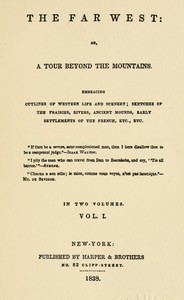
Before opening Flagg's The Far West, 1836-1837, part 1 — Context and Discussion, the edition data offers a quick orientation: 122,848 words, 8 hr 55 min estimated reading time, and 17 detected text sections.
The text analysis averages about 27.8 words per sentence, while the detected sections provide another way to judge how the source is divided.
Project Gutenberg metadata also associates the work with “Illinois -- Description and travel,” connecting these edition facts with the source record’s subject description.
Explore this collection
These alternatives are selected using recorded categories and estimated reading time.
About 516 minutes
Geography
118,616 recorded words. 19 minutes difference from this book's estimate.
View Gutenberg source #50952About 562 minutes
Geography
129,124 recorded words. 27 minutes difference from this book's estimate.
View Gutenberg source #46418About 493 minutes
Geography
113,355 recorded words. 42 minutes difference from this book's estimate.
View Gutenberg source #40884Search stored excerpts and compare books → Choose by your preferences →
Choices use stored catalog measurements. Estimates vary with reading speed. A shared category is a catalog label, not a claim that two books have the same argument or literary quality.
Search reads excerpt text stored with this catalog and links to its associated Gutenberg record. The connection is stored in the site database; this tool does not recheck that every excerpt is word-for-word identical to that external record. Excerpt search does not cover every chapter and does not verify historical publication dates.
Catalog snapshot checked: 2026-09-25. Coverage: 96 public books, 96 available source excerpts.
Calculated from edition completeness, EPUB availability, text structure and catalogue metadata. Not a user rating.
Total of 100 points, scaled to a 2.5-5.0 range. Editions with an empty description or a missing EPUB file are not scored.
Public-domain source text
The source text is kept in the dedicated reader, separate from this catalogue record and its commentary.
Edmund Flagg, a recent Bowdoin graduate, wrote the letters collected in The Far West for the Louisville Journal during the summer and autumn of 1836. This volume reprints the first thirty-two chapters of his two-part work, covering travels through Illinois and Missouri. Flagg's narrative voice is self-consciously literary, frequently quoting Byron and invoking the "roving, tameless race of wights" who wander without definite object. Yet his eye for detail is sharp: he notes the depth of creek channels that run dry in summer but become impassable torrents in spring rains, and he records the precise complaints of a Virginia emigrant forced to farm without slave labor. The result is a travelogue that oscillates between Romantic reverie and concrete social observation.
Flagg opens one excerpt by noting that he traveled on the Fourth of July, a "political Sabbath" that had emptied the countryside of its inhabitants. He describes every farmhouse and log-cabin deserted, their tenants gathered in villages to celebrate. This observation is typical of Flagg's method: he uses a specific date and its social consequences to frame his own solitary journey. The contrast between communal festivity and individual movement recurs throughout the text. Flagg presents himself as a wanderer who feels a "heedless desecration" of the holiday, yet he continues riding through the quiet landscape. The passage reveals how Flagg's persona—part Yankee, part Bohemian—negotiates between participation in American civic life and the detached, observing stance of the traveler.
A recurring structural pattern in Flagg's descriptions is the contrast between dry and flooded creek beds. He writes that in summer these streams are "either completely free of water, or contain but a mere rivulet," leaving the traveler amazed at the depth and breadth of the channel. But during spring or autumnal rains, a "deep, turbid torrent rolls wildly onward," carrying tree trunks and bridge ruins. Flagg emphasizes the suddenness of the change: a stream that "would scarcely have wet the traveller's sole" becomes a dangerous obstacle. This pattern of seasonal transformation serves as a metaphor for the volatility of frontier life and the precariousness of travel. Flagg's precise observation of the landscape—the "precipitous banks loaded with enormous trees," the "tangled underbrush and gigantic vegetation"—grounds his Romantic flourishes in material reality.
Flagg's encounter with a Virginia emigrant farmer crystallizes a central tension in the text. The farmer, a "high-minded, haughty" man, bitterly complains about cultivating his own land in the absence of slave labor. Though he has made a "pretty place of it" with the help of a Dutchman, he vows to return to the "Ancient Dominion." Flagg, a New Englander, presents this scene without explicit judgment, but the contrast is clear: the Yankee traveler observes the Southerner's discontent with a system that forces him to work alongside hired labor. The passage also highlights the ethnic division of labor—the "Dutchman" (German) as hired hand—and the persistence of regional identities even in the supposedly leveling West. Flagg's own identity as a "Yankee" wanderer is implicitly set against the rooted, nostalgic Southerner.
Readers should attend to Flagg's habit of juxtaposing literary quotations with mundane details of travel—the price of a meal, the condition of a road, the complaints of a landlord. This tension between the Romantic and the practical is the book's central stylistic feature. The excerpts suggest that Flagg is less interested in a coherent argument about the West than in capturing the texture of a region in flux. Treat each chapter as a discrete letter, and note how Flagg's persona shifts between poet, journalist, and ethnographer.
That grey afternoon, Flagg’s The Far West kept me company, his Romantic eyes finding grandeur in muddy river towns. What lingered wasn’t the scenery, though, but his quiet patience with slow travel—the waiting at ferries, the long roads between thin settlements. It sent me wandering afterward to something similarly unhurried: The Great North Road, the Old Mail Road to Scotland: York to Edinburgh — A Closer Reading. Same sense of distance measured in days, not miles.
Save your reaction, strongest insight, and memorable passage.