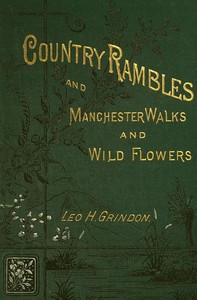
Country Rambles, and Manchester Walks and Wild Flowers Being Rural Wanderings in Cheshire, Lancashire, Derbyshire, and Yorkshire — Background and Themes

(0 User reviews)   41
In Category - Geography
Grindon, Leo H. (Leo Hartley), 1818-1904 Project Gutenberg 2014 Not confirmed
England -- Description and travel; Natural history -- England -- Manchester Readers of public-domain and historical texts
Project Gutenberg digital edition en

Edition facts

Words 81,724
Reading time 356 min
Text sections 11

For Country Rambles, and Manchester Walks and Wild Flowers Being Rural Wanderings in Cheshire, Lancashire, Derbyshire, and Yorkshire — Background and Themes, the stored edition analysis reports 81,724 words, 5 hr 56 min estimated reading time, and 11 detected text sections.

The text analysis averages about 23.0 words per sentence, while the detected sections provide another way to judge how the source is divided.

Project Gutenberg metadata also associates the work with “England -- Description and travel,” connecting these edition facts with the source record’s subject description.

Leo H. Grindon's 1882 collection of natural history essays blends botanical observation with local folklore, documenting the changing landscapes around Manchester through detailed accounts of rambles in Cheshire, Lancashire, Derbyshire, and Yorkshire.
Share
Editorial Edition Score 4.9/5

Calculated from edition completeness, EPUB availability, text structure and catalogue metadata. Not a user rating.

How this score is calculated
  • Description quality20 pts
  • Title & short description10 pts
  • Source metadata20 pts
  • Text length15 pts
  • Chapters / structure15 pts
  • EPUB file integrity20 pts

Total of 100 points, scaled to a 2.5-5.0 range. Editions with an empty description or a missing EPUB file are not scored.

Edition quality

Read the Text

THE ASHLEY MEADOWS AND THE LOWER BOLLIN VALLEY 13

ROSTHERNE MERE, TATTON, DELAMERE 31

CARRINGTON MOSS, DUNHAM, LYMM 47

GATLEY CARRS, WYTHENSHAWE 68

NORCLIFFE, ALDERLEY EDGE 84

COMBERMERE, BEESTON CASTLE 93

THE REDDISH VALLEY, ARDEN HALL 100

PRESTBURY, POTT SHRIGLEY, GAWSWORTH, ALTON TOWERS 111

DISLEY, LYME PARK, TAXAL 121

MARPLE, CASTLETON, MILLER'S DALE 129

KINDER SCOUT, STALEY BRUSHES, SEAL BARK 139

BOGGART-HOLE CLOUGH, BAMFORD WOOD, HARDCASTLE CRAGS 151

MERE CLOUGH, THE AGECROFT VALLEY 175

THE OLD LANCASHIRE BOTANISTS 194

ROSSENDALE, WHALLEY ABBEY, CLITHEROE, PENDLE 213

RIVINGTON, ASHURST, LATHOM HOUSE 232

THE LOCAL ORNITHOLOGY 257

NATURAL HISTORY IN THE LIBRARY 291

SUMMARY OF RAILWAY STATIONS AND DISTANCES 303

FULL-PAGE ILLUSTRATIONS.

ROSTHERNE MERE. Drawn and Engraved by W. Morton, _Frontispiece_.

OLDFIELD, DUNHAM. Drawn and Etched by Thos. Letherbrow 64

BARLOW HALL. Drawn and Etched by Thos. Letherbrow 82

LYME HALL. Drawn and Etched by Thos. Letherbrow 124

HALEWOOD CHURCH. Drawn by W. Hull, Etched by Thos. Letherbrow 168

HALE HUT. Drawn and Etched by Thos. Letherbrow 254

The meanest floweret of the vale, The simplest note that swells the gale, The common sun, the air, the skies, To him are opening Paradise.

Wide as may be the circle covered by a great town, we come to the country at last. Let the bricks and mortar stride far as they will over the greensward, there are always sanctuaries beyond--sweet spots where we may yet listen to the singing of the birds, and pluck the early primrose and anemone. We need but take our survey from a sufficiently high point, to see that the vastest mass of houses ever heaped together by man is still only an encampment in the fields. Like the waves of the sea upon the shores of the islands, the surge of the yellow corn is still close upon our borders. We need but turn our faces fondly towards rural things and rural sights, and we shall find them.

Manchester itself, grim, flat, smoky Manchester, with its gigantic suburb ever on the roll further into the plain, and scouts from its great army of masons posted on every spot available for hostile purposes,--Manchester itself denies to no one of its five hundred thousand, who is blessed with health and strength, the amenities and genial influences of the country. True, we have no grand scenery; no Clyde, no Ben Lomond, no Leigh Woods, no St. Vincent's Rocks, no Clevedon, no Durdham Down; our rivers are anything but limpid; our mountains are far away, upon the horizon; our lakes owe less to nature than to art; as for waterfalls, we have none but in our portfolios. Still is our town bosomed in beauty. Though the magnificent and the romantic be wanting, we have meadows trimmed with wild-flowers, the scent of the new-mown hay and the purple clover; we have many a sweet sylvan walk where we may hear

The burnie wimplin' doon the glen,

Leo H. Grindon's Country Rambles, and Manchester Walks and Wild Flowers (1882) is a composite work, reprinting his 1858 Manchester Walks and Wild–Flowers alongside excerpts from Field Naturalists' Society reports (1860–1881) and new material. The preface frames the book as a record of 'local conditions now effaced,' noting that suburbs once 'familiar as delightful rural solitudes' had been covered with houses. This tension between observation and loss pervades the text.

The catalog subjects—'England—Description and travel' and 'Natural history—England—Manchester'—are accurate but incomplete. The excerpts reveal a work equally concerned with folklore, industrial change, and the ethics of progress. Grindon's voice is that of a naturalist who is also a local historian, weaving botanical detail with legends such as the Boggart of Boggart–hole Clough.

Botany and the Built Environment

Grindon's botanical observations are inseparable from the urban encroachment he documents. In the preface, he recalls that fields near St. George's Church, once rich in flora, had been lost to development by 1840. His descriptions of plants are precise, but they often serve as markers of vanished landscapes. The stream through Boggart–hole Clough is a tributary of the Irk, a river that 'seems to grow ashamed of its blackened waters' as it enters Manchester. Grindon does not merely catalog species; he traces how industrial growth alters habitats.

Yet he resists simple nostalgia. In a striking passage, he argues that 'the truly poetical man is never a sentimentalist' and accepts the conversion of 'beautiful objects' into 'sources of general welfare.' This pragmatic strain complicates the catalog subject of natural history, suggesting that Grindon's botany is always also a social and economic commentary.

Folklore as Natural History

The excerpts devote considerable space to local legends, particularly the Boggart of Boggart–hole Clough. Grindon reviews multiple explanations: a supernatural 'brownie,' a corruption of the family name 'Bowker,' or a cover story for a Jacobite fugitive. He treats these with scholarly detachment, citing Harland and Wilkinson's Lancashire Folk–lore and the Traditions of Lancashire. This digression might seem tangential to natural history, but Grindon frames it as part of 'that beautiful old tendency of the universal human heart to assign spiritual beings to every part of physical nature.'

For him, folklore is another layer of the landscape, as worthy of record as flora. The catalog subjects do not capture this dimension; the work is as much about human imagination as about wildflowers. Grindon's willingness to entertain multiple versions of the legend—without settling on one—reflects his broader method of accumulating observations rather than asserting definitive truths.

Structure and the Rambler's Gaze

The book's structure mirrors its title: a series of discrete rambles, each focused on a specific location. The excerpts show Grindon moving from botanical catalog to historical anecdote to personal reflection within a single paragraph. For instance, the description of Boggart–hole Clough shifts from the path from Manchester to the scent of new–cut hay, then to the Irk's industrial fate, and finally to a defense of utilitarian rivers. This associative style resists easy categorization as either travelogue or field guide.

The preface reveals that the work is a 'reprint' with 'new matter,' suggesting a layered composition. The original 1858 volume aimed to foster 'the present widespread local taste for rural scenes'; the 1882 edition adds a retrospective dimension. Readers encounter not just a naturalist's notes but a record of how those notes were themselves part of a cultural shift. The catalog subjects label this 'Geography,' but the excerpts show a work that is also a memoir of a changing region.

Grindon's Country Rambles rewards readers who approach it as a layered document rather than a straightforward guide. The botanical details are precise, but they are embedded in a broader inquiry into how landscapes are remembered, altered, and reimagined. The folklore sections, in particular, remind us that natural history in the nineteenth century could encompass the supernatural as readily as the Linnaean. Readers interested in the interplay between industrial expansion and local knowledge will find this a rich, if digressive, source.

Rain fell against my window that afternoon, and I drifted through Grindon’s descriptions of Cheshire lanes, his quiet notice of moss and folklore. Something about his unhurried attention made me restless for another city’s voice. I reached for a different shelf and found Paris and the Parisians in 1835 (Vol. 2) — Edition Insights, its pages full of boulevards where even the gutters seemed to tell stories. Two wanderers, two worlds, one grey afternoon.

There are no reviews for this eBook.

0
0 out of 5 (0 User reviews )

Add a Review

Your Rating *
There are no comments for this eBook.

Reader reflection

Before you leave, reflect on the book

Use these questions to collect your thoughts before moving on.

Your progress 0 / 10
1

Have you finished this book?

2

Did this book hold your interest?

3

Is this a title you would suggest to others?

4

Did the language feel accessible?

Related eBooks