1

Oxford — Context and Discussion
(0 User reviews)
2211
Project Gutenberg
2014
Not confirmed
Oxford (England) -- Description and travel; University of Oxford
Readers of public-domain and historical texts
Project Gutenberg digital edition
en
Edition facts
Words
22,354
Reading time
98 min
Text sections
4
For Oxford — Context and Discussion, the stored edition analysis reports 22,354 words, 1 hr 38 min estimated reading time, and 4 detected text sections.
The text analysis averages about 21.7 words per sentence, while the detected sections provide another way to judge how the source is divided.
Project Gutenberg metadata also associates the work with “Oxford (England) -- Description and travel,” connecting these edition facts with the source record’s subject description.
Source:
Project Gutenberg record #45290
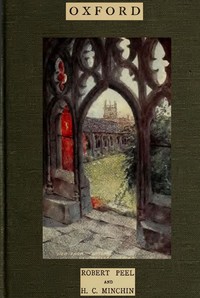
This illustrated volume pairs early 20th-century paintings with concise historical notes on Oxford's colleges and city, focusing on architectural beauty and institutional origins rather than serving as a comprehensive guidebook.
Editorial Edition Score
4.6/5
★★★★★
★★★★★
Calculated from edition completeness, EPUB availability, text structure and catalogue metadata. Not a user rating.
How this score is calculated
- Description quality20 pts
- Title & short description10 pts
- Source metadata20 pts
- Text length15 pts
- Chapters / structure15 pts
- EPUB file integrity20 pts
Total of 100 points, scaled to a 2.5-5.0 range. Editions with an empty description or a missing EPUB file are not scored.
Edition quality
Read the Text
Proctor had already been instituted, and that functionary had plenty of students to employ his time--30,000 one writer assures us, but him we cannot credit. A fourth of that number is a liberal estimate. They lived in Halls and lodgings, a hard and an undisciplined life, preyed upon by the townsfolk and biting their thumbs at them in return (whence collisions frequently ensued) until Walter de Merton devised the College system, to the no small advantage of all concerned.
Benefactions poured in upon the several Colleges, but the greater institution was not forgotten. In the Divinity School, within whose walls Latimer and Ridley defended their opinions, and Charles II.'s Parliament debated, the University possesses, as is fit and proper, the most beautiful room in Oxford and one of the most beautiful in England. The style is Perpendicular and the ceiling is particularly admirable. Together with the fine room above it, in which Duke Humphrey's manuscripts were housed, the Divinity School was completed in 1480.
Those six hundred manuscripts of Humphrey, Duke of Gloucester, which he bestowed on the University, had a sad history. They were dispersed by Edward vi.'s Commissioners, who judged them to be popish in tendency, and only four of them were ever restored to their old home. Nevertheless, Duke Humphreys gift was the origin of the Bodleian Library. One does not like to think what the Library was like in the days which followed, when its manuscripts were scattered abroad and its shelves sold; but in the last years of the sixteenth century there arose a man who took pity upon its desolation. This was Sir Thomas Bodley, Fellow of Merton, a man of travel and affairs, who devoted the last years of his life to the creation of what is now one of the most famous libraries in existence. It has ever been the delight of scholars since the days of James I., who wished he might be chained to the Library, as some of the books were.
The original chamber did not long suffice to contain the volumes; an east and then a west wing were added, the latter over Archbishop Laud's Convocation House (1640) which superseded Cobham's Chapel. From these the books overflowed into various rooms in the Old Schools Quadrangle, which had been rebuilt in James I.'s reign. Further space was gained in 1860, when the Radcliffe, set free by the removal of its collection of scientific works to the New Museum, was lent to the Bodleian; and again in 1882, on the opening of the New Examination Schools (sketched by Mr. Matthison), when the Old Schools were rendered available for the uses of the Library.
The various public buildings belonging to the University erected during the nineteenth century, such as the Taylor Institution, the University Art Galleries, the New Museum, and the Indian Institute, can hardly escape attracting the attention of visitors to Oxford. It remains to say a word of two older structures, which appear side by side in Mr. Matthison's next drawing--the Clarendon Building and the Sheldonian Theatre.
The Clarendon Building was designed by Vanbrugh, and completed in 1713. It is named after the author of the _History of the Rebellion_, and was partially built out of the profits of the copyright of that work, which Clarendon's son presented to the University. It was the home of the University Press until 1830, and is now occupied by the offices of various University Boards.
The Sheldonian Theatre, designed by Sir Christopher Wren, is associated with less tranquil occupations. It is here that honorary degrees are conferred and the Encænia held; here the _Terrce Filius_, a licensed jester, used to hurl his witticisms at whomsoever he pleased; and here, in later times, the occupants of the Undergraduates' Gallery have endeavoured to keep up his tradition. Here, too, Convocation sometimes meets, when a burning question is to be discussed and Masters of Arts assemble in their hundreds. On such occasions the Sheldonian has been known to be as full of clamour as at the Encaenia. It is perhaps pleasanter to view Wren's stately building when it is void alike of undergraduate merriment and of graduate contention.
This volume, published in 1906, explicitly states it is not a formal guidebook but a showcase of Oxford's chief beauties through colour illustrations. The authors, Robert Peel and H. C. Minchin, provide a running commentary that explains the pictures and highlights points of interest. The work draws on earlier histories by Alexander Chalmers, Andrew Lang, and J. Wells, but the text remains secondary to the visual record. Most illustrations are by living artists of the time, notably W. Matthison, with only six reproduced from Ackermann's earlier work. The result is a hybrid: part art book, part architectural sketch, part institutional chronicle.
A Deliberately Selective Approach
The preface makes clear that this book does not aim to compete with existing guides. Instead, it selects scenes that have appeared to several artists and offers notes that are slight but, the authors believe, accurate. This framing shapes the entire work: the reader is not given a systematic tour but a curated sequence of views. The text often lingers on visual details—the spire of Exeter Chapel seen from Turl Street, the cedar roof of Lincoln College Chapel—while the historical notes remain concise. The authors trust the illustrations to carry much of the descriptive burden.
Founders, Privileges, and Reforms
The entry on New College reveals a pattern: the authors trace a founder's original intentions, then note how those intentions were later modified. William of Wykeham's motto, 'Manners Makyth Man,' is cited, and the text explains that his plan for an exclusive connection with Winchester College eventually became a disadvantage. In 1857 half the fellowships were opened to public competition. The authors remark that Wykeham, 'shrewd and liberal-minded,' would likely approve. Similarly, a privilege that allowed Wykehamists to evade university examinations—originally meant to impose a stricter test—was voluntarily surrendered in 1834. These observations show the authors' interest in institutional evolution.
Lincoln College: A Case Study in Origins
The account of Lincoln College is notably specific about its founding purpose: Bishop John Flemmyng, once a Lollard sympathiser, changed his opinions and founded the college to train divines to confute Lollard doctrines. The text then moves to architectural details—the entrance tower from the founder's time, the battlements called a 'modern addition, and anything but an improvement,' the cedar roof and painted windows of the chapel. The windows, bought in Italy according to tradition, depict six gospel events paired with Old Testament types. This blend of doctrinal motive, architectural judgment, and anecdotal provenance typifies the book's method.
Readers should approach this book as a period piece: a record of what early 20th-century artists and writers found most worth preserving in Oxford's built environment. The text assumes familiarity with the university's basic layout and history, so newcomers may wish to supplement it with a modern guide. The illustrations, however, offer a unique visual record of college interiors and street views as they appeared over a century ago, before later alterations.
The rain blurred the quad into watercolour, and I kept returning to how those painted spires felt more permanent than the city I walked through. That lingering sense of place—rooted yet shifting—followed me home. Later, flipping through The Americans as they are — Background and Themes, I found the same quiet ache for belonging, though the rivers ran differently there.
There are no reviews for this eBook.
There are no comments for this eBook.
Reader reflection
Record your reading impressions
A brief reflection can help important ideas stay with you longer.
Your progress
0
/
10
2
How much did you enjoy the reading experience?
3
How likely are you to recommend this book?
4
Did the language feel accessible?
5
Would you read this book again?
6
How would you describe its reading pace?
7
What did you appreciate most?
8
Did it raise ideas you would like to talk about?
9
In one sentence, what did you learn?
10