Canadian Scenery, Volume 1 (of 2) — Background and Themes

(9 User reviews)   2480
In Category - Geography
Willis, Nathaniel Parker, 1806-1867, Bartlett, W. H. (William Henry), 1809-1854 [Illustrator] Project Gutenberg 2014 Not confirmed
Canada -- Description and travel; Canada -- History Readers of public-domain and historical texts
Project Gutenberg digital edition en

Edition facts

Words 67,966
Reading time 296 min
Text sections 8

This digital edition of Canadian Scenery, Volume 1 (of 2) — Background and Themes is described by source-level measurements including 67,966 words, 4 hr 56 min estimated reading time, and 8 detected text sections.

The text analysis averages about 27.0 words per sentence, while the detected sections provide another way to judge how the source is divided.

Project Gutenberg metadata also associates the work with “Canada -- Description and travel,” connecting these edition facts with the source record’s subject description.

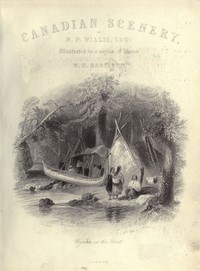
Willis's prose and Bartlett's engravings combine in this 1842 travelogue to depict Canadian landscapes, settlements, and history through precise diction and visual description, revealing 19th-century colonial perspectives.
Share
Editorial Edition Score 4.7/5

Calculated from edition completeness, EPUB availability, text structure and catalogue metadata. Not a user rating.

How this score is calculated
  • Description quality20 pts
  • Title & short description10 pts
  • Source metadata20 pts
  • Text length15 pts
  • Chapters / structure15 pts
  • EPUB file integrity20 pts

Total of 100 points, scaled to a 2.5-5.0 range. Editions with an empty description or a missing EPUB file are not scored.

Edition quality

Read the Text

territory of Upper Canada. But they were at the same time more effeminate and voluptuous, and had less of the proud independence of savage life, having chiefs hereditary in the female line, to whom they paid considerable deference.

The Iroquois, destined to act the most conspicuous part among all the native tribes, occupied a long range of territory on the southern border of the St. Lawrence, from Lake Champlain to the western extremity of Lake Ontario. They were thus beyond the limits of what is now considered Canada; yet, as all their transactions were completely connected with the interests of that country, we cannot at present avoid considering them as belonging to it.

This people were divided into five cantons, each of which was considered as an independant nation. They were united, however, by the closest alliance; are never found waging war with each other, nor did they often fail to combine their forces when attacked by neighbouring tribes. The following are the names given to them by English and French authors.

Mohawks. Aguiers. Oneidas. Onneyouths. Onondagoes. Onontagues. Cayugas. Anniegué. Senekas. Tsonnouthouans.

We add to these general remarks on the habits and character of the natives of North America, a few anecdotes which were collected by a distinguished soldier in Canada, and which we copy literally from his MS. The first is a legend of the Falls of Shawenagam, river St. Maurice.

Shortly after the Hurons established themselves in the part of the Lower Province to the N. E. of the St. Maurice, that rapid river was fixed as the boundary between this nation and the Algonquins. In one of the many fierce rencontres that took place between these two warlike tribes, the following circumstance occurred, too descriptive of the Indian character to pass unnoticed. A party of Hurons had been hunting on the shores of the St. Maurice, and were returning in loaded canoes down the stream, when, on approaching the head of these falls, they suddenly heard a signal, and on looking up descried a large party of Algonquins half hidden among the thick foliage in the tops of trees. The Hurons had advanced too far to recede; to pull back against the stream was totally impossible, and to land at the head of the falls was only throwing themselves into the hands of the host of enemies waiting to bear their scalps in triumph to their nation. The mind, like the eye, of an Indian is quick and determined. The chieftain in the leading canoe cast one hurried glance on his enemies, and setting up a yell of defiance, steered his frail bark to the edge of the foaming precipice: in this resolute action he was followed by his people, and the whole party were hurried down the dreadful abyss mingled in one mass of wreck and destruction. Scarcely a vestige of these brave men was washed ashore to gratify the vengeance of the disappointed Algonquins.

_Tête-de-Bules._—The Indians frequenting the Fur Post of Wemontashingur in the St. Maurice, latitude 47° 55' 58" N. are not numerous, and generally speaking are a very inoffensive people, although some actions of a horrid nature, committed by individuals of the tribe, have come to our knowledge. They are ignorant and superstitious, influenced in all their actions by dreams, which they imagine are sent to them for a good purpose by the Great Spirit: under this cloak they oftentimes commit great barbarities. They are likewise much addicted to ardent spirits.

That cannibalism is occasionally practised to a great extent among the aborigines inhabiting these dreary regions, the many accounts which have reached our ears would lead us to believe; but as these things are generally exaggerated, we know not what degree of credence they deserve. Among the anecdotes of this nature related to us, are the following, which, if true, show to what a degraded state of mind these miserable people are reduced. An Indian _Montagnier_, whose name is Mocontagan, or Crooked Knife, in a drunken fit confessed having in the course of his life killed and eaten several Indians and Metifs, or half-breeds. When sober, he attempted to deny it; but upon being closely pressed he acknowledged the fact, but said starvation drove him to kill and eat the first man, and that he slew and ate the others from a decided preference of that to any other kind of flesh; and finished his statement by declaring that he would kill any Metif, and eat him, that he should meet alone. He is much feared by the other Indians, who are inclined to believe him to be an evil spirit. He is described as a powerful man, six feet high, and strong built, and possessing what is termed “a bad countenance.” Upon one occasion, about six years since, at Wemontashingur, the Algonquins took courage and rose upon him: he fled for protection to Mr. Hyslop, the resident clerk of the Post, who with Mr. Le Blanc, now at Rat River, advised him to leave the place, as they could not be answerable for his life. This man is still living, much dreaded by the Indians frequenting the St. Maurice.

Another instance was related to us by Mr. Vassal, belonging to the King’s Post company. One day, during the winter, as he was travelling among the mountains, he saw an Indian stretched on the snow. Vassal approached him, and demanded what was the matter. The Indian replied he was sick, doubtless imagining Vassal would be alarmed by the thoughts of fever, and quit the place without entering the cabin: but Vassal, anxious to collect furs, attempted to go in, the Indian pulled him back by the leg; Vassal made another attempt, and succeeded in entering. A fire was burning, and a large kettle was on it, which, to his horror, he found contained a portion of a very young child. The savage acknowledged that it was his grandson, and that hunger had driven him to eat it. This, Vassal says, could not be possible, as there were remains of musk-rats about the place.

With respect to “bad dreams,” there is a Tête-de-Bule belonging to Wemontashingur at present labouring under the delusion. He imagines he shall fail in every undertaking until he has slain some person; and once he actually fired at his brother, but fortunately missed him. He is much feared by the tribe, as they imagine him possessed of an evil spirit, which will not depart until he has spilt blood.

The Indians navigating the St. Maurice have a notion that in a large cavern at the back of the Upper Caribonif Mountain, are a species of wood demons, and that when encamped near the place, they can distinctly hear the screams of children, but where the children come from in these desolate and unpeopled regions, our informant could not tell. The place is certainly very gloomy, but it being our encamping time, we made ourselves comfortable for the night in spite of the wood demons. Before morning, we ascertained the screams of the children to be the hooting and screeching of the owls and night hawks, so numerous in this part of the country.

In one of the deep bays of Lake Kempt, we saw three Indian graves, built in the usual long narrow shape adopted by the Indians, and well defended from wild beasts by an outer covering of split wood, bound together with branches. Within this outer mausoleum was one made of birch bark, and under this rested the body, covered over with the fine white sand forming the shores of the Lake. Opposite one of the graves was a cross. From the information we received, it appears that one of these graves belonged to Menesino’s mother, the second contained the body of his wife, and the third that of his infant child.

We were assured that the mother met with her death from the hands of her daughter, in a quarrel which took place a few years since in one of the sandy bays of Lake Malawin. The wife was slain by Menesino in a fit of jealousy, by striking his axe between her shoulders while she was in the act of stooping. How the infant came to its end, we did not hear. This man Menesino also slew another wife, and shot a Canadian who went to take him. For these murders, and others of which he was accused, Menesino was once taken and conveyed handcuffed to within a short distance of Three-Rivers. His guards being excessively fatigued, fell asleep, which Menesino took advantage of, and plunged into the river. In spite of his handcuffs he succeeded in gaining the opposite shore, whence crossing many large lakes,—God knows how,—and travelling a vast extent of forest covered with thick underwood, he regained his own country, and has never since been taken. Indeed, he is such a powerful man, and in the prime of life, that few would like to make the attempt, although we have since heard that a party are in pursuit of him. He is said to possess unbounded influence, occasioned by fear, over the male part of his tribe; but the female part, as may easily be supposed, have a great repugnance to living with him.

M. Le Blanc, when at Wemontashingur, was compelled to stand all night over an Indian woman whom Menesino wanted to carry off with him into the woods. He is described as a good looking man, and, what is unusual among the Indians, not at all addicted to ardent spirits. From all we heard, it would appear that he is constantly on his guard, fearful of some stratagem; living entirely alone, the sole inhabitant of these dreary waters.

On arriving at the point of the graves in Lake Nemeashingur, we landed to examine them. They were three in number, and similar in construction to those we had seen on Lake Kempt, except that they were more ornamented according to the pagan rites of Indians. Near the principal grave was a pile of wood, a paddle, snow shoes, and a snow shovel, for the use of the departed during his journey to the hunting grounds in the next world. In addition to these articles, on one of the mausoleums was a sword, the emblem of a chieftain. At the foot of this grave was a rude wooden cross. We had an opportunity of becoming acquainted with the history of the parties who were buried here, of which the following is a slight sketch:—

Near the graves are the remains of a log-hut, which had been erected as a temporary receiving place for furs, until a sufficient quantity had been collected to send into the Post at Wemontashingur. This hut was in charge of a man named Tefu, a Bois-Brulé, who was married to a woman belonging to the tribe inhabiting the lake of the two mountains. One day in the year 1816, while Tefu was absent, a brother of Menesino named Kenecabannishcum, accompanied by his wife and mother, went to the hut and demanded of Tefu’s wife some provisions, which she refused. He insisted upon having some, a scuffle ensued, and the villain shot the woman dead upon the spot. They then departed, taking with them a young boy who was living with Tefu. The mother observed, that if the boy met any of the half-breeds who were in the habit of going round to collect furs, he would certainly tell them, in French, of the murder. Kenecabannishcum replied, he would soon settle that, and steered his canoe to the rocky point of an island directly opposite. On his arrival at the point, the ruffian seized the child by his legs, and dashed his brains out against the rock. The murderer’s mother returned to the hut and buried the body of the unfortunate infant. This is the woman who afterwards met her death on Lake Malawin from the hands of her daughter-in-law, and lies buried on Lake Kempt. Some time after the murders had been committed, a quarrel ensued between Kenecabannishcum and his wife and mother; in consequence of this, the two women repaired to the cabin of the wife’s father, a chieftain named Meshenawash, and acquainted him with the crimes of her husband: when this reached the murderer’s ears he vowed vengeance against the old chieftain, who consequently was compelled to secrete himself until the day of his death, which took place a short time after, for he was no match for such a powerful man as his son-in-law. The grave with the sword upon it was this chieftain’s.

In the year 1824, this man came to his end in the following manner. An Algonquin, named Michel, was married to a very handsome woman, whom Kenecabannishcum endeavoured more than once to carry off by force. In the scuffles which ensued, Michel, who was not possessed with the strength of his opponent, was glad to make his escape, and in one instance, he was obliged to swim across a rapid stream, and dive repeatedly to avoid being shot. In the last encounter, which took place in the year above mentioned, each man was armed with an axe, when a fierce conflict ensued. Michel by a lucky blow struck off the nose of his adversary, and the next stroke took off his ear. These wounds so bewildered Kenecabannishcum, that he lost all presence of mind, and before he could recover, Michel struck his axe so deep into his enemy’s skull, that he was under the necessity of placing his foot on the neck of the fallen man to withdraw it. Thus fell this noted character: his body was buried by his brother Menesino on the point near the log-hut, close by his father-in-law and the infant whom he had murdered eight years before in cold blood. The body of Tefu’s wife was never found. Michel was obliged to fly that part of the country, fearful of the vengeance of Menesino, and is now resident at the post on Lac des Sables.

[1] We have to acknowledge our obligations for most valuable information in the following pages, first, to our distinguished friend Col. Cockburn, of the Royal Artillery, long resident in Canada; next, to Hugh Murray, Esq., F.R.S.E. for extracts from his most admirable work on that country; to the Author of “Backwoods of America,” and to many writers, both old and modern, including Charlevoix, Adair, Colden, La Potherie, Rogers, Champlain, Heriot, M^{c}Gregor, Raynal, Talbot, Hall, and others. From the inconvenience of making these acknowledgments in every instance, we return our thanks simply in this note, and embody the information simply as it comes, without further mark or comment.

THE DISCOVERY AND SETTLEMENT OF CANADA.

Having given, from the best authority, the condition and characteristics of the aboriginal tribes of America, we go on briefly to enumerate the prominent events in the first stage of discovery and civilization. Those who read the curious picture we have been enabled to present, in the foregoing pages, of a nation almost, we may say, recently sprung to light, and who now look into the singular events of the first civilized history of the land they possessed, will have materials for a comparison between these and the lovely pictures on the other pages of the work, such as, for force of contrast and interest, is not often presented.

The Italian adventurers, John, and his sons Sebastian, Louis, and Sanchez Cabot, who received a commission on the 5th of March, 1495, from Henry VII. of England, to discover what Columbus was in search of, a north-west passage to the East Indies or China, (or, as the latter named country was then called, _Cathay_,) claim the honour of having been the first discoverers of Canada. The adventurers sailed in 1497 with six ships, and early in June of the same year, discovered Newfoundland; whence continuing a westerly course, they reached the continent of North America, which the Cabots coasted (after exploring the gulf of St. Lawrence) as far north as 67° 50' N. lat. They returned to England in August, 1497, but although Sebastian subsequently performed three voyages to the New World, no settlement was effected on its shores.

In 1500, Gaspar Cortereal, a Portuguese gentleman, visited the coast, and pursued the track of Sir John Cabot (who was knighted by our sovereign); but Cortereal and his brothers accomplished nothing further than the kidnapping of several of the natives, whom they employed and sold as slaves. In 1502 Hugh Elliot and Thomas Ashurst, merchants of Bristol, with two other gentlemen, obtained a patent from Henry VIII. to establish colonies in the countries lately discovered by Cabot: but the result of the permission granted is not known. In 1527 an expedition was fitted out by Henry VIII. by the advice of Robert Thorne, a merchant of Bristol, for the purpose of discovering a north-west passage to the East Indies; one of the ships attempting which was lost.

Francis I. of France, piqued at the discoveries of Spain and Portugal, and having his ambition roused by the monopolizing pretensions of these two powers to the possessions in the New World, authorized the fitting out of an expedition, the command of which he gave to Verrazzano, a Florentine, who on his second voyage discovered Florida, and thence sailing back along the American coast to the 50° of lat. took formal possession of it for his royal master, and called it _La Nouvelle France_. On Verrazzano’s return to Europe in 1525, without gold or silver or valuable merchandize, he was at first coldly received, but, it is said, subsequently sent out with more particular instructions and directions to open a communication with the natives; in endeavouring to fulfil which, he lost his life in a fray with the Indians. This, however, is denied; and it is asserted that the capture of Francis I. at the battle of Pavia in 1525, prevented him from further exploring the coast, and that he returned to his native country and died in obscurity.

When the government ceased to follow up the result of Verrazzano’s formal acquisition of Canada, the Frenchmen of St. Maloes commenced a successful fishery at Newfoundland, which so early as 1517 had fifty ships, belonging to the English, Spanish, French, and Portuguese, employed in the cod-fishery on its banks. _Jacques Cartier_, a native of St. Maloes, engaged in the Newfoundland fishery, took the lead in exploring at his own risk the northern coasts of the new hemisphere.

This bold and experienced navigator at last received a commission from his sovereign, Francis I., and left St. Maloes on the 20th of April, 1534, with two vessels of sixty tons each; arrived at Newfoundland on the 10th of May, remained there ten days, and then sailed to the northward, passing through the straits of Bellisle; changed his course somewhat to the southward, traversed the great gulf of St. Lawrence, (already known to Europeans,) and, in the month of July, arrived in the _Bay of Chaleurs_, which he so named on account of its heat. On the 24th of July, Cartier was at Gaspé, where he erected a cross, surmounted by a _fleur-de-lis_, and on the 25th of July sailed for France with two native Indians.

The enterprising character of his royal master induced him to despatch Cartier in the following year with three larger vessels, and a number of young gentlemen as volunteers. The ships rendezvoused at Newfoundland, and in August sailed up the St. Lawrence, so called from its being discovered on the 10th day of that month, being the festival of the saint of that name.

Cartier anchored off Quebec, then called Stadaconna, and the abode of an Indian chief called Donnaconna. After leaving his ships secure, he pursued his route in the pinnace and two boats, until, on the third of October, he reached an island in the river, with a lofty mountain, which he named _Mont Royal_, now called Montreal. After losing many of his followers by scurvy, during his wintering at Stadaconna, which he named St. Croix, Cartier returned to France in 1536, carrying off by force Donnaconna, two other chiefs, and eight natives. The French court, finding there was no gold and silver to be had, paid no further attention to _La Nouvelle France_, or Canada, until the year 1540, when Cartier, after much exertion, succeeded in getting a royal expedition fitted out under the command of François de la Roque, Seigneur de Roberval, who was commissioned by Francis I. as viceroy and lieutenant-general in Canada, Hochelaga, or Montreal.

Willis opens Canadian Scenery not with a landscape but with a philological puzzle: the origin of the name “Canada.” He weighs Hennepin’s claim that Spanish explorers called it Capo di Nada (“Cape Nothing”) against La Potherie’s variant, letting the reader choose. This scholarly gesture sets the tone for a work that mingles travel narrative, historical summary, and engraved illustration. Willis’s prose is deliberate and often formal, favoring balanced clauses and periodic sentences. He describes the Chaudière Falls, for instance, with measured awe, while Bartlett’s engravings freeze the scene in fine detail. The book’s structure—moving from discovery and settlement to contemporary impressions—reflects an authorial desire to frame Canada as both a storied colony and a vivid present reality.

Etymological Openings and Colonial Naming

Willis devotes his first pages to the contested etymology of “Canada,” citing Hennepin and La Potherie. He does not resolve the debate but presents it as a curiosity, inviting readers to “leave the choice of solutions to the reader.” This rhetorical move establishes Willis as a compiler of evidence rather than a dogmatic guide. The wordplay—Capo di Nada becoming “Canada”—highlights how European explorers imposed names that carried judgments of value. Willis’s own diction remains neutral, but the implication lingers: the land was deemed “nothing” before being rechristened. This opening gambit reveals his method: he layers historical anecdote, linguistic speculation, and descriptive travelogue without forcing a single narrative.

The Engraver’s Eye and the Writer’s Hand

Bartlett’s engravings are listed in detail, from “The Squaw’s Grave” to “Raft in a Squall on Lake St. Peter.” Willis’s text often mirrors the visual emphasis on topography and settlement. He describes the Chaudière Falls with attention to scale and motion, while the accompanying engraving captures the cascade’s vertical plunge. The collaboration is asymmetrical: Bartlett provides the “scenery,” Willis the “literary department.” Yet Willis’s prose does not merely caption the images; it supplies historical context, such as the Battle of the Plains of Abraham, and ethnographic notes on Indian villages. The result is a hybrid work where word and image vie for authority, each claiming to represent Canada authentically.

Political History as Narrative of Discontent

Willis devotes substantial space to the political conflicts of Upper and Lower Canada, tracing disputes between governors and assemblies. He recounts the impeachment of judges, the Duke of Richmond’s “innovation” of lump-sum estimates, and the Assembly’s refusal to grant permanent supplies. His tone is even-handed, but he notes that the Duke’s “extreme monarchical ideas” ill-fitted him for the “new crisis.” Willis selects details that dramatize constitutional friction: the governor drawing on the treasurer without approval, the Assembly specifying “every item.” These passages read less as dry chronicle than as a narrative of clashing principles—executive prerogative versus popular control—that Willis presents without overt partisanship.

Diction of Distance and Detail

Willis’s vocabulary oscillates between the elevated and the precise. He calls the St. Lawrence a “magnificent link in the colonial chain,” a metaphor that casts geography as imperial infrastructure. Elsewhere, he notes the “insolvency of the receiver-general, Sir John Caldwell,” a concrete fiscal detail that grounds abstract political struggles. His sentences often pile subordinate clauses, as when he describes the Duke of Richmond’s death by hydrophobia after a paragraph of legislative wrangling. This juxtaposition of the mundane and the dramatic is a deliberate authorial choice: Willis treats Canadian scenery and Canadian politics as equally worthy of careful observation. The effect is a text that feels both encyclopedic and personal, shaped by a writer who trusts his reader to follow digressions.

Readers approaching Canadian Scenery should expect a work that shifts between modes—etymology, landscape description, military history, and political reportage. Willis does not provide a unified thesis; instead, he assembles evidence and lets the reader draw conclusions. Bartlett’s engravings offer a visual counterpart, but the text stands on its own as a document of mid-nineteenth-century travel writing. Pay attention to how Willis handles uncertainty: he often presents conflicting accounts without resolution. This restraint is a feature, not a flaw, of his method.

In Canadian Scenery, Willis’s words and Bartlett’s engravings hold a quiet conversation, each trusting the other to finish the landscape. It reminds me of the gentle companionship between place and prose in Highways and Byways in Cambridge and Ely — Reading Notes. Both are patient guides, content to let travellers linger in the margins of a page.

Scarlett Ramirez
3 weeks ago

Henry Roberts
1 week ago

Ella Hall
3 weeks ago

Charlotte Brown
3 weeks ago

Wyatt Jones
1 month ago

5
5 out of 5 (9 User reviews )

Add a Review

Your Rating *
  • ...
    Dennis Medina - 1 month ago
    Volume 1 of Canadian Scenery is a visual and literary feast. The detailed engravings bring the 19th-century Canadian landscape to life, from the majestic St. Lawrence River to the rugged shores of Nova Scotia. The accompanying text is both informative and poetic, capturing the spirit of an emerging nation. A perfect blend of art and history, this book is a must-have for lovers of Canadian heritage and vintage travel writing.

  • ...
    Taylor Simmons - 3 weeks ago
    Despite its historical value, Canadian Scenery Volume 1 is difficult to appreciate in digital format. The engravings lose their detail when scaled, and the text is dense and flowery, making it a chore to read. The author's colonial viewpoint also feels outdated and lacks critical perspective on the displacement of Indigenous peoples. Only recommended for serious historians with a tolerance for archaic prose.

  • ...
    Jo Bond - 2 weeks ago
    This volume offers beautiful engravings and a quaint glimpse into 19th-century Canada. The text is informative but occasionally verbose, and some descriptions feel repetitive. Still, it's a charming piece of historical documentation, especially for those interested in early Canadian landscapes and settlement. Could benefit from more contextual annotations for modern readers.


Reader reflection

What was your reading experience?

Capture what you thought, learned, and would like to remember.

Your progress 0 / 10
1

How far have you progressed with this book?

2

What was your overall reaction to the book?

3

Would you encourage someone else to read it?

4

How demanding did the text feel?

Related eBooks