1

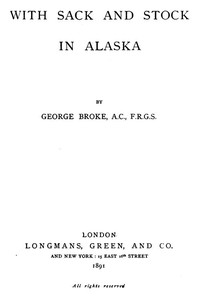
With Sack and Stock in Alaska — Background and Themes
37
14
Project Gutenberg
2017
Alaska -- Description and travel; Mountaineering -- Alaska; Saint Elias, Mount (Alaska and Yukon)
Readers of public-domain and historical texts
Project Gutenberg digital edition
en
Edition facts
Words: 42,863
Reading time: 187 min
Text sections: 5
Source:
Project Gutenberg record #55980
George Broke's 1891 account of mountaineering in Alaska, based on his diary, details attempts on Mount St. Elias from Icy Bay and Yakutat, with precise observations of glaciers, crevasses, and the challenges of loose shale and rotten snow.
Editorial Edition Score
4.7/5
★★★★★
★★★★★
Calculated from edition completeness, EPUB availability, text structure and catalogue metadata. Not a user rating.
Edition quality
George Broke's With Sack and Stock in Alaska (1891) opens with a preface that candidly admits its own 'crudeness and diariness,' a note that prepares the reader for a narrative that is less a polished travelogue and more a day-by-day record of setbacks and small victories. The book's structure follows the chronology of an expedition to Mount St. Elias, beginning with the journey from London to Sitka and then to Yakutat. Broke's voice is matter-of-fact, often understated, and he does not inflate his own role: he reports that the party's forces include 'Shorty,' 'Lyons,' and unnamed Indians, and that progress is repeatedly hampered by 'miserable weather,' wading through torrents, and the difficulty of moving supplies across glaciers.
The Diary as a Structural Frame
The book's subtitle might well be 'notes,' as Broke himself calls them. The opening chapters proceed by dates and locations, from 'London to Sitka' to 'Sitka to Yakutat.' The reader quickly learns that the narrative will not offer a dramatic arc but a sequence of practical challenges: hiring canoes, recruiting men, and dealing with 'a deceitful car-conductor' on the Canadian Pacific Railway. The diary format means that events are recorded as they happen, with little retrospection. For instance, when Broke writes that 'the men return to the beach' or that 'we make a cache,' these are presented as simple facts, not as moments of tension. This structure rewards a reader who pays attention to small details—the mention of 'a wasp’s nest' or 'mosquitoes'—because these are the texture of the expedition.
Glaciers and the Language of Difficulty
Broke's descriptions of the terrain are precise and technical. He notes that the Tyndall Glacier 'makes two long and beautiful sweeps round the foot of St. Elias, full of tremendous crevasses.' The climbing is often over 'loose shale and steep dirt giving no real foothold.' On one arête, H. 'had to cut a hundred and fifty steps, which took the best part of an hour and a half.' These details are not embellished; they are the raw data of mountaineering. The reader unfamiliar with glacial geography will still grasp the physical effort involved. Broke also records altitudes (7,725 feet on one arête) and compares the scenery to the Mer de Glace, but on 'a far larger scale.' The cumulative effect is a sense of the landscape's scale and the party's persistent, unglamorous labor.
The Party and Its Dynamics
Broke rarely analyzes his companions, but their actions speak. The Indians are sent to help when packs are heavy; Shorty and Lyons kill ptarmigan with stones; a 'blue bear' is sighted. The narrative includes moments of shared resourcefulness: 'they succeeded in smoking out and killing four baby marmots.' There is also friction, hinted at in the chapter 'An Attack and a Countermarch,' where the men return to the beach and the party splits. Broke's own retreat is noted without self-justification: 'The others go on—Alone with Billy and Jimmy.' The reader must infer the group's morale from these sparse reports. The dedication to 'A— M—, killed on the Düssistock' adds a somber note, suggesting that the author is aware of the risks, even if he does not dwell on them.
The Role of the Reader's Attention
Because Broke does not explain the significance of each event, the reader must actively piece together the expedition's progress. For example, the mention of 'Lake Castani' or 'the Guyot Glacier' appears without fanfare, and only by following the maps (included in the original edition) can one track the route. The narrative is dense with proper names—'Sha-klokh,' 'Verstovia,' 'the Chaix Hills'—that are not glossed. A first-time reader may find this disorienting, but it also mirrors the experience of being in unfamiliar territory. The book rewards those who read slowly, noting when the party 'made a cache' or when 'wild-geese for supper' appears as a rare moment of comfort. The final chapters, describing the return to Sitka via canoe, maintain the same unadorned tone, ending not with triumph but with a note on the 'Height of St. Elias.'
For a first reading, treat With Sack and Stock in Alaska as a primary document rather than a polished memoir. Pay attention to the dates and the small logistical details—the loss of a frying-pan, the difficulty of finding firewood—because these are the expedition's real story. The book does not offer a climax or a moral; it simply records what happened. Readers interested in the history of Alaskan exploration or the everyday realities of nineteenth-century mountaineering will find it a valuable, unvarnished account.
Reader reflection
Take a moment to reflect on this book
Create a short personal record of your experience with this book.
Your progress
0
/
10
2
Was reading this book enjoyable?
3
Would you recommend this book to another reader?
4
How much effort did this book require?
5
Would a second reading be valuable?
6
Could you follow the author’s main argument?
7
What was its emotional impact?
8
Did it raise ideas you would like to talk about?
9
What changed or sharpened your thinking?
10