1

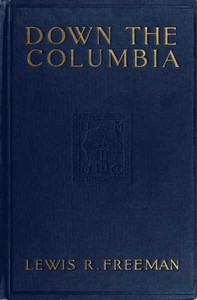
Down the Columbia — A Reader’s Guide
25
10
Project Gutenberg
2011
Columbia River -- Description and travel; Freeman, Lewis R. (Lewis Ransome), 1878-1960 -- Travel -- Columbia River
Readers of public-domain and historical texts
Project Gutenberg digital edition
en
Edition facts
Words: 121,658
Reading time: 529 min
Text sections: 12
Source:
Project Gutenberg record #38249
Lewis R. Freeman recounts his boat trip down the Columbia River, from its headwaters to the Pacific, blending travelogue with encounters with trappers, settlers, and the river's changing character.
Editorial Edition Score
4.9/5
★★★★★
★★★★★
Calculated from edition completeness, EPUB availability, text structure and catalogue metadata. Not a user rating.
Edition quality
The book opens not on the Columbia but on the Continental Divide, where a chance remark by a Game Patrol sergeant about dipping water for either ocean sparks Freeman's idea for a river journey. The introduction establishes a voice that is both observant and wry, as when the scout warns that the trip requires 'lots of time and no dependent family.' This framing sets up a narrative that will balance adventure with the practicalities of navigating a major river.
From Idea to Riverbank
The opening pages trace the genesis of the expedition, moving from the snowy Divide to the actual launch. Freeman's prose is precise about place: the 'powdery snow overlying the crust rustled under our ski like autumn leaves,' and distant peaks 'seemed fairly to float upon the eyeball.' The sergeant's theatrical dipping—left for the Pacific, right for the Atlantic—gives the river a continental significance before the journey begins. Yet the author undercuts any grandiosity with the scout's dry warning about 'no dependent family to think of and shake your nerve in the pinches.' This tension between the sublime and the practical will recur throughout.
Characters Along the Current
Freeman populates his narrative with vivid figures met on the river. One of the most memorable is 'Wild Bill,' an old trapper whose encounter with a bottle of rum escalates into a comic-tragic scene. The author captures Bill's precise gestures: 'snatching the bottle from me with a hand whose fingers crooked like claws,' then downing half a pint of 'liquid fire' without a blink. The aftermath—Bill chasing twin tomcats, unable to tell them apart—is rendered with deadpan restraint. Another companion, Blackmore, provides a laconic counterpoint, tossing the empty rum bottle into the river and remarking, 'The next time you ask a man to take a “swallow,” probably you’ll know enough to find out how big his “swallow” is in advance.'
Navigating the River's Grip
The physical experience of the river dominates the middle excerpts. At Revelstoke Canyon, the current 'rushes with great velocity, throwing itself in a roaring wave now against one side, now against the other.' The cliffs are 'not over a hundred feet apart,' and the depth exceeds a hundred and fifty feet. Freeman notes that while the rapids were manageable for their boat, 'the swirls would have made the run very dangerous for a skiff or canoe at any time.' The author's eye for detail extends to the weather: 'drizzling rain and lowering clouds made pictures of what is one of the very finest scenic stretches of the Big Bend quite out of the question.' This blend of practical hazard and thwarted aesthetics is characteristic.
Voice and Observation
Freeman's narrative voice is that of a seasoned traveler who records both the spectacular and the mundane. He notes the 'diamond clear' air at the Divide, the 'rustling' of snow under skis, and the precise mechanics of a boat's passage through a canyon. His humor is understated, as when he describes Wild Bill's counting of the tomcats: 'Very likely by that time there were two of him in fancy as well as in fact—possibly mauve and pink ones.' The author does not inflate the river's dangers into melodrama; instead, he lets the details—a hundred-and-fifty-foot sounding line failing to find bottom—speak for themselves. This restraint gives the narrative a documentary credibility.
The River as a Living Entity
Throughout the excerpts, the Columbia is more than a setting; it is a force with its own rhythms. Freeman describes the current 'speeding up at Rocky Point Rapids' and the river 'throwing itself' against canyon walls. The boat is subject to the river's will, and the author's language often personifies the water: it 'rushes,' 'throws,' 'roars.' Yet he also notes its beauty, as when he regrets the rain that obscures the canyon's scenery. This dual perspective—the river as both adversary and spectacle—gives the travelogue a dynamic tension. The reader is never allowed to forget that the journey is a negotiation with a powerful natural system.
Freeman's account rewards a reader attentive to the interplay between human character and natural force. The excerpts suggest a narrative that moves from the conceptual to the concrete, from the Divide to the sea, with each stretch of river bringing new encounters and challenges. The author's eye for the telling detail—a gesture, a remark, a change in current—makes the journey vivid without overstatement. Readers should expect a travelogue that is as much about the people met along the way as about the river itself.
Reader reflection
How did this book work for you?
Your answers remain private and are stored only in this browser.
Your progress
0
/
10
2
How much did you enjoy the reading experience?
3
Would you pass this book on to a friend?
4
What was the reading difficulty like?
5
Did it raise ideas you would like to talk about?
6
Do you expect to return to this book?
7
Did anything about the book feel genuinely new?
8
What was the strongest part of the book?
9
What is the main idea you are taking away?
10