1

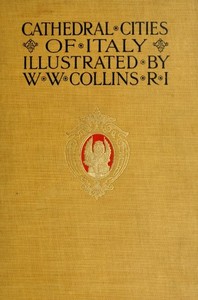
Cathedral Cities of Italy — Reading Companion
28
9
Project Gutenberg
2011
Italy -- Description and travel; Cathedrals -- Italy
Readers of public-domain and historical texts
Project Gutenberg digital edition
en
Edition facts
Words: 69,971
Reading time: 305 min
Text sections: 7
Source:
Project Gutenberg record #37692
W. W. Collins examines Italian cathedrals through an artist's eye, focusing on architectural details, materials, and the interplay of light and shadow, with particular attention to Pisa's marble and the effects of weather.
W. W. Collins, a painter and member of the Royal Institute of Painters in Water Colours, approaches Italy's cathedral cities with the eye of an artist rather than a historian. His descriptions dwell on the physical fabric of buildings—the color and weathering of stone, the play of light across arcades, and the visual effect of decorative details. In his account of Pisa Cathedral, for instance, he notes how the white marble has been 'baked to a beautiful warm yellow and light red' by the sun, while the north side, exposed to the bitter tramontana wind, is 'blistered and scored' into an unpleasant ashen white. Such observations reveal a sensibility attuned to materiality and environment.
Architectural Description as Visual Experience
Collins rarely offers a dry inventory of architectural features. Instead, he describes how a building looks in specific conditions. The façade of Pisa Cathedral is analyzed in terms of its layered galleries: 'the slender pillars that support the arches of these galleries have wonderfully carved capitals, and stand out in the brilliant afternoon sun from the deep shadow behind with marvellous effect.' He notes the arrangement of columns—round on the façade and apses, pilasters elsewhere—as 'an extremely good arrangement' that enhances the building's length without breaking up the wall surface. Even the interior's 'forest of columns and arches' is evaluated for its visual complexity, with the observation that 'if it were not for the fine proportions of the nave, the eye would have but little rest.'
Materials and Weathering
Collins pays close attention to the physical condition of stone and the effects of climate. At Pisa, he contrasts the warm yellow and light red of the sun-baked south side with the 'ashen white' of the north, where the marble is 'blistered and scored' by the cold tramontana. He also remarks on the 'crude mosaics in the tympanums' as 'a jarring colour note which one would willingly suppress,' while praising the 'wonderful patterns of inlaid marble' and 'rich ornamentation of vine-leaves and floral forms, human heads and animals' that embellish the façade. This sensitivity to material decay and repair—the lead-covered penthouse that 'wards off the inclemency of the weather'—suggests a writer who sees buildings as living, aging objects.
Selective Detail and Omission
Collins does not attempt a comprehensive guide. He focuses on what strikes his eye, often omitting historical context or complete inventories. For example, he mentions that the bronze doors of Pisa's façade are 'good examples of the seventeenth century' without naming their makers, and attributes the design of six altars to Michelangelo with a brief 'is attributed to.' He notes that mosaics in the transept apses are 'said to be designed by Cimabue' but adds that 'the same origin can be more justly c[?]'—the text breaks off, leaving the judgment incomplete. This selectivity mirrors the artist's habit of choosing what to paint, and it invites the reader to see the cathedrals as a series of vivid, composed scenes rather than encyclopedic entries.
Collins's text rewards readers who share his interest in the visual and tactile qualities of architecture. His judgments are those of a practitioner—praising a 'good arrangement' of columns, lamenting a 'jarring colour note'—and his descriptions are most vivid when he captures the effect of light on stone. The book is less a systematic guide than a painter's notebook, offering a series of sharp, personal observations that can enrich a traveller's own encounter with these buildings.
Reader reflection
What did you think of this book?
Answer a few questions and save a private reflection on this device.
Your progress
0
/
10
2
Was reading this book enjoyable?
3
Would you recommend this book to another reader?
4
Did the language feel accessible?
5
Would you read this book again?
6
Was the book what you thought it would be?
7
Did any part of the book stay with you emotionally?
8
How closely did the book connect with your experience?
9
Which lesson or insight stayed with you?
10