1

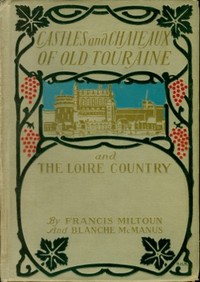
Castles and Chateaux of Old Touraine and the Loire Country — Story, Setting & Ideas
30
14
Project Gutenberg
2011
France -- Description and travel; Castles -- France
Readers of public-domain and historical texts
Project Gutenberg digital edition
en
Edition facts
Words: 69,519
Reading time: 303 min
Text sections: 11
Source:
Project Gutenberg record #37211
This editorial note examines how M. F. Mansfield's 1906 travelogue uses a leisurely, notebook-based structure to guide readers through the châteaux of the Loire, with observations on its blend of history, anecdote, and personal impression drawn from the opening, middle, and later excerpts.
Mansfield introduces his book as the product of "leisurely wanderings" rather than conventional sightseeing, explicitly distancing it from guidebooks like Baedeker and Joanne. The opening pages establish a method: the author and illustrator set out in September to fill gaps left by earlier trips, buying more notebooks and following Mark Twain's advice on equipment. This framing signals that the text will prioritize personal observation and cumulative detail over systematic coverage.
The reader is thus prepared for a narrative that moves at its own pace, weaving together architectural description, historical anecdote, and the author's own reactions. The excerpts from the Chenonceaux chapter confirm this approach: Mansfield lingers on the château's associations with Rousseau, Voltaire, and Catherine de Medici, but also notes the modern sale of photographs and postcards in the feudal tower. The book's voice is that of an informed enthusiast who values both the grand Renaissance monuments and the small, telling details of their present-day use.
A Method of Leisurely Accumulation
The preface makes clear that this book was not written from a single journey but assembled from multiple trips and extensive note-taking. Mansfield mentions earlier visits to Angers and Nantes, and a separate excursion up the Loire valley to Nevers and Le Puy. The final ramble, begun in September, aimed to "reduce" these scattered experiences "to something like consecutiveness and uniformity." This compositional history is important for the reader: the text will not follow a linear itinerary but will draw on a reservoir of accumulated impressions. The author's voice is that of a connoisseur who has returned to the region repeatedly, and the narrative assumes a familiarity with French history and architecture that may require the reader to pause and consult references. The presence of Blanche McManus's illustrations, "made on the spot," reinforces the documentary intent: the book is as much a record of seeing as of knowing.
Chenonceaux as a Case Study in Mansfield's Method
The extended treatment of Chenonceaux in the excerpts illustrates how Mansfield blends architectural description, historical narrative, and personal commentary. He notes the château's construction on the piers of an old mill, the succession of owners from Catherine de Medici to the Dupin family, and the famous guests—Fontenelle, Montesquieu, Voltaire, Rousseau—who gathered there. But he also includes a quotation from Rousseau's Confessions describing his stay, and a remark from the Marquise de Créquy about Rousseau's memoirs. Mansfield then shifts to the present: the chapel's 1521 glass, the dining room's ceiling with Catherine's cipher, and the feudal tower now serving as a kiosque for photographs and guidebooks. This movement between past and present, between documented history and contemporary observation, is the book's characteristic rhythm. The reader is invited to imagine inhabiting the château—"the desire to possess it for one's own is but human"—while being reminded that the nearest one can get is to sign the visitors' book.
The Role of Anecdote and Quotation
Mansfield frequently inserts quotations from historical figures and earlier writers, but he does not use them as mere decoration. In the Chenonceaux section, Rousseau's account of acting comedies and making music is juxtaposed with the Marquise de Créquy's opinion that his memoirs "ought to be much curtailed." Mansfield adds his own gloss: "undoubtedly she was right." This technique gives the text a conversational, opinionated quality. The reader is not simply receiving facts but engaging with the author's judgments. Similarly, the reference to Viollet-le-Duc on feudal chapels shows Mansfield grounding his observations in architectural scholarship. The excerpts suggest that the book as a whole will alternate between such learned asides and more personal reflections, creating a texture that is neither dry guidebook nor pure travel memoir. Readers should expect to encounter a range of voices, from the author's own to those of the historical figures who once inhabited these spaces.
Navigating the Book's Structure and Gaps
The excerpts provided cover only the preface and a portion of one chapter, so the overall organization of the book must be inferred. The catalog lists eleven text sections, and the preface mentions earlier travels to various parts of the Loire valley. It is likely that each section treats a specific château or cluster of sites, moving geographically along the river. The reader should be aware that Mansfield assumes prior knowledge of French history: names like "La Duchesse Anne" and events like the Edict of Nantes are mentioned without explanation. The book also contains a list of the author's other works, suggesting a series of similar regional studies. For a first reading, it may be helpful to have a map of the Loire at hand and to read the chapters in order, as Mansfield's references to earlier visits may build cumulatively. The illustrations by Blanche McManus are an integral part of the work; the text often describes scenes that the reader can examine in the plates.
This edition preserves the original 1906 text and illustrations, including the author's occasional period-specific judgments and the full apparatus of the Project Gutenberg transcription. Readers should approach the book as a period piece—a record of how an early twentieth-century American traveler experienced the châteaux of Touraine. Mansfield's voice is that of a well-read amateur, enthusiastic and opinionated, and his book rewards those who share his curiosity for both the grand monuments and the small, human details that surround them.
Reader reflection
How will you remember this book?
Save your reaction, strongest insight, and memorable passage.
Your progress
0
/
10
2
What was your overall reaction to the book?
3
Is this a title you would suggest to others?
4
How demanding did the text feel?
5
Which element worked best for you?
6
Did it raise ideas you would like to talk about?
7
How much did the book move you?
8
Was the book easy to understand?
9
What is the main idea you are taking away?
10