1

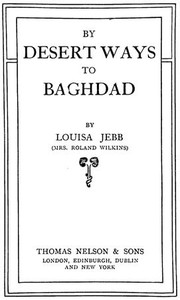
By Desert Ways to Baghdad — Key Ideas to Explore
28
10
Project Gutenberg
2011
Syria -- Description and travel; Iraq -- Description and travel
Readers of public-domain and historical texts
Project Gutenberg digital edition
en
Edition facts
Words: 80,527
Reading time: 351 min
Text sections: 9
Source:
Project Gutenberg record #38319
Louisa Jebb Wilkins's 1909 travelogue recounts a journey from Brusa to Baghdad via raft on the Tigris, blending vivid descriptions of landscapes, ruins, and local customs with observations on Ottoman governance and the nascent Baghdad Railway.
Editorial Edition Score
4.8/5
★★★★★
★★★★★
Calculated from edition completeness, EPUB availability, text structure and catalogue metadata. Not a user rating.
Edition quality
Louisa Jebb Wilkins's By Desert Ways to Baghdad opens not with a grand departure but with a chapter titled "Disentanglement," signaling the practical and emotional work of leaving behind one life for another. The narrative quickly establishes a pattern: the author and her companion X move through landscapes that are simultaneously ancient and contemporary, from the Taurus Mountains to the Tigris. Wilkins's eye for detail—the "low divan" in a mudir's house, the "ruined buttresses of a Roman bridge"—grounds the reader in a world where history is not a backdrop but a lived reality. The catalog subjects list Syria and Iraq as destinations, but the excerpts reveal a journey that is as much about the people encountered and the logistics of travel as about the places themselves.
A Journey of Disentanglement
Wilkins's prologue and first chapter establish a theme of disentanglement—from Europe, from the familiar, from the trappings of settled life. The journey is not merely a route but a process of shedding. This is evident in the author's attention to the practicalities of travel: the hiring of a kalek (raft), the negotiation with local officials, the management of supplies. The narrative voice is matter-of-fact, yet the details accumulate to create a sense of gradual immersion. For instance, the description of the Mudir's house—a single room with a bed kept in a cupboard—illustrates how the author observes domestic arrangements as clues to a different way of life. The catalog subjects suggest a geographical survey, but the text itself is more concerned with the texture of experience.
Conversations and Customs
One of the most striking excerpts is a transcribed conversation between the author's companion X and a Mudir. The dialogue is formal, mediated by a translator, and reveals the social codes of hospitality and inquiry. The Mudir asks about family, about the kalek, about the ladies' opinions of Turkey. X's replies are polite and evasive, adhering to the expected formulas. Wilkins does not comment on the exchange; she lets it stand as a record of cross-cultural encounter. This restraint is characteristic. The author often presents scenes without overt analysis, allowing the reader to infer the dynamics of power, gender, and curiosity. The catalog subjects do not capture this ethnographic dimension, which is central to the book's interest.
The River as a Thread
The second part of the book, "Down the Tigris on Goatskins," shifts the focus to river travel. The raft becomes a mobile home, and the riverbanks reveal a succession of ruins and settlements. Wilkins describes the necropolis at Hassan Kaif, where "the natives live in the tombs and in caves cut out of the rocks." The landscape is layered: Roman bridges, Christian ruins, Kurdish habitations. The author's tone remains observational, but the accumulation of such details creates a sense of deep time. The catalog subjects list "Description and travel" for Syria and Iraq, but the excerpts show that Wilkins is less interested in systematic description than in the incidental, the everyday, and the strange. The river is both a literal route and a narrative device, linking disparate scenes into a coherent journey.
Readers approaching By Desert Ways to Baghdad should expect a travel narrative that prioritizes observation over interpretation. Wilkins rarely moralizes or generalizes; instead, she records what she sees and hears, from the layout of a room to the phrasing of a greeting. The result is a document that feels immediate and unvarnished. The catalog subjects may suggest a dry geographical account, but the text itself is rich with human encounter and material detail. For those interested in early twentieth-century travel writing, Ottoman provincial life, or the practicalities of overland journey, this book offers a distinctive, unpretentious perspective.
Reader reflection
Your personal reading reflection
Build a private reading journal entry for this title.
Your progress
0
/
10
2
How much did you enjoy the reading experience?
3
Would you encourage someone else to read it?
4
What was the reading difficulty like?
5
Did anything about the book feel genuinely new?
6
What did you think about the pace?
7
Did the book deliver what you hoped for?
8
How valuable was this book for your own interests?
9
Which lesson or insight stayed with you?
10