1

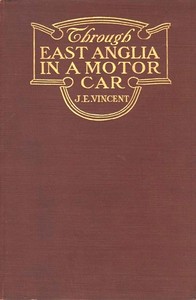
Through East Anglia in a Motor Car — Edition Insights
22
10
Project Gutenberg
2012
Norfolk (England) -- Description and travel; Suffolk (England) -- Description and travel
Readers of public-domain and historical texts
Project Gutenberg digital edition
en
Edition facts
Words: 137,575
Reading time: 599 min
Text sections: 15
Source:
Project Gutenberg record #38938
J. E. Vincent's 1907 travelogue blends motor touring with military maneuvers, bird-seed crops, and patulous elms. The book's structure alternates practical road notes with digressions into balloon chases and seaside spectacles, offering a unique view of Edwardian East Anglia.
Editorial Edition Score
4.9/5
★★★★★
★★★★★
Calculated from edition completeness, EPUB availability, text structure and catalogue metadata. Not a user rating.
Edition quality
J. E. Vincent's Through East Anglia in a Motor Car (1907) is as much a record of Edwardian roadside curiosities as a driving guide. The book opens with a table of practical abbreviations—R. for garage, P. for petrol—but quickly veers into a balloon chase near Tiptree, where a Royal Engineer officer, suspended a thousand feet up, fails to spot troops hidden by “patulous elms.” Vincent, a neutral non-combatant, sees them from the ground. This early episode sets the pattern: the motor car becomes a mobile observatory, catching what official eyes miss.
Structure: Road Notes and Rambles
The book’s fifteen chapters are prefaced with a table of road conditions, gradients, and distances—flat, fair, poor, sinuous. Yet the narrative that follows is anything but systematic. Vincent moves between practical advice and digressive set-pieces: a military exercise at Clacton, a visit to the “dene-holes” at Grays, or a meditation on the word “patulous.” The effect is a layered travelogue where the route is merely a spine for observations on landscape, history, and human behaviour. The motor car enables both speed and pause, allowing Vincent to chase a balloon one moment and linger on a word the next.
Recurring Images: The View from the Road
Vincent repeatedly frames his scenes through the windscreen or from a hilltop. Ely at eventide appears as a frontispiece; the “patulous elms” of Essex become a motif for how the landscape conceals as much as it reveals. At Clacton, he describes a “quite wonderful spectacle” of troops, trippers, and mountebanks, all seen from the beach. The car is both a means of arrival and a platform for observation. These visual set-pieces—balloons, horse-boats, market squares—are often described with a detached, almost ethnographic eye, as if the motorist is a collector of fleeting scenes.
Movement Between Scenes: From Fen to Seaside
The journey is not linear. Vincent moves from Cambridge to Ipswich, then to Norwich, then back to London, then to Felixstowe, then to Colchester, and so on. The chapters are grouped by season—Winter, Spring, Late Summer—but within each, the car jumps between towns and landscapes. The Fens give way to the coast; a priory is followed by a description of Great Yarmouth. This restless movement mirrors the motor car’s freedom, but also creates a mosaic of East Anglia rather than a continuous narrative. The reader is invited to dip in and out, much as Vincent himself seems to have done.
Voice: Detached Curiosity and Dry Humour
Vincent’s tone is that of an amused, well-read observer. He quotes a minor poet for the word “patulous,” notes that “balloons as they descend know no law,” and describes Clacton’s horse-boats as “certainly never reappear.” His humour is understated, his judgments reserved. He does not romanticize the landscape; instead, he notes its oddities—a crop of bird-seed, a storm that wrecks the boats, a crowd of “East End trippers.” This voice, at once precise and wry, gives the book its character: a travelogue that is less about destinations than about the unexpected sights encountered along the way.
Readers should approach Through East Anglia in a Motor Car not as a straightforward itinerary but as a collection of roadside essays. The practical notes are genuine, but the real journey is through Vincent’s mind—alert to language, landscape, and the peculiarities of Edwardian life. The motor car is his excuse, not his subject. To enjoy the book, follow the digressions; they are where the texture of the time emerges.
Reader reflection
Record your reading impressions
A brief reflection can help important ideas stay with you longer.
Your progress
0
/
10
2
How did the book work for you overall?
3
Would you recommend this book to another reader?
4
Did the language feel accessible?
5
Could you follow the author’s main argument?
6
What did you think about the pace?
7
Would a second reading be valuable?
8
Did the book give you something worth debating?
9
Which lesson or insight stayed with you?
10