1

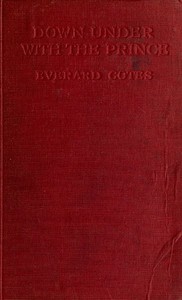
Down Under with the Prince — Reading Notes
19
10
Project Gutenberg
2012
New Zealand -- Description and travel; Australia -- Description and travel; Windsor, Edward, Duke of, 1894-1972
Readers of public-domain and historical texts
Project Gutenberg digital edition
en
Edition facts
Words: 74,950
Reading time: 326 min
Text sections: 9
Source:
Project Gutenberg record #38691
Everard Cotes's firsthand account of the Prince of Wales's 1920 Australasian tour, blending travelogue and reportage with vivid descriptions of landscapes, crowds, and colonial ceremonies across New Zealand and Australia.
Editorial Edition Score
4.7/5
★★★★★
★★★★★
Calculated from edition completeness, EPUB availability, text structure and catalogue metadata. Not a user rating.
Edition quality
The book opens not with the Prince but with an ordinary train leaving Waterloo, carrying a few passengers who are going further. This understated beginning—a shared glance at a battle-cruiser's fighting tops above Portsmouth houses—sets the tone for a narrative that treats royal spectacle as a backdrop to the logistics of travel. Cotes, a correspondent who accompanied the tour, frames himself as a gangway for the reader, promising forty-five thousand miles by battle-cruiser, train, horse, motor, and foot.
The excerpts reveal a writer attentive to weather, terrain, and the mechanics of welcome: the Renown battling gales in the Australian Bight, a desolate pier in Albany with wet decorations flapping, and the precise composition of reception committees. Cotes's voice is factual yet evocative, grounding the Prince's progress in the physical realities of early twentieth-century travel.
A Reporter's Frame: The Gangway Metaphor
Cotes announces his purpose in the preface: to be a gangway for the reader who would travel the entire tour. This metaphor shapes the book's structure, which follows the Prince's itinerary chapter by chapter, from sea to islands to each Australian state. The opening scene at Waterloo—ordinary people, ordinary train—establishes Cotes as an observer among equals, not a court chronicler. He notes the Prince's movements but lingers on the crowds, the weather, and the landscape. In Western Australia, for instance, he describes the Renown straining and groaning in the Bight, then the contrast of a night train through rolling country and bush, with apple orchards and orange gardens appearing in brilliant sunshine. The gangway is not just a route but a perspective: Cotes stands between the royal party and the reader, filtering the tour through a reporter's eye for detail.
The Texture of Welcome: Crowds and Ceremony
Cotes repeatedly catalogues who turned out to greet the Prince, and how. In Albany, the entire population despite the weather; in Perth, the crowd lined behind wooden barriers, kept by blue-jackets, naval reservists, returned soldiers, cadets, and scouts. He lists officials by name and title—Governor, Premier, Mayor, Chief Justice—but also notes the varied composition: traders, fruit-growers, farmers, returned soldiers, school children, nurses. The ceremonies follow a pattern—address, inspection, motorcade—yet Cotes finds variation in the setting: a wind-swept platform before a town hall on a low hill, or a two-mile route through principal business and residential streets. The crowd's response is described in a string of verbs: clapping, cheering, laughing, flag-waving. These passages convey the repetitive yet locally distinct nature of royal tours, where each city stages its own version of loyalty.
Landscape as Character: From Bush to Bight
Cotes devotes as much attention to the land as to the Prince. The journey across the Nullarbor Plain, the Hawkesbury river seen from a train, the Swan River wide as a lagoon—these are set pieces. His descriptions are precise: the Renown lying four miles from land in King George's Sound, the shore in rocky grass-grown hummocks, surf beating heavily. In Western Australia, he notes the state's size—combined areas of England, France, Germany, Austria, Spain, and Holland—with a population under half a million. The contrast between vast territory and sparse settlement is a recurring theme. Even the weather becomes a character: the Bight's frequent gales, the cold wind and spray at Albany, the chill morning air at Parkerville where children sang patriotic songs. Cotes's eye for the physical world gives the tour a tangible geography, making the reader feel the distance and the elements.
The Prince in the Background: A Deliberate Distance
Despite the title, the Prince himself often recedes in Cotes's narrative. The excerpts show him arriving, inspecting guards, proceeding by motor-car—but rarely speaking or acting. Cotes records the Prince's movements as a series of official acts: he held a reception in Gosford, he alighted at Perth, he went through the usual inspection. The focus is on the apparatus of the tour—the train, the ship, the reception committee—and on the crowds who came to see him. This distance is a deliberate choice, consistent with Cotes's role as a correspondent rather than a biographer. The reader learns more about the landscape of Western Australia or the composition of a crowd than about the Prince's reactions. The book thus becomes a record of a royal tour as a public event, shaped by infrastructure, protocol, and the enthusiasm of onlookers, rather than a portrait of the Prince himself.
Cotes's account rewards a reader interested in the mechanics of early twentieth-century travel and the staging of imperial loyalty. The book's value lies not in revelations about the Prince but in its accumulation of concrete detail: the names of officials, the condition of roads, the behavior of crowds in rain or sunshine. Reading the excerpts, one senses the tour as a logistical achievement, a series of arrivals and departures measured in miles and minutes. Cotes's plain style and reporter's discipline make the book a useful primary source for understanding how royal tours were organized and perceived in the aftermath of the First World War.
Reader reflection
Take a moment to reflect on this book
Create a short personal record of your experience with this book.
Your progress
0
/
10
2
Did this book hold your interest?
3
How likely are you to recommend this book?
4
Did the language feel accessible?
5
Did you relate to its people, ideas, or situations?
6
How useful did the reading feel?
7
Was the book what you thought it would be?
8
How strongly did the book affect you emotionally?
9
In one sentence, what did you learn?
10