1

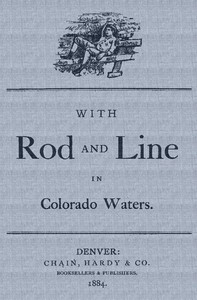
With Rod and Line in Colorado Waters — Inside the Classic
23
10
Project Gutenberg
2014
Colorado -- Description and travel; Fly fishing -- Colorado
Readers of public-domain and historical texts
Project Gutenberg digital edition
en
Edition facts
Words: 43,612
Reading time: 190 min
Text sections: 5
Source:
Project Gutenberg record #45016
Lewis B. France's 1884 fishing memoir blends precise observations of Colorado's waters with digressive humor and philosophical asides, shifting between lyrical nature writing and self-deprecating anecdotes.
Editorial Edition Score
4.7/5
★★★★★
★★★★★
Calculated from edition completeness, EPUB availability, text structure and catalogue metadata. Not a user rating.
Edition quality
Lewis B. France opens his 1884 fishing memoir not on a Colorado stream but on a memory of a barefoot boy crawling out from under a bridge forty years earlier, watching a man-of-war at anchor. That shift—from the long-ago East to the present-day Rockies—sets the pattern for a book that moves freely between precise natural description and digressive reflection. France writes of rain-soaked camps where he watches chipmunks nibble wild rye and imagines a bedraggled blackbird as the cursed jackdaw of Rheims. The prose is unhurried, often comic, and alert to the small dramas of outdoor life.
A Voice That Wanders
France’s narrative voice is the book’s most distinctive feature: it refuses to stay still. In one paragraph he describes the color of a river—‘the Grand is brown, Williams’ Fork is gold color’—and in the next he is imagining a blackbird hauled before a magistrate on a vagrancy charge. The register shifts from plain observation to literary allusion to self-mockery without warning. He quotes Holmes in the epigraph and drops references to Dickens and Herbert Spencer into a passage about rainy-day reading. The effect is not academic but playful; France seems to be talking to himself as much as to the reader. This restlessness gives the prose a conversational, almost improvisational quality, as if the act of writing were itself a kind of angling—casting out a line of thought and seeing what comes back.
The Pace of a Rainy Day
The excerpts show a writer deeply attentive to the rhythms of waiting. In the section headed ‘Meteorological,’ France spends pages under canvas watching rain fall, tracing rivulets, and noting the behavior of ground squirrels. The pacing is deliberate, even slow, matching the enforced idleness of a storm-bound camp. He does not rush to action; instead, he lets the scene expand through small details—the way a chipmunk drops from a stalk of wild rye, the glistening of raindrops on fur. This unhurried attention creates a sense of real time passing. When he finally writes ‘I want to go home,’ the frustration feels earned. The book’s structure, with chapter titles like ‘An Idle Morning at Grand Lake’ and ‘Philosophy,’ signals that France values these pauses as much as the fishing itself.
Humor as a Counterweight
France leavens his descriptive passages with a dry, self-deprecating humor. After reading Herbert Spencer’s ‘Social Statics’ in camp, he confesses that he sometimes thought the philosopher ‘must have been a very old man, in his second childhood, for instance, and troubled with dyspepsia.’ The joke is at his own expense—the angler-philosopher grappling with ideas beyond his grasp. Elsewhere, he compares the muddy Troublesome River to a substance ‘so thick that you can stick a knife into it, turn it round and see the hole.’ The exaggeration is affectionate, not dismissive. This humor prevents the book from becoming merely descriptive; it gives France a persona—the slightly hapless, endlessly curious fisherman—that makes the reader willing to follow his digressions. Even the chapter titles (‘Egotism and—Rods,’ ‘Boys and Burros’) promise a wry, informal tone.
France’s book rewards a reader who is willing to slow down. The fishing is real, but the real subject may be the mind at leisure—how it wanders, what it notices, how it turns a rainy afternoon into a small comedy. Pay attention to the asides; they are where the voice comes alive.
Reader reflection
Before you leave, reflect on the book
Use these questions to collect your thoughts before moving on.
Your progress
0
/
10
2
Was reading this book enjoyable?
3
Would you recommend this book to another reader?
4
What was the reading difficulty like?
5
How understandable was the text?
6
Did this book create an emotional response?
7
Did the story or argument move comfortably?
8
Did it raise ideas you would like to talk about?
9
What changed or sharpened your thinking?
10