1

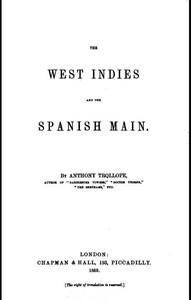
The West Indies and the Spanish Main — A Closer Reading
37
12
Project Gutenberg
2017
West Indies -- Description and travel; West Indies, British -- Description and travel; Spanish Main; Central America -- Description and travel
Readers of public-domain and historical texts
Project Gutenberg digital edition
en
Edition facts
Words: 123,537
Reading time: 538 min
Text sections: 10
Source:
Project Gutenberg record #55100
Anthony Trollope's travelogue of the West Indies and Central America, written in 1859, combines sharp observation of colonial society, wry self-deprecation, and detailed accounts of sugar cultivation, emancipation's aftermath, and the region's geography.
Editorial Edition Score
4.8/5
★★★★★
★★★★★
Calculated from edition completeness, EPUB availability, text structure and catalogue metadata. Not a user rating.
Edition quality
Trollope opens this travel narrative aboard a becalmed brig between Jamaica and Cuba, complaining of yams, salt pork, and bad coffee while a friend's sardines keep him alive. The scene sets a tone of wry, self-deprecating observation that persists throughout. He notes that the comfortable route everywhere is via St. Thomas, a remark that becomes a refrain. The book is not a systematic geography but a personal account of places visited in 1858–59, with chapters on Jamaica, Cuba, British Guiana, Barbados, Trinidad, and the Central American isthmus.
Trollope's Narrative Voice and Self-Deprecation
Trollope frequently casts himself as a slightly hapless traveler. In the opening, he regrets not taking a second box of sardines and grumbles about the cramped cabin. Later, in Barbados, he reports being told the population is larger than China's—per square foot—and that he suggested a railroad system, which was taken in good part. These asides humanize the narrator and undercut any pretense of authority. He also uses hyperbole for comic effect: the Barbadians once offered to protect King George III from Napoleon. The humor is dry and often directed at himself, making the reader a confidant rather than a pupil.
Barbados: A Case Study in Post-Emancipation Labor
Trollope contrasts Barbados with other islands like Jamaica. In Barbados, he writes, there was no squatting ground for freed slaves; they had to work or starve. Consequently, labor remained abundant, sugar was made respectably, and the island paid its debts. But he notes that the Barbadians think too much of their own achievements. The island's appearance is unremarkable—every inch planted in canes—and he calls it the least picturesque of the West Indies. The roads are excellent but painfully white, and Bridgetown resembles a second-rate English town, complete with a Trafalgar Square and a statue of Nelson. Trollope's observations tie landscape directly to economic history.
The Role of St. Thomas as a Transit Hub
In the introductory chapter, Trollope declares that the comfortable route from everywhere to everywhere else is via the Danish island of St. Thomas. He repeats this formula: from Demerara to Panama, from Panama to Jamaica, from Jamaica to Cuba, all go by St. Thomas. This refrain underscores the centrality of steamship lines and colonial trade routes. The remark is both practical and ironic—Trollope himself is not on a comfortable route but on a miserable brig. The contrast between the ideal and the actual is a recurring structural device.
Observations on Landscape and Agriculture
Trollope links scenic beauty to agricultural neglect. In Barbados, he notes that a country broken into landscapes is seldom propitious to agriculture, and that waste land makes a place picturesque. Barbados has no waste land, so it is not interesting. This blunt equation—picturesque = unproductive—is typical of his practical eye. He also remarks on the absence of tropical foliage in Barbados, which to an English eye is less attractive. The island is like an ordinary ugly agricultural county, but for the heat. Such observations reveal Trollope's preference for utility over romance, even as he acknowledges the aesthetic cost.
Trollope's travelogue rewards readers who enjoy a narrator who is opinionated, observant, and unafraid to mock himself. The book is not a dry catalogue but a series of encounters with places and people, filtered through a novelist's sensibility. Pay attention to his asides and comparisons—they often carry more weight than the factual descriptions. The work stands as a document of mid-nineteenth-century colonial travel, but its real interest lies in the personality of the traveler.
Reader reflection
What was your reading experience?
Capture what you thought, learned, and would like to remember.
Your progress
0
/
10
2
Was reading this book enjoyable?
3
How likely are you to recommend this book?
4
What was the reading difficulty like?
5
Was the book easy to understand?
6
Would you start a conversation about this book?
7
Did this book create an emotional response?
8
Was the book what you thought it would be?
9
What did this book teach you most?
10