1

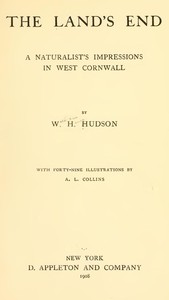
The Land's End: A Naturalist's Impressions In West Cornwall, Illustrated — Story, Setting & Ideas
22
8
Project Gutenberg
2015
Cornwall (England : County) -- Description and travel; Natural history -- England -- Cornwall (County); Land's End (England)
Readers of public-domain and historical texts
Project Gutenberg digital edition
en
Edition facts
Words: 85,895
Reading time: 374 min
Text sections: 10
Source:
Project Gutenberg record #47990
Hudson's naturalist impressions of West Cornwall, focusing on wildlife, landscapes, and local character, with observations on gulls, jackdaws, hedges, and Cornish humour, illustrated by A. L. Collins.
Editorial Edition Score
4.9/5
★★★★★
★★★★★
Calculated from edition completeness, EPUB availability, text structure and catalogue metadata. Not a user rating.
Edition quality
Hudson opens The Land's End by confessing he long avoided Cornwall, expecting a poor fauna compared to other English counties. He quotes Fuller on knowing one's own country, then admits the West Country's 'observables' kept him from crossing the Tamar. The first chapter, 'Wintering in West Cornwall,' immediately establishes his naturalist lens: he values living creatures over 'granite and serpentine cliffs and seas of Mediterranean blue.' The reader is thus primed for a book that treats landscape as setting, not subject, and that will measure Cornwall by its wild life—especially birds.
Birds as the Book's True Subject
Hudson's opening chapters dwell on gulls at St. Ives and jackdaws on the roofs. He describes a 'greedy sheep-dog' that competes with birds for scraps, and records a 'dialogue between two daws' as a morning pastime. These passages reveal his method: patient observation of animal behaviour, often with a dry humour. The jackdaws' intelligence is a recurring note—he watches them feed, interact, and exploit human settlements. For a first reader, these early bird studies set the expectation that the book's core is ethology, not travelogue. Hudson's voice is precise and unhurried, attentive to small actions.
Cornish Hedges and Human Landscape
Chapter IV, 'Old Cornish Hedges,' turns to the man-made environment. Hudson examines the stone hedges that crisscross the county, noting their age, construction, and the plants that colonise them. He treats them as habitats—'living gems' in a setting of granite. This section shows his ability to find natural history in agricultural boundaries. The hedges become a lens for understanding how people have shaped the land. Hudson does not romanticise; he describes the hedges' structure and the species they support, linking human craft to ecological niches. A reader sees that his 'impressions' are grounded in material detail.
The People and Their Humour
Later chapters address Cornish character. Hudson is sceptical of dialect books that 'do not help us much' and may mislead. He distinguishes two types of unconscious humour, giving examples: a minister's remark that no souls were won during elections, and a fisherman's reaction to painter Brett's palette-knife technique. These anecdotes are not mere colour; they illustrate Hudson's argument that Cornish humour is 'of the second kind'—saying things impossible for someone with a sense of humour. The reader encounters a naturalist equally interested in human behaviour, though his observations are limited to what he witnessed or heard directly.
Winter, Spring, and the Seasonal Arc
The book's structure follows the seasons: from wintering at St. Ives through a great frost to the coming of spring and early flowers. Hudson notes 'Winter Aspects and a Bird Visitation' and 'The Furze in its Glory.' This seasonal progression gives a temporal shape to the impressions. The excerpts suggest he is attentive to change—the arrival of migrant birds, the thaw, the bloom of gorse. For a first reader, this arc provides a natural rhythm. Hudson does not claim completeness; he offers a winter and spring view, leaving summer and autumn undescribed. The book is a slice of the year, not a full natural history.
Hudson's The Land's End rewards a reader who follows his gaze: at birds on roofs, at stone hedges, at the way fishermen talk. He writes as a naturalist who values the living over the scenic, and his prose is precise, often wry. The book is not a guide or a systematic survey; it is a set of impressions, limited to winter and spring, shaped by one observer's curiosity. Read it for the jackdaws, the gulls, the old hedges, and the quiet humour of the people—not for a complete portrait of Cornwall.
Reader reflection
Record your reading impressions
A brief reflection can help important ideas stay with you longer.
Your progress
0
/
10
2
Did this book hold your interest?
3
Is this a title you would suggest to others?
4
How much effort did this book require?
5
Did you relate to its people, ideas, or situations?
6
Was the book easy to understand?
7
How useful were the ideas in this book?
8
Which aspect of the book did you value most?
9
In one sentence, what did you learn?
10