1

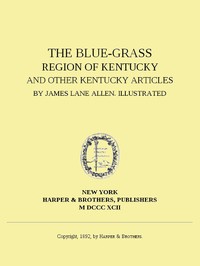
The Blue-Grass Region of Kentucky, and Other Kentucky Articles — Reading Notes
25
11
Project Gutenberg
2013
Kentucky -- Description and travel; Kentucky -- Social life and customs
Readers of public-domain and historical texts
Project Gutenberg digital edition
en
Edition facts
Words: 61,187
Reading time: 267 min
Text sections: 8
Source:
Project Gutenberg record #43888
James Lane Allen's 1892 collection of descriptive articles on Kentucky's Blue-Grass region, blending travelogue with social observation. The prose shifts from pastoral landscapes to detailed accounts of county court days, fairs, and Trappist monastery life, revealing a writer attentive to both natural beauty and human customs.
Editorial Edition Score
4.7/5
★★★★★
★★★★★
Calculated from edition completeness, EPUB availability, text structure and catalogue metadata. Not a user rating.
Edition quality
James Lane Allen opens his collection with a preface that reveals an unfinished plan: each descriptive article was to be paired with a short story on the same subject, a scheme only partly realized. The resulting volume thus stands as a hybrid—part travelogue, part social sketch—in which the author's voice moves between detached observer and engaged storyteller. Readers encounter Kentucky not through a single lens but through a series of sharply focused vignettes: the blue-grass pastures, the county court day's bustling trade, the quiet routines of a Trappist monastery. Allen's prose, at once precise and evocative, captures both the region's physical beauty and the rhythms of its daily life.
Pastoral Precision and the Blue-Grass Landscape
Allen's descriptions of the Blue-Grass region rely on a careful accumulation of detail rather than broad romanticism. He notes the blue-grass itself, the sheep in woodland pasture, the negro cabins, and the cattle in a blue-grass pasture—each image rendered with a naturalist's eye. The landscape is not merely scenic but functional: the hemp field and tobacco patch are as much a part of the picture as the Harrodsburg Pike or the spring-house. This attention to the working countryside gives the prose a grounded, almost documentary quality. Allen's sentences often move from the general to the particular, as when he describes a great quadrangular pile of brick or a green inner court laid off with care. The effect is a portrait of place that feels both intimate and authoritative.
The Pace of Public Life: Court Days and Fairs
In articles such as County Court Day in Kentucky and Kentucky Fairs, Allen shifts from pastoral stillness to the rhythms of communal gathering. The court-house square becomes a stage for concluding a bargain, auctioning a jack, and swapping horses—activities rendered with a reporter's eye for gesture and transaction. The prose quickens here, matching the energy of the crowd. Allen notes the quack-doctor and the tickler, figures that add color without descending into caricature. At the fair, the judge's stand and the finish of a race are described with an almost technical precision, while stallions and mules are cataloged as products of the soil. These sections reveal Allen's interest in the intersection of commerce and community, where the pace of life accelerates into a kind of orderly chaos.
Contrasts in Silence: The Trappist Monastery
The article A Home of the Silent Brotherhood offers a striking change of pace. Here, Allen enters the Trappist monastery, a world of votive poverty and cold gray interiors. His description of the church—fine proportion in stone and gracefully disposed columns—conveys a beauty stripped of ornament. The cemetery garth, with its plain wooden crucifix marking each grave, is rendered in quiet, respectful prose. Allen notes the practice of beginning a new grave beside the one just filled, a reminder of mortality that he presents without sentimentality. The monks themselves are glimpsed through their routines: praying with wan faces or sleeping in a great upper room divided into narrow berths. This section slows the narrative to a meditative pace, contrasting sharply with the bustling court days and fairs. Allen's voice here is that of an observer who respects the silence he describes.
Allen's collection rewards readers who attend to its shifts in tempo. The same author who lingers over a spring-house or a tobacco patch can also capture the quick transactions of a horse swap or the solemn quiet of a monastery. To read these articles is to follow a writer testing his range, moving between the descriptive and the narrative, the pastoral and the social. The Blue-Grass region emerges not as a single picture but as a series of frames, each with its own pace and focus.
Reader reflection
How will you remember this book?
Save your reaction, strongest insight, and memorable passage.
Your progress
0
/
10
2
Did this book hold your interest?
3
Would you pass this book on to a friend?
4
How much effort did this book require?
5
How useful did the reading feel?
6
Did the book offer a fresh perspective?
7
How well did it match your expectations?
8
How strong was your personal connection to the text?
9
In one sentence, what did you learn?
10