1

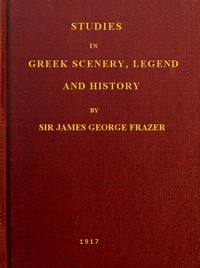
Studies in Greek Scenery, Legend and History Selected from His Commentary on Pausanias' 'Description of Greece,' — Context and Discussion
30
12
Project Gutenberg
2017
Greece -- Description and travel; Greece -- Antiquities
Readers of public-domain and historical texts
Project Gutenberg digital edition
en
Edition facts
Words: 104,105
Reading time: 453 min
Text sections: 103
Source:
Project Gutenberg record #56002
James George Frazer's selected commentary on Pausanias blends precise topographical description with mythological and historical digressions, revealing how landscape, legend, and ancient testimony intertwine.
Editorial Edition Score
4.9/5
★★★★★
★★★★★
Calculated from edition completeness, EPUB availability, text structure and catalogue metadata. Not a user rating.
Edition quality
James George Frazer's Studies in Greek Scenery, Legend and History extracts and reworks passages from his monumental commentary on Pausanias' second-century travelogue. The prose moves between two distinct registers: a taut, almost technical description of terrain—roads, springs, masonry—and a looser, associative voice that reaches toward myth, ritual, and historical anecdote. In the excerpt tracing the Sacred Way to Eleusis, Frazer notes the precise location of salt-springs, the dam that pools them, and the right of fishing reserved for Eleusinian priests, then pivots to mention flying-fish observed by a nineteenth-century traveller. This oscillation between ancient authority and modern observation is characteristic of the work's method.
Topography as Narrative
Frazer's descriptive passages often read like a guided itinerary, but one in which the landscape itself becomes a palimpsest. He notes the 'cubical mass of earth, cased with white marble' marking the tomb of Strato, Polla Munatia, and Isidotus—a monument Pausanias does not mention. This inclusion signals Frazer's willingness to supplement ancient testimony with archaeological and epigraphic evidence. The route is traced with careful attention to changes in elevation and view: the pass 'opening out' to reveal the Gulf of Salamis 'like a lake,' the distant peak of Cyllene visible 'in clear weather.' Such details anchor the reader in a specific, embodied experience of place.
The Voice of the Commentator
Frazer's authorial presence is felt most strongly in his parenthetical asides and comparative gestures. When describing the salt-pools, he adds that 'Fiedler observed flying-fish of the size of herrings rising from the surface' and notes their flesh was 'white and succulent.' This sudden shift from ancient custom to a naturalist's report from the 1830s exemplifies Frazer's method: he layers sources without explicit hierarchy. The prose is generally declarative, but occasionally a note of uncertainty enters—'or rather used to turn, another mill'—reminding the reader that the commentary is itself a provisional reconstruction.
Pace and the Accumulation of Detail
The narrative rhythm in the Sacred Way passage is deliberate, almost cumulative. Frazer builds the scene step by step: the monastery, the ancient masonry, the niches cut into rock, the sanctuary of Aphrodite. Then the hills 'retire on both sides' and the road turns sharply. This measured progression mirrors the traveller's own movement. Yet within this steady pace, Frazer inserts compressed digressions—the fishing rights, the mill-stream, the debate over the ancient road's alignment—that momentarily halt forward motion. The effect is a texture of stops and starts, where the commentary's scholarly apparatus periodically interrupts the descriptive flow.
Readers approaching this work should attend to the interplay between Frazer's two voices: the precise topographer and the speculative folklorist. The excerpts offer only a partial view—the full text likely extends these habits across many more sites and legends. A useful strategy is to track how Frazer signals his own uncertainty, and to note where he lets a modern observation stand without ancient corroboration. The book rewards those who read with a map in hand and a willingness to follow the digressions.
Reader reflection
What was your reading experience?
Capture what you thought, learned, and would like to remember.
Your progress
0
/
10
2
Did this book hold your interest?
3
Would you encourage someone else to read it?
4
How much effort did this book require?
5
Was the book what you thought it would be?
6
Would you like to discuss this book with someone?
7
How would you describe its reading pace?
8
Would you read this book again?
9
What is the main idea you are taking away?
10