1

Seeing America First, with the Berry Brothers — Key Ideas to Explore
30
13
Project Gutenberg
2017
United States -- Description and travel -- Juvenile literature; Canada -- Description and travel -- Juvenile literature
Readers of public-domain and historical texts
Project Gutenberg digital edition
en
Edition facts
Words: 11,750
Reading time: 52 min
Text sections: 2
Source:
Project Gutenberg record #55713
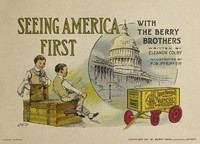
An early 20th-century travelogue narrated by the Berry Wagon Boys, blending boosterish Detroit pride with visits to Canadian capitals, Yosemite, and Columbia River salmon canneries, illustrated by F. W. Pfeiffer.
Editorial Edition Score
4.5/5
★★★★★
★★★★★
Calculated from edition completeness, EPUB availability, text structure and catalogue metadata. Not a user rating.
Edition quality
The Berry Wagon Boys announce themselves as youthful travelers determined to "see America first," a slogan the book treats with earnest enthusiasm. Their home base, Detroit, is described with civic pride: the city doubled in population in a decade, its river is "too fine and dignified" to flood, and Berry Brothers varnish is touted as the best. This commercial tie—the book was copyrighted by Berry Bros., Incorporated—colors the narrative from the start, blending geography with product placement.
The opening also establishes a pattern of mixing booster statistics with child-friendly analogies: Detroit grows "as fast as Jack's famous beanstalk," and visitors "oh" and "ah" as if taking a singing lesson. The voice is colloquial and direct, addressing readers as fellow "nephews and nieces" of Uncle Sam.
A Wagon-Boy Voice and Its Limits
The narrator adopts a collective first-person plural—"we Berry Wagon Boys"—creating a sense of shared adventure. The tone is informal, with exclamations and rhetorical questions: "One thing is certain, if the varnish on your floors and furniture is the best that can be bought, it came from BERRY BROTHERS." This direct address to a young audience is consistent, but the excerpts reveal gaps: the narrative jumps from Detroit to Canada to the Pacific Northwest without transitional explanation. Readers must infer that the brothers are traveling, perhaps by rail or auto, though the text does not specify. The voice remains cheerful and assured, even when describing industrial processes like salmon canning, where Chinese workers are noted as "very swift"—a detail that reflects period attitudes without commentary.
Numbers, Wonders, and Boosterism
The book is studded with concrete figures: Detroit grew from 400,000 to 800,000 in ten years; a single salmon wheel caught fifteen thousand fish in a day; a redwood tree began growing "at least 2000 years before Christ." These numbers serve as marvels, not statistics. The tone is consistently awestruck—the Parliament buildings "make one think of kings and queens," and Yosemite's El Capitan is visible sixty miles away. Yet the boosterism is selective: Detroit's manufacturing might is celebrated, but the environmental cost of canning is absent. The salmon's life cycle is anthropomorphized—they get "homesick" and return for a "home-coming"—a storytelling choice that humanizes natural history for young readers.
National Parks as Democratic Playgrounds
A recurring theme is that America's national parks belong equally to all citizens, unlike the preserves of kings. The narrator asserts that "a king or an emperor would never dream of putting great tracts of land aside for his subjects to enjoy without paying a cent of toll." This democratic framing is reinforced by the description of Yosemite: the valley floor feels like summer while peaks hold perpetual snow, and giant sequoias have dwarf neighbors sixty years old but pencil-thin. The Bridal Veil cascade is called "the birthplace of the rainbow." The parks are presented as accessible wonders, though the excerpts do not show the Berry Wagon Boys actually hiking or camping—they observe from roadsides or guided tours.
Industrial Tourism and the Columbia River
The visit to a salmon cannery offers a rare glimpse of industrial process in a travel book for children. The description is methodical: fish are caught in traps, nets, and water wheels; Chinese workers kill them swiftly; machines clean forty-five fish per minute; cans are steamed. The scale is emphasized—"ninety thousand fish have been caught at once"—and the market is global: "Columbia river salmon always finds a market." The tone remains admiring, not critical. This section contrasts with the pastoral Yosemite scenes, showing that the Berry Wagon Boys value both natural wonders and human ingenuity. The salmon life cycle is told as a story, ending with "little fish children starting out to see the world," mirroring the brothers' own journey.
Readers should note that the excerpts cover only the beginning and a few later passages; the middle of the journey is absent. The book's structure appears episodic, moving from city to natural wonder to industrial site without a strong narrative arc. The Berry Wagon Boys remain cheerful observers, never encountering conflict or hardship. For a first reading, pay attention to how the author balances factual reporting with a promotional voice—and how the illustrations by F. W. Pfeiffer might complement or complicate the text's boosterish tone.
Reader reflection
Record your reading impressions
A brief reflection can help important ideas stay with you longer.
Your progress
0
/
10
2
What was your overall reaction to the book?
3
Is this a title you would suggest to others?
4
How demanding did the text feel?
5
How useful did the reading feel?
6
How clear did the writing feel?
7
How strong was your personal connection to the text?
8
What did you think about the pace?
9
What did this book teach you most?
10