1

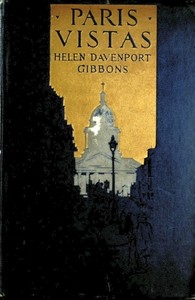
Paris Vistas — Text and Context
25
10
Project Gutenberg
2012
Paris (France) -- Social life and customs; Paris (France) -- Description and travel; World War, 1914-1918 -- France
Readers of public-domain and historical texts
Project Gutenberg digital edition
en
Edition facts
Words: 92,155
Reading time: 401 min
Text sections: 9
Source:
Project Gutenberg record #40292
Helen Davenport Gibbons blends memoir and travelogue in a series of vignettes about Paris during and after World War I, focusing on domestic life, apartment hunting, and the city's familiar vistas, illustrated by Lester G. Hornby.
Editorial Edition Score
4.8/5
★★★★★
★★★★★
Calculated from edition completeness, EPUB availability, text structure and catalogue metadata. Not a user rating.
Edition quality
Gibbons opens her account not with a monument but with a definition: a vista is 'a view, especially a distant view, through or between intervening objects.' She immediately rejects a literal guidebook approach, warning that her book offers no substitute for Baedeker or photographs. Instead, she proposes that memories can serve as 'intervening objects,' making vistas as much temporal as spatial. The Arc de Triomphe, the Madeleine, and the Palais Bourbon become as familiar as 'your mother's face in the doorway of the childhood home.' This personal framing sets the tone for a work that intertwines the city's landmarks with the author's own domestic routines and wartime experiences.
The Apartment as a Lens
Gibbons devotes considerable attention to the practicalities of renting in Paris, turning the search for housing into a recurring motif. She describes the three-month term system, the horror of the inventory, and the meticulous French habit of 'biting a penny.' The lease itself becomes a document of cultural difference: clauses forbid pets and business, yet children are more likely to be refused than dogs. Her account of furnishing an unfurnished apartment—buying simple pieces, selling them at year's end without great loss—reveals a transient, pragmatic approach to home. These details ground the narrative in the material realities of expatriate life, where even a villa rental involves arm's-length sheets recording the state of walls, carpets, and mattresses.
War and the Familiar Skyline
The war intrudes obliquely. Gibbons mentions a Zeppelin floating over the Gare Saint-Lazaire, and notes that Paris has been 'overcrowded' during the conflict. Yet she does not dwell on battles or politics; instead, she observes how the city's landmarks persist unchanged. The obelisk in the Place de la Concorde 'always has been' there, and the Arc de Triomphe looks exactly as it should. This insistence on continuity amid upheaval gives the book its distinctive tone. The vistas she describes—Sacré Coeur seen from apartment-house-lined streets, the Invalides from Pont Alexandre III—are not just views but anchors of normalcy. Her prose moves between the intimate scale of a three-room kitchen and the grand perspective of a city under strain.
Sketches and Words in Parallel
Lester G. Hornby's sixteen illustrations accompany the text, and Gibbons explicitly links her verbal vistas to his visual ones. She writes that 'vistas in words can no more convey the impression of things seen than Lester Hornby's sketches,' establishing a partnership between image and narrative. The illustrations are not decorative but integral: they share the same selective, impressionistic approach. Where a photograph would tick off monuments by name, Hornby's sketches and Gibbons's prose both aim to evoke a feeling of familiarity. This synergy extends to the book's structure, which moves from scene to scene without the systematic coverage of a guide. The reader is invited to see Paris through a double lens—the author's memory and the artist's line.
The Autobiographical Thread
Gibbons acknowledges that her own life keeps coming to the front, and she does not apologize for it. She recounts being lost as a child at the Gare Saint-Lazaire, saying goodbye to her husband there, and raising her family in a series of rented apartments. These personal anecdotes are the 'intervening objects' that shape her vistas. The book is as much about the rhythms of domesticity—finding a suitable apartment, dealing with the concierge, heating costs from November to March—as about the city's famous views. By grounding her observations in the mundane, Gibbons offers a portrait of Paris that is intimate and specific. The reader who expects a conventional travelogue will be redirected instead to the texture of daily life during and after the Great War.
Gibbons's Paris is not a collection of postcard scenes but a lived-in city, measured in leases, inventories, and the familiar silhouette of Sacré Coeur. Readers should approach this book as a memoir of place rather than a guide, letting the author's domestic details and wartime asides accumulate into a composite portrait. The illustrations by Hornby reinforce this personal geography, offering visual echoes of the text's selective, memory-infused views.
Reader reflection
What was your reading experience?
Capture what you thought, learned, and would like to remember.
Your progress
0
/
10
2
How did the book work for you overall?
3
Would you pass this book on to a friend?
4
How easy was the book to follow?
5
Which aspect of the book did you value most?
6
Did any part of the book stay with you emotionally?
7
Do you expect to return to this book?
8
Did you gain anything practical from the text?
9
What did this book teach you most?
10