1

Canadian Scenery, Volume 1 (of 2) — Background and Themes
22
9
Project Gutenberg
2014
Canada -- Description and travel; Canada -- History
Readers of public-domain and historical texts
Project Gutenberg digital edition
en
Edition facts
Words: 67,966
Reading time: 296 min
Text sections: 8
Source:
Project Gutenberg record #47690
Willis's prose and Bartlett's engravings combine in this 1842 travelogue to depict Canadian landscapes, settlements, and history through precise diction and visual description, revealing 19th-century colonial perspectives.
Editorial Edition Score
4.7/5
★★★★★
★★★★★
Calculated from edition completeness, EPUB availability, text structure and catalogue metadata. Not a user rating.
Edition quality
Willis opens Canadian Scenery not with a landscape but with a philological puzzle: the origin of the name “Canada.” He weighs Hennepin’s claim that Spanish explorers called it Capo di Nada (“Cape Nothing”) against La Potherie’s variant, letting the reader choose. This scholarly gesture sets the tone for a work that mingles travel narrative, historical summary, and engraved illustration. Willis’s prose is deliberate and often formal, favoring balanced clauses and periodic sentences. He describes the Chaudière Falls, for instance, with measured awe, while Bartlett’s engravings freeze the scene in fine detail. The book’s structure—moving from discovery and settlement to contemporary impressions—reflects an authorial desire to frame Canada as both a storied colony and a vivid present reality.
Etymological Openings and Colonial Naming
Willis devotes his first pages to the contested etymology of “Canada,” citing Hennepin and La Potherie. He does not resolve the debate but presents it as a curiosity, inviting readers to “leave the choice of solutions to the reader.” This rhetorical move establishes Willis as a compiler of evidence rather than a dogmatic guide. The wordplay—Capo di Nada becoming “Canada”—highlights how European explorers imposed names that carried judgments of value. Willis’s own diction remains neutral, but the implication lingers: the land was deemed “nothing” before being rechristened. This opening gambit reveals his method: he layers historical anecdote, linguistic speculation, and descriptive travelogue without forcing a single narrative.
The Engraver’s Eye and the Writer’s Hand
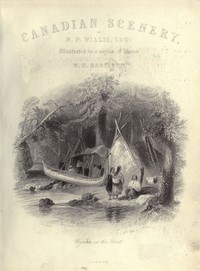
Bartlett’s engravings are listed in detail, from “The Squaw’s Grave” to “Raft in a Squall on Lake St. Peter.” Willis’s text often mirrors the visual emphasis on topography and settlement. He describes the Chaudière Falls with attention to scale and motion, while the accompanying engraving captures the cascade’s vertical plunge. The collaboration is asymmetrical: Bartlett provides the “scenery,” Willis the “literary department.” Yet Willis’s prose does not merely caption the images; it supplies historical context, such as the Battle of the Plains of Abraham, and ethnographic notes on Indian villages. The result is a hybrid work where word and image vie for authority, each claiming to represent Canada authentically.
Political History as Narrative of Discontent
Willis devotes substantial space to the political conflicts of Upper and Lower Canada, tracing disputes between governors and assemblies. He recounts the impeachment of judges, the Duke of Richmond’s “innovation” of lump-sum estimates, and the Assembly’s refusal to grant permanent supplies. His tone is even-handed, but he notes that the Duke’s “extreme monarchical ideas” ill-fitted him for the “new crisis.” Willis selects details that dramatize constitutional friction: the governor drawing on the treasurer without approval, the Assembly specifying “every item.” These passages read less as dry chronicle than as a narrative of clashing principles—executive prerogative versus popular control—that Willis presents without overt partisanship.
Diction of Distance and Detail
Willis’s vocabulary oscillates between the elevated and the precise. He calls the St. Lawrence a “magnificent link in the colonial chain,” a metaphor that casts geography as imperial infrastructure. Elsewhere, he notes the “insolvency of the receiver-general, Sir John Caldwell,” a concrete fiscal detail that grounds abstract political struggles. His sentences often pile subordinate clauses, as when he describes the Duke of Richmond’s death by hydrophobia after a paragraph of legislative wrangling. This juxtaposition of the mundane and the dramatic is a deliberate authorial choice: Willis treats Canadian scenery and Canadian politics as equally worthy of careful observation. The effect is a text that feels both encyclopedic and personal, shaped by a writer who trusts his reader to follow digressions.
Readers approaching Canadian Scenery should expect a work that shifts between modes—etymology, landscape description, military history, and political reportage. Willis does not provide a unified thesis; instead, he assembles evidence and lets the reader draw conclusions. Bartlett’s engravings offer a visual counterpart, but the text stands on its own as a document of mid-nineteenth-century travel writing. Pay attention to how Willis handles uncertainty: he often presents conflicting accounts without resolution. This restraint is a feature, not a flaw, of his method.
Reader reflection
What was your reading experience?
Capture what you thought, learned, and would like to remember.
Your progress
0
/
10
2
What was your overall reaction to the book?
3
Would you encourage someone else to read it?
4
How demanding did the text feel?
5
Could you follow the author’s main argument?
6
How valuable was this book for your own interests?
7
What did you think about the pace?
8
Did the book offer a fresh perspective?
9
What is the main idea you are taking away?
10