1

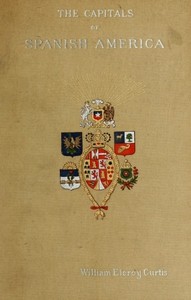
The Capitals of Spanish America — Key Ideas to Explore
(7 User reviews)
1738
Project Gutenberg
2015
Not confirmed
Latin America -- Description and travel; Cities and towns -- Latin America; Capitals (Cities) -- Latin America
Readers of public-domain and historical texts
Project Gutenberg digital edition
en
Edition facts
Words
181,429
Reading time
789 min
Text sections
30
For The Capitals of Spanish America — Key Ideas to Explore, the stored edition analysis reports 181,429 words, 13 hr 9 min estimated reading time, and 30 detected text sections.
The text analysis averages about 25.9 words per sentence, while the detected sections provide another way to judge how the source is divided.
Project Gutenberg metadata also associates the work with “Latin America -- Description and travel,” connecting these edition facts with the source record’s subject description.
Source:
Project Gutenberg record #50298
William Eleroy Curtis's 1888 travelogue surveys nine Spanish American capitals, blending diplomatic reportage with vivid street-level observations. The excerpts reveal a keen eye for contrasts: Lima's bull-baiting as 'high-toned athletic sport,' Chinese merchants dominating silk trades, and nuns producing both lace and confectionery. Curtis frames these details within a commercial and political agenda, making the work a hybrid of guidebook and trade mission brief.
Editorial Edition Score
4.9/5
★★★★★
★★★★★
Calculated from edition completeness, EPUB availability, text structure and catalogue metadata. Not a user rating.
How this score is calculated
- Description quality20 pts
- Title & short description10 pts
- Source metadata20 pts
- Text length15 pts
- Chapters / structure15 pts
- EPUB file integrity20 pts
Total of 100 points, scaled to a 2.5-5.0 range. Editions with an empty description or a missing EPUB file are not scored.
Edition quality
Read the Text
orgeous palace, and its foundations still endure. Here the rigid ceremonial etiquette of Aztec imperialism was enforced, and human sacrifice was made to invoke the favor of the Sun.
In Mexican society one meets many notable people; some are remarkable for talent, or their birth, etc., and others for the strange vicissitudes of their lives. For example, in an obscure little house lives a well-educated gentleman who is, by lineal descent from Montezuma II., the legal heir to the Aztec throne, and should be Emperor of Anahuac. This Señor Montezuma, however, indulges in no idle dream of the restoration of the ancient Empire, and quietly accepts the meagre pension paid him by the Government. In contradistinction to this scion of the house of Montezuma, the heirs of Cortez receive immense revenues from the estates of the “Marquis del Valle” (Cortez), live in grand style, and are haughty and influential. There is also a lineal descendant of the Indian emperor Chimalpopoca. This young man is a civil engineer, industrious, and quite independent.
The acknowledged heir to the throne of Mexico is young
Augustin Yturbide, according to the feelings of the few and feeble remnants of the Monarchical party; but it may be said to the young man’s credit that he entirely repudiates their homage, although he is the heir to two brief and ill-starred dynasties. He is the grandson of the Emperor Augustin Yturbide, and the adopted heir of Maximilian and Carlotta. The Yturbide they call “Emperor” was an officer in the Spanish army when Mexico was a colony, and during the revolution headed by the priest Hidalgo, in 1810, he fought on the side of the King. But, being dismissed from the army in 1816, he retired to seclusion, to remain until the movement of 1820, when he placed himself at the head of an irregular force, and captured a large sum of money that was being conveyed to the sea-coast. With these resources he promulgated what is known in history as “the plan of Iguala,” which proposed the organization of Mexico into an independent empire, and the election of a ruler by the people. The revolution was bloodless, and in May, 1822, Yturbide proclaimed himself Emperor, declared the crown hereditary, and established a court. He was formally crowned in the July following, but in December Santa Anna proclaimed the Republic, and after a brief and ignominious reign Yturbide left Mexico on May 11, 1822, just a year, lacking a week, from the date he assumed power. The Congress gave him a pension of $25,000 yearly, and required that he should live in Italy; but impelled by an insane desire to regain his crown, in May, 1824, he returned to Mexico, and was shot in the following July.
He left a son, Angel de Yturbide, who came to the United States with his mother, and was educated at the Jesuit College at Georgetown, District of Columbia, the Government having given them a liberal pension. There he fell in love
with Miss Alice Green, the daughter of a modest but prosperous merchant of the town, and married her. They had one child, the so-called Prince Augustin, who, when three years old, with the consent of his ambitious mother, was adopted by the childless Maximilian and Carlotta, in the vain hope that the act might in a measure increase their popularity among the Mexicans.
Meanwhile Maximilian’s fate was fast overtaking him. When he saw the catastrophe was at hand, he determined to save the young Yturbide, and with the assistance of the Archbishop of Mexico notified Madame Yturbide that her child would be placed on a certain steamer reaching Havana at such a date; and it was there the mother was united to him after a separation of two years. Maximilian and Carlotta had surrounded the young prince with all the elegancies of royalty, and he retained many of their royal gifts. His father was then dead, and his mother had sole charge of his education. He was educated at Washington, where Madame Yturbide lived in a fine house on the corner of Nineteenth and N streets. When her son came of age she sold her house and returned with him to Mexico. His intention was to enter the army at once, but by the advice of his Mexican friends he entered the national military college for a course of study before taking his commission. He is a handsome young man, very quiet and prepossessing. His abilities can scarcely be judged so far, but he has always conducted himself with great good-sense. Madame Yturbide is now with him in Mexico. One of the most promising signs of the permanency of the Republic is the presence in the party of progress of this young man, whose name represents all the ancient aristocracy desires to restore. He has inherited two worthless crests; but, whether from policy or principle, has added his youthful strength and the traditions that surround his name to the support of the Diaz administration.
The widow of General Santa Anna is a woman who played a prominent part in the political tragedies that have succeeded one another with such great rapidity upon the Mexican stage. Until her death in the autumn of 1886, she was an object of interest to all visitors to the capital, and always welcomed cordially strangers who called upon her, provided they would permit her to smoke her cigarettes, and talk about her beauty and the attentions she had received in the past.
Santa Anna is not so highly estimated in Mexico as in some other parts of the world where people are not so familiar with his eccentric and adventurous career. He was a man of remarkable natural abilities, force of character, energy, and personal courage, but devoid of principle, education, culture, and mindful only of his own interests. He served all political parties in turn. She was his second wife, and was only thirteen years old when he married her, in the fifth term of his presidency, and when he was trying to set himself up as an absolute monarch. For twenty years her life was spent in a camp, surrounded by the whirl of warfare. Her husband was five times President of Mexico, and four times Military Dictator in absolute power. He was banished, recalled, banished again, and finally died, denounced by all as a traitor. She had seen much “glory,” and had received unlimited adulation, but she hardly ever enjoyed one thoroughly peaceful month in her life.
It created a sensation in Mexico when the pretty peon girl, Dolores Testa, was suddenly raised from abject poverty to affluence. The Dictator ordered all to address his bride as “Your Highness,” ladies-in-waiting were appointed in order to teach the bewildered little Dolores how to play her rôle in the great world, and then the President organized for her a body-guard of twenty-five military men, who were uniformed in white and gold, and were styled “los Guardias de la Alteza” (her Highness’s Body-guard). When the President’s wife attended the theatre these guards rode in advance of and at the sides of the coach, each bearing a lighted torch. During the performance they remained in the _patio_ or _foyer_ of the theatre, and then escorted her Highness back to the palace in the same order. Such was the power of General Santa Anna in those days that even the clergy bent before him; and when
his young wife went to mass, the priests, attended by their acolytes, actually used to leave the cathedral to meet her on the pavement, and with cross and lighted tapers escort her from her carriage to her seat within the church, and at the conclusion of the mass accompanied her to her coach.
Her last days were quite in contrast with the glory of her youth. She owned a residence in the city and a lovely country-seat in Tacubaya, the aristocratic suburb; her wardrobes and chests were filled with rich robes of velvet, satin, and silk, costly laces, and magnificent jewels; but she was too listless to interest herself in anything. No stranger who by chance might see her ex-highness at home, with her pretty feet thrust into down-trodden old leather shoes, and her unkempt hair covered by a common cotton _rebosa_, could ever, by the greatest effort of imagination, possibly fancy her to be the same person who once dazzled Mexico by a display of pomp that exceeded even that of the Empress Carlotta. Mrs. Santa Anna was an estimable woman, but was almost forgotten by the generation that once bent before her. Her family plate, and the diamond snuffbox which was presented her husband when he was Dictator, and cost twenty-five thousand dollars, were, during the latter years of her life, and still are, in the National pawn-shops of Mexico, and his wooden leg, captured in battle during our war with Mexico, is in the Smithsonian Institute.
The family of the great Juarez, the Washington of Mexico, an Aztec peon, who overthrew the empire of Maximilian as Cortez had overthrown the ancient dynasty of his ancestors, live in good style in the city of Mexico, the daughters being well married, and the son the secretary of the Mexican legation at Berlin. They all talk English well, and are very highly educated. Every American who visits their city is handsomely entertained by them.
But time spent in conjecturing the future of the aristocratic or clerical party is wholly wasted. No priest, no bishop, is allowed by law to hold real estate; titles vested in religious orders are worthless; the Church is forbidden to acquire wealth, and has been stripped of the accumulated treasures of three centuries. The candlesticks and altar ornaments are gilt instead of gold, and the heavy embroideries in gold and silver have been replaced by tinsel. A solid silver balustrade which has stood in one of the churches since the time of Cortez was torn down not long ago and taken to the mint, and a chandelier in the cathedral of Puebla, when it was melted, made sixty thousand silver dollars.
There still stands in the cathedral at Guadalupe, on the spot where the Mother of Christ appeared to a poor shepherd and stamped her image in beautiful colors upon his cotton _serape_, a double railing from the altar to the choir, perhaps sixty feet long and three feet high, which is said to be of solid silver, with considerable gold. This is the only one of the remnants of pontifical magnificence which remains undespoiled, for the superstition which pervades all classes of society has protected it; but the altars have been stripped of the jewels which were bestowed by grateful people who had received the protection of the Virgin, who watches over those in distress, and the veneering of gold which once covered the altar carvings has all been ripped off. It is said that an enterprising American offered to replace the solid silver railing with a plated one, and give a bonus of three hundred thousand dollars to the Church, but the proposition was rejected.
This Guadalupe shrine is the most sacred spot in Mexico, and to it come, on the 12th of each December, the anniversary of the appearance of the Virgin, thousands upon thousands of pilgrims, bringing their sick and lame and blind to drink of the miraculous waters of a spring which the Virgin opened on the mountain-side to convince the sceptical shepherd of her divine power. The waters have a very strong taste of sulphur, and are said to be a potent remedy for diseases of the blood. In testimony of this the walls of the chapel, which is built over the spring, are covered with quaint, rudely written certificates of people who claim to have been miraculously cured by its use. In the cathedral are multitudes of other testimonials from people who have been preserved from death in danger by having appealed for protection to the Virgin of Guadalupe; but nowadays, instead of sending jewels and other articles of value as they did when the Church was able to protect its property, they hang up gaudily painted inscriptions reciting specifically the blessings they have received. On the crest of the hill is a massive shaft of stone, representing the main-mast of a ship with the yards out and sails spread. This was erected many years ago by a sea-captain who was caught in a storm at sea, and who made a vow to the Virgin that if she would bring him safe to land he would carry his main-mast and sails to Guadalupe, and raise them there as an evidence of his gratitude for her mercy. He fulfilled his vow, and within the double tiers of stone are the masts and canvas.
In the cathedral is the original blanket, or _serape_, which
the shepherd wore when the Virgin appeared to him, and upon which she stamped her portrait. It is preserved in a glass case over the altar, and may be seen by paying a small fee to the priest. Copies of the Guadalupe Virgin are common and familiar; one can scarcely look in any direction in Mexico without seeing the representation upon the walls of a house, or pendent from the watch-chain of a passer-by; but the average reproduction is a great improvement upon the original, which is a dull and heavy daub, without any evidences of skill in its execution, or even the average degree of accuracy in drawing. According to the story, the portrait was stamped upon the _serape_ or blanket of the shepherd, and this all Catholics in Mexico devoutly believe; but a close examination reveals the fact that it is done in ordinary oil colors, upon a piece of ordinary canvas, and that the pigments peel off like those of any poorly executed piece of work.
In the ancient town of Guadalupe, in a house near the cathedral, was signed the famous treaty determining the boundary line between Mexico and the United States, while in a cemetery on the hill General Santa Anna lies buried.
The Mexican people, like all the Spanish race, are fond of ceremony, but the inauguration of their President is not attended with so much display or interest as is shown on similar occasions on this side of the Rio Grande. Perhaps it is because the event occurs so often. During the two hundred and eighty-six years between the fall of the Empire and the establishment of the Republic, there were but sixty-four Viceroys; but during the sixty-three years that followed there have been thirty-two Presidents, seven Dictators, and two Emperors. Although the constitutional term of the presidency is four years, but two in the long list were permitted to serve out their time, and they were the last, which at least shows improvement in the political condition of the country.
I witnessed the inauguration of President Diaz on the 1st of December, 1884. The ceremonies, which were simple enough to satisfy the most critical of Democrats, took place in the handsome theatre erected in 1854, and named in honor of the Emperor Yturbide. It is now called the Chamber of Deputies, and is occupied by the lower branch of the National Legislature, a body of some two hundred and twenty-seven men. The Senate, composed of fifty-six members, meets in a long, narrow room in the old National Palace which was formerly used as a chapel by the Viceroys. The viceregal throne, a massive chair of carved and gilded rosewood, still stands upon a platform opposite the entrance, under a canopy of crimson velvet, but upon its crest is carved the American eagle, with a snake in its mouth, the emblem of Republican Mexico. Maximilian hung a golden crown over the eagle; Juarez tore it down and placed the broken sword of the Emperor in the talons of the bird. The Aztecs say that the founders of their empire, whose origin is lost in the mists of fable, were told to march on until they found an eagle sitting upon a cactus with a snake in its mouth, and there they should rest and build a great city. The bird and the bush were discovered in the valley that is shadowed by the twin volcanoes, and there the imperishable walls were laid which are now bidding farewell to their seventh century.
The old Theatre Yturbide has not been remodelled since it became the shelter of legislative power, and all the natural light it gets is filtered through the opaque panels of the dome, so that during the day sessions the Deputies are always in a state of partial eclipse. It is about as badly off for light as our own Congress. The members occupy comfortable arm-chairs in the parquet, arranged in semicircular rows. The presiding officer and the secretaries sit upon the stage, and at either side is a sort of pulpit from which formal addresses are made, although conversational debates are conducted from the floor. The orchestra circle and galleries are divided into boxes, and are reserved for spectators, but are seldom occupied, as the proceedings of the Congress are not regarded with much public interest.
The members of both Houses have no regular seats, but sit where they please. As they have few constituents to write to, they use no desks. There are some that might be used, but never are. The members vote themselves no stationery, postage-stamps, or incidentals, as our Congressmen do, but are paid two hundred and fifty dollars a month during the two years for which they are elected. Habit and the exercise of military power have reversed the constitutional relations of the executive and legislative branches of the Government, and the business of the Congress sometimes is not to pass bills for the approval or disapproval of the President, but to enact such legislation as he recommends. The members of the Cabinet have seats in both houses of the Congress, participate in the debates, and submit measures for consideration, but have no vote; and the President himself often exercises his constitutional right to meet and act with the Legislature. Very seldom is a law passed that does not come prepared and approved by the Executive Department, and to oppose the policy of the administration is usually fatal to the ambition of Mexican statesmen.
In appearance the members will compare favorably with those of our Congress, and they are far in advance of the average State Legislature in ability and learning. The first features that strike a visitor familiar with legislative bodies in the United States is the decorum with which proceedings are conducted, and the scrupulous care with which every one is clothed. On certain formal occasions it is usual for all of the members to appear in evening dress, which gives the body the appearance of a social gathering rather than a legislative assembly. Nine-tenths of the members are white, and the other tenth show little trace of Aztec blood. There is never anything like confusion, and the laws of propriety are never transgressed. One hears no bad syntax or incorrect pronunciation in the speeches; no coarse language is used, and no wrangles ever occur like those which so often disgrace our own Congress. The statesmen never tilt their chairs back, nor lounge about the chamber; their feet are never raised upon the railings or desks; there is no letter-writing going on; the floor is never littered with scraps of paper; no spittoons are to be seen, and no conversation is permitted. Extreme dignity and decorum mark the proceedings, which are always short and silent, and the solemnity which prevails gives a funereal aspect to the scene.
But everybody smokes. The secretary lights a cigarette at the end of a roll-call, and the chairman blows a puff of smoke from his lips before he announces a decision. The members are constantly rolling cigarettes with deft fingers, and the people in the galleries do the same, so that a cloud of gray vapor always hangs over the body, and in the dark corners of the chamber one can see the glow of burning tobacco like the flash of fire-flies. But cigars are never used, nor pipes, and no one chews tobacco.
Whole sessions pass away with nothing but formal business, such as receiving communications from the Executives of the States or petitions from the people, which are rarely acted on. Occasionally a bill is passed, but it passes almost as a matter of course, some of the members giving a delicate little wave of the hand to the secretary as he calls their names by sight, others merely smiling at him, some paying no attention whatever to him, but none of them taking the trouble to open their mouths or rise, as the rules require. Weeks and months pass away without a speech of any kind, or even a point of order.
William Eleroy Curtis, former secretary of the South American Commission, opens his 1888 travelogue with a dedication to President Chester A. Arthur, whose letter frames the book as a tool for expanding U.S. trade and goodwill. The excerpts that follow, however, reveal a writer equally attentive to the textures of daily life: a Peruvian milk-peddler riding astride a mule, the sale of young women's photographs like souvenirs, and bull-baiting described as a sport akin to Newport polo. Curtis moves between diplomatic purpose and ethnographic curiosity, producing a record that is at once commercial brief and cultural inventory.
Commerce and Custom in the Marketplace
Curtis repeatedly notes who controls which trade. In Lima, Chinese merchants monopolize mantas and silk dress-goods; Italians run the bodegas and eating-houses; the American house of Grace Brothers practically monopolizes Peru's foreign trade. These observations are not asides but central to his project: a book dedicated to a president who believed the nation's commercial prosperity required new southern markets. The author's eye for economic detail—who sells, who buys, who profits—turns a travel narrative into a kind of commercial census.
Yet the same passages also linger on the picturesque: nuns embroidering skirt-fronts and molding sugar into artistic shapes, a custom 'handed down from the days of the viceroys.' Curtis does not resolve the tension between modern commerce and inherited craft; he simply records both, leaving the reader to weigh the forces shaping these capitals.
The Social Stage: Bull-Baiting and Buena Noche
Two entertainments dominate the Lima excerpts. Bull-baiting, where young men plant tin darts in the animal's hide, is described as 'a very high-toned sort of athletic sport, like polo at Newport.' The comparison is telling: Curtis translates a local practice into a familiar American idiom, even as he notes the real danger—'fair señoritas have seen their lovers badly gored.'
The Buena Noche festival, by contrast, offers a gentler scene: band music, fireworks, ice-cream vendors, and the chance for couples to promenade in the plaza 'murmuring soft nothings' until midnight. Curtis frames these events as rare opportunities for courtship, suggesting a society where public sociability is both regulated and prized. His tone is observational, not judgmental, but the juxtaposition of violence and romance underscores the range of social rituals he documents.
Photography, Portraiture, and the Commerce of Likeness
A striking passage describes Lima's photography galleries, where portraits of young women line the walls and are sold at news-stands 'like views of Niagara Falls or Coney Island.' Curtis notes that in Havana and Venezuela, such a photograph signals an engagement, but in Peru 'it signifies nothing.' The detail is precise and culturally specific: a single object—a photographic portrait—carries radically different meanings across Spanish America.
Curtis does not elaborate on why this difference exists, but his observation invites reflection on how commerce reshapes intimacy. The same market forces that sell silk and sugar also commodify faces. The author's own role as a collector of such images—'strangers usually take home collections of the pictures of beauties'—blurs the line between traveler and consumer, reminding the reader that this book, too, is a kind of portrait gallery offered for sale.
Curtis's account resists easy summary: it is part trade report, part social sketch, part personal narrative. Readers will find the most value by attending to the specificities—the Chinese silk merchant, the nun-made confection, the bull-baiting as sport—rather than seeking a unified argument. The book's strength lies in its accumulation of concrete detail, each observation a fragment of a larger, unfinished portrait of a continent in transition.
There’s something poignant in how Curtis watched Lima’s bustling trades and quiet convents side by side, the world’s commerce brushing against cloistered lace. It reminded me of that same layered feeling in Paris and the Parisians in 1835 (Vol. 1) — Background and Themes, where a city’s pulse beats beneath every passing carriage and candlelit window. Both books feel like holding a faded photograph, knowing those streets have since changed forever.
Leo Harris
1 month agoMila Thomas
1 week agoLeo Gonzalez
1 week agoWyatt Ramirez
1 month ago-

Christine Perry - 1 month ago
{'rating': 2, 'text': "Despite the impressive scope, this book feels overly long and repetitive in its descriptions of city layouts and buildings. The author's colonialist attitude towards the local populations is off-putting to modern readers. The lack of visual aids and the dense, dated language make it a challenging read. Only recommended for those with a deep academic interest in the subject."} -
Maria Weber - 2 weeks ago
{'rating': 3, 'text': "A useful and informative account of the major cities of Spanish America, covering both well-known and lesser-known capitals. The descriptions are rich in detail, but the book could benefit from more maps and illustrations to aid the reader. The author's perspective is somewhat Eurocentric, but overall it's an interesting historical snapshot."} -
Melissa Kirk - 1 week ago
{'rating': 5, 'text': 'An excellent historical travelogue that vividly brings to life the capitals of Spanish America in the late 19th century. The author provides insightful observations on the architecture, culture, and politics of each city, enriched with personal anecdotes. This book is a valuable resource for anyone interested in Latin American history and a captivating read for those who enjoy classic travel writing.'}
Reader reflection
Record your reading impressions
A brief reflection can help important ideas stay with you longer.
Your progress
0
/
10
2
How did the book work for you overall?
3
Is this a title you would suggest to others?
4
Did the language feel accessible?
5
Would a second reading be valuable?
6
Did the book give you something worth debating?
7
Was the book easy to understand?
8
Did this book create an emotional response?
9
What is the main idea you are taking away?
10






Madison Robinson
1 month ago