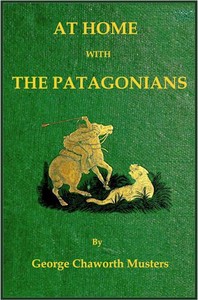
At home with the Patagonians — Reading Notes
Edition facts
At home with the Patagonians — Reading Notes can be approached with a clearer sense of reading commitment from its source measurements: 139,159 words, 10 hr 6 min estimated reading time, and 15 detected text sections.
The text analysis averages about 25.4 words per sentence, while the detected sections provide another way to judge how the source is divided.
Project Gutenberg metadata also associates the work with “Patagonia (Argentina and Chile) -- Description and travel,” connecting these edition facts with the source record’s subject description.
Calculated from edition completeness, EPUB availability, text structure and catalogue metadata. Not a user rating.
How this score is calculated
- Description quality20 pts
- Title & short description10 pts
- Source metadata20 pts
- Text length15 pts
- Chapters / structure15 pts
- EPUB file integrity20 pts
Total of 100 points, scaled to a 2.5-5.0 range. Editions with an empty description or a missing EPUB file are not scored.
Read the Text
FROM THE STRAITS TO SANTA CRUZ. PAGE Journey Planned. -- Preparations. -- Passage from Stanley. -- The Straits. -- First Footsteps in Patagonia. -- The Narrows. -- Punta Arenas. -- Commandante Viel. -- The Colony. -- The Town. -- Chilotes and Convicts. -- Resources. -- Visit to the Coal Bed. -- Lieut. Gallegos. -- The Start. -- Rio Chaunco. -- The Patagonian Pampas. -- Our Party. -- Cabecera del Mar. -- Oazy Harbour. -- A useless Chase. -- A Fireless Night. -- Volcanic Hills. -- Pampa Yarns. -- Rio Gallegos. -- First Indians. -- Sam Slick. -- Rio Cuheyli. -- Meeting with Tehuelches. -- Caravan of Women. -- 'Anglish' Politeness. -- Desert. -- Santa Cruz at last 1
Introduction to Chiefs. -- Orkeke. -- Chilian Deserters. -- The Settlement. -- Island of Pabon. -- Natural Advantages. -- The Mission Station. -- Mr. Clarke. -- Our Circle at Pabon. -- Expedition to Lake Viedma. -- Winter Occupations. -- Work and Play. -- Casimiro's Adventures. -- His Character. -- A Winter Hunting Excursion. -- A Pampa Snow-storm. -- The Santa Cruz Valley. -- Up the River. -- The Northern Hills. -- Pumas. -- Devil's Eyes. -- Hunting on Foot. -- Intense Cold. -- Return of the Deserters. -- Visit to the Indian Camp. -- First Night in a Toldo. -- Towing a Horse. -- Adieu to Santa Cruz 33
Breaking up of the Camp. -- An Idle Day. -- A Rash Start. -- A Dilemma. -- Alone on the Pampa. -- Reunion. -- The Kau or Toldo. -- The Domestic Interior. -- The Indian Tribes. -- Three Races. -- Order of the March. -- The Hunt. -- Indian Game Law. -- Tehuelche Cookery. -- Basaltic Hills. -- An Indian Festival. -- My First Tehuelche Ball. -- Mrs. Orkeke's Spill. -- Fording Rio Chico. -- A Battle. -- Death of Cuastro. -- Dangerous Times. -- Chilian Conspiracy. -- Obsidian Plain and Pass. -- First Ostrich Eggs. -- Amakaken. -- Lifting the Boulder. -- The Devil's Country. -- God's Hill. -- Condors and Dinner. -- Sunrise on the Cordillera. -- The Plague Herald. -- Gelgel Aik. -- Escape from Matrimony. -- Téle. -- Eyes of the Desert. -- Preparations for War. -- Another Fight. -- Water Tigers. -- Indian Bravoes. -- Iron Ores. -- Ship Rock. -- Perch Fishing. -- Appley-kaik. -- Casimiro's Escape. -- Arrival at Henno 62
Ceremonial of Welcome. -- Hinchel's Indians. -- Tehuelches and Araucanos. -- Jackechan and the Chupat Tribe. -- My Examination. -- Encampment at Henno. -- Peaceful Occupations. -- The Oldest Inhabitant. -- Chiriq. -- The Hidden Cities. -- Modern Legends. -- Mysteries of the Cordillera. -- Los Cesares. -- La Ciudad Encantada. -- Its Whereabouts. -- The Indian Cesares. -- The Guanaco. -- The Patagonian Ostrich. -- Neighbourhood of Chiriq. -- Horseracing. -- Indian Horses. -- Indian Dogs. -- Dog and Lover. -- Plaiting Sinews. -- Windy Hill. -- Surrounded by Fire. -- Young Guanaco. -- Arrival of Grog. -- News from Santa Cruz. -- Gisk. -- Romantic Scenery. -- A Pleasant Neighbourhood. -- Fairy Glen. -- Breaking a Horse. -- Female Curiosity. -- The Wild Cattle Country. -- The Forests of the Cordillera. -- The Watershed. -- Among the Mountains. -- Wild Flowers. -- A Bull Fight. -- The Bull Victorious. -- No Christmas Beef. -- Teckel. -- Change of Quarters 108
MANNERS AND CUSTOMS OF THE TEHUELCHES.
Patagonian Giants. -- A Long Walk. -- Strength and Good Humour. -- Heads of Hair. -- Tehuelche Coquettes. -- Dress of Men and Women. -- Ornaments and Cosmetics. -- Toilette and Bath. -- Arms and Implements. -- Ancient Bolas and Arrows. -- Saddles and Bridles. -- Silversmiths. -- Manufacture of Mantles. -- Women's Work. -- Diet and Cookery. -- Smoking. -- Card Playing. -- Game of Ball. -- Ceremonies at Birth. -- Childhood. -- Marriage. -- Funeral Rites. -- Religion. -- Demons and Doctors. -- Witchcraft and Omens. -- Medical Skill. -- Population and Politics. -- Etiquette. -- Tehuelche Character. -- Natural Affection. -- Advice to Travellers 157
Casimiro's Household. -- Carge-kaik. -- Quintuhual's Son. -- Woolkein. -- Partridges. -- Meeting with the Araucanians. -- The Cacique Quintuhual. -- Esgel-kaik. -- Araucanian Belles. -- Communication with Chupat Colony. -- Diplaik. -- Calficura's Declaration of War. -- Tehuelches learn Fishing. -- My Indian Relatives. -- Woodland Rambles. -- An Indian Paradise. -- The Upper Chupat. -- Cushamon. -- Losing Horses. -- Official Functions. -- Message from Las Manzanas. -- Blessing the Liquor. -- Casimiro Intoxicated. -- Foyel's Encampment. -- Great Parlemento. -- Foyel's Ideas. -- Gatchen-kaik. -- Arrival at Geylum 189
Catching a Thief. -- Miss Foyel. -- Start for Las Manzanas. -- First View of the Apple Groves. -- Omens of War. -- Inacayal's Tolderia. -- Crossing the Rio Limay. -- Mr. Cox's Shipwreck. -- Lenketrou's Raid. -- A Night of Alarm. -- Bravery of my Cousins. -- The Great Cheoeque. -- A Mounted Parlemento. -- Apples and Piñones. -- Graviel's Madness. -- Las Manzanas. -- Cheoeque's Palace. -- The Revels. -- Feuds between the Chiefs. -- The Picunches and the Passes to Valdivia. -- Trading and Politics. -- Resolutions of Peace. -- A Grand Banquet. -- Power of Cheoeque. -- Araucanian Customs. -- Farewell Presents. -- Invitation to Return. -- Orkeke's Generosity. -- Return to Geylum. -- Outbreak of an Epidemic. -- My Pretty Page. -- Departure from Geylum 218
A Sick Camp. -- Oerroè Volcanic Hill. -- Crimè's Deathbed. -- Graviel's Promotion. -- The Burning Ground. -- Hot Springs. -- Fighting the Gualichu. -- A Real Fight. -- A Soda Lake. -- Encampment at Telck. -- The Doctor comes to Grief. -- An Obliging Ostrich. -- Appointed Chasqui. -- Miseries of Pampa Life. -- A Bad Time. -- The Plains of Margensho. -- Casimiro's Distrust. -- Doctor and Sick Child. -- Duties of a Messenger. -- Departure of the Chasquis. -- Travelling Express. -- The Paved Pampas. -- An Ideal Bandit. -- Letter from the Chupat Colony. -- Trinita. -- Teneforo's Pampas. -- Champayo's Generosity. -- A Morning Drink. -- Departure from Trinita. -- Valchita. -- The Pig's-Road. -- Wild Horses. -- The Travesia. -- Limit of the Patagonian Fauna and Flora. -- First View of the Rio Negro. -- Sauce Blanco. -- The Guardia. -- San Xaviel. -- Approach to Patagones. -- Señor Murga. -- Welsh Hospitality. -- Among Friends at Last 247
THE RIO NEGRO SETTLEMENTS.
Patagones, or Carmen Old Town. -- The Fort and Buildings. -- The Southern Town. -- The English Mission. -- Elements of the Population. -- The Negroes. -- The Convicts. -- Lawless State of Society. -- The Cemetery. -- Early History of the Colony. -- A Successful Stratagem. -- Villarino's Ascent of the River. -- Expedition of Rosas. -- The Island of Choelechel. -- La Guardia Chica. -- Estancia of Messrs. Kincaid. -- Ancient Indian Graves. -- Flint Weapons. -- The Shepherd and Pumas. -- Estancia San André. -- The Indians and the Colonists. -- Calficura's Raid. -- Indian Method of Attack. -- The Tame Indians. -- View of the Valley. -- Trade of Patagones. -- Fertility of the Soil. -- Rio Negro Wine. -- The Sportsman. -- Advice to Emigrants. -- Interview with Col. Murga. -- The Government Grants to Chiefs. -- Casimiro again. -- The Tehuelches in Town. -- Farewell. -- The Welsh Utopia. -- Social Life at Patagones. -- The Steamer at Last. -- Aground. -- The Pilot. -- Pat Sweeny. -- Adieu to Patagonia 288
A.--A partial Vocabulary of the Tsoneca Language as spoken by the Northern Tehuelches 319
B.--Testimony of successive Voyagers to the Stature of the Patagonians 323
LIST OF ILLUSTRATIONS.
WÁKI KILLING A PUMA _Frontispiece_
MAP OF PATAGONIA _at the end_
STATION ON PABON ISLAND, RIO SANTA CRUZ _to face p._ 37
HUNTING GUANACO AND OSTRICH, VALLEY OF RIO CHICO _p._ 64
START FROM THE CAMP AT MÔWAISH, OR WINDOW HILL 75
CEREMONY OF WELCOME (TEHUELCHES AND ARAUCANIANS) 110
A WILD BULL IN THE CORDILLERA 151
SKETCH MAP FROM RIO SENGEL TO TECKEL 156
TEHUELCHE ARMS AND IMPLEMENTS 164
THE PRETTY HOUSE AND DANCE 175
CROSSING THE RIO LIMAY 223
Three hundred and fifty years ago the great navigator Magellan anchored in a port on the eastern coast of an unknown shore, part of the seaboard of the vast continent of South America, to which he gave the name of St. Julian. Starting from this point, the pilot Serrano explored the coast to the southward, and discovered a river, which he named Santa Cruz. His ship was wrecked near the mouth, and left her timbers on the rocks, the first of the long list of vessels lost on that ironbound coast which, from the mouth of the Rio Negro to the Straits, offers but one or two safe harbours, while submerged reefs, fierce gales, strong tides, currents, and overfalls combine to render it nearly the most perilous known to navigators.
Magellan remained at Port St. Julian and Santa Cruz from April till October of 1520, when he sailed southward, and discovered the Straits which bear his name. Two months after his arrival at Port St. Julian a man of gigantic stature appeared on the beach, 'larger and taller than the stoutest man of Castile.' Eighteen natives afterwards arrived, dressed in cloaks of skins and shoes of guanaco hide, which made huge footmarks, whence they were called Patagonés, or 'large feet,' by the Spaniards; and thus originated in a nickname the name of the country, Patagonia. These men used bows and arrows, and had with them four young guanacos, with which they decoyed the wild ones within shot. Two young men were treacherously seized and carried off, howling and calling on their god Setebos. The natives naturally resented this return for their ready friendliness, and, attacking a party sent after them, killed one Spaniard with their arrows. Enough, however, was seen of them to furnish Pigafetta with some details. 'Their tents were light movable frames, covered with skins; their faces were painted; they were very swift of foot, had tools of sharp-edged flints, and ate their meat nearly raw.'
That the first knowledge of Patagonia was diffused in England by Pigafetta's narrative is suggested by Caliban's lines in the 'Tempest:' 'he could command my dam's god Setebos;' but it was not till 1578 that the newly-discovered country was visited by Englishmen.
Sir Francis Drake in that year anchored in Seal Bay--probably a little to the south of Port Desire--and saw several Indians. His chaplain narrates their method of stalking the ostriches: 'They have a plume of ostrich feathers on a long staff, large enough to hide a man behind, and with this they stalk the ostriches.' He further says: 'They would have none of our company until such time as they were warranted by their God "Settaboth." They never cut their hair, which they make a store-house for all the things they carry about--a quiver for arrows, a sheath for knives, a case for toothpicks, a box for fire sticks, and what not; they are fond of dancing with rattles round their waists; they have clean, comely, and strong bodies, are swift of foot, very active, a goodly and lively people. Magellan was not altogether wrong in naming them giants, yet they are not taller than some Englishmen.' Drake next visited Port St. Julian; and, curiously enough, as Magellan had in this place put to death two and marooned a third of his captains who mutinied, so this harbour was the scene of the execution of Mr. Doughty, who chose rather to be beheaded than to be put on shore. The ensuing year Sarmiento was despatched from Callao to examine the Straits in search of the daring Englishman. He saw natives who chased their game on horseback, and brought it down with bolas. But fifty years had elapsed since horses had been imported by the Spaniards of the Rio de la Plata, and already the Indians in the far south had become horsemen, and would seem to have exchanged their bows and arrows for the bolas.
In 1581 Sarmiento was sent from Spain with 2,500 men in twenty-three ships, to found new colonies in the Straits, and established a settlement, leaving 400 men and thirty women, furnished with eight months' provisions. On his way home his ship was captured by the English, and the unhappy colonists were altogether forgotten and neglected by their Government.
Five years after, Thomas Cavendish anchored in a bay to the south of St. Julian, called by him Port Desire, which perpetuates the name of his little craft of 120 tons. Here the natives attacked his men with bows and arrows. Visiting the Straits, he arrived at the settlement, and found only twelve men and three women surviving, the rest having perished of slow starvation and disease; and the name of the place, Port Famine, conferred by him, still recalls the miserable fate of these ill-fated colonists.
On his next voyage, in 1591, Cavendish died; but John Davis twice visited Port Desire, and explored the river for twenty miles. During his stay some 1,000 natives visited the strangers, and Knyvet describes them as being fifteen or sixteen span high.
Passing over the visits of Van Noort and Schouten, in the reign of Charles the Second Sir John Narborough took possession of the country near Port Desire in the name of the King. But few natives were seen, and the mate, Mr. Wood, boastingly declared that he himself was taller than any of them.
In the eighteenth century Byron and Wallis successively visited the shores of Patagonia, and made friends with the natives, whose height was found to be from 5 feet 10 inches to 6 feet, while some were nearly 7 feet high.
In 1774 the Jesuit Father Falkner published his work on Patagonia, containing all the information procured by himself and the other Jesuit missionaries who had attempted to obtain a footing on the western and northern boundaries. His account of the Tehuelches, or Tsoneca Indians, was evidently derived from personal communication with them, although his knowledge of the topography of their country seems to have been procured from the reports of others. By this work, which produced a great sensation, the jealous fears of the Spanish Government were aroused, and they hastened to despatch an expedition to form settlements on the coast of Patagonia.
Of the brothers Viedma, who were sent in command, Francisco founded Carmen at the mouth of the Rio Negro, and Antonio, after first fixing on Port Desire, determined finally on Port St. Julian as the site of another colony. He thence undertook the first exploration of the interior in search of timber for building, in the course of which he reached the great lake at the foot of the Cordillera, from which flowed the Rio Santa Cruz. Both on the coast and in the interior he received much friendly aid from the Indians, of whom he formed a most favourable opinion.
Under his brother's auspices the Rio Negro was ascended as far as the mountains by Villarino, to whose expedition reference will be made in the proper place.
No further knowledge was gained of the interior of Patagonia until the survey of the Beagle, so ably performed and so admirably described by Fitzroy and Darwin; during which the ascent of the Santa Cruz river for 200 miles enabled the latter to observe the remarkable formations which he has so aptly described in his work on the Geology of South America.
This brief but perhaps tedious account has been given to show that although the coasts of Patagonia had been explored and surveyed, yet the interior of the country, though pierced by the expeditions of Viedma and Fitzroy, remained up to a late date still almost unknown. Its inhabitants, the Tehuelches, had been often communicated with, their stature noted, and their friendly disposition commended; but their real manners of life as they wandered through the country, and their relations with, or difference from, the Araucanian and Pampa Indians, had remained almost as much a mystery as they were in the last century.
During the last thirty years the Governments of Chili and of Buenos Ayres have shown themselves inclined to claim the possession of the coast, the former trying to advance from the Straits, and the latter from Patagones; and the natives have acknowledged the influence of either Government as they happened to be in the northern or southern parts respectively. Our missionaries also have not left the Patagonians without some efforts to instruct and evangelise them; and although these efforts have been necessarily limited to the coast, yet the fruits of Mr. Schmid's sojourn with the Tehuelches remain both in their friendly feelings and in the lasting record of the vocabulary of the Tsoneca language published by him. And the intercourse of these Indians with Argentines and Chilians, and more especially with English officers, sealers, and missionaries successively, all of whom have testified favourably to their character, has tended to make them more open to access, and to give them a knowledge of foreigners; so that in this respect I can feel that to all those who have been mentioned as having thus preceded me, this brief record is due from a traveller who has experienced the friendly feelings of the natives towards strangers, and especially Englishmen.
While engaged in preparing the ensuing pages for the press, I have had an opportunity of perusing the work of M. Guinnard, first published in French, and recently given to the English public in a spirited translation, entitled 'Three Years' Slavery among the Patagonians.' The name necessarily attracted me, but to my great surprise careful perusal led to the distinct conviction that the author's personal experiences were altogether confined to the Pampas Indians north of the Rio Negro. From his own statements and omissions it is quite evident that he was not carried by any of his successive masters across this river, which he clearly and accurately defines to be (p. 40) the northern boundary of Patagonia. The name of Patagonians is, therefore, a complete misnomer; and the curious account (pp. 72-3) of the 'Tchéouelches,' or Foot Nomads, clothed in seal skins and accustomed to live on fish, and literally destitute of horses, is applicable to no tribe whatever east of the Cordillera, the Fuegians being the only race presenting any of the characteristic habits attributed to this so-called Patagonian tribe.
I hope I may not be supposed to be desirous of impeaching the accuracy of M. Guinnard's account of the hardships endured in his captivity, or of the customs of the Indians into whose hands he fell, much of which I can corroborate; but it is to be regretted that he was induced, probably by others, to describe under the name of Patagonians, the Pampas Indians, who, by country, race, language, and character, are marked as being altogether distinct from the Tehuelches of Patagonia.
FROM THE STRAITS TO SANTA CRUZ.
Journey Planned. -- Preparations. -- Passage from Stanley. -- The Straits. -- First Footsteps in Patagonia. -- The Narrows. -- Punta Arenas. -- Commandante Viel. -- The Colony. -- The Town. -- Chilotes and Convicts. -- Resources. -- Visit to the Coal Bed. -- Lieut. Gallegos. -- The Start. -- Rio Chaunco. -- The Patagonian Pampas. -- Our Party. -- Cabecera del Mar. -- Oazy Harbour. -- A useless Chase. -- A Fireless Night. -- Volcanic Hills. -- Pampa Yarns. -- Rio Gallegos. -- First Indians. -- Sam Slick. -- Rio Cuheyli. -- Meeting with Tehuelches. -- Caravan of Women. -- 'Anglish' Politeness. -- Desert. -- Santa Cruz at last.
George Chaworth Musters opens his 1871 narrative with a frank admission: readers expecting precise scientific geography or tales of hair-breadth escapes will be disappointed. Instead, he offers a “faithful record of life with the Indians all the year round,” aiming to make his audience “really at home with the Tehuelches.” This tension between expectation and actuality runs through the book. Musters, a retired Royal Navy commander, travelled from the Straits of Magellan to the Rio Negro, living among the Tehuelche people for a year. His account is neither a dry survey nor a sensational adventure story, but a detailed observation of daily life, customs, and social structures, filtered through a Victorian naval officer’s sensibility. The preface sets the tone: he acknowledges the lack of scientific instruments and the impossibility of carrying them, yet insists his map is “so far accurate, and, if incomplete, at least is not imaginative.” This careful, self-aware framing invites readers to consider what kind of knowledge a traveller can reliably produce.
Mourning Rites and Material Evidence
One of the most detailed passages in the excerpts describes Tehuelche funeral practices. Musters notes that the body is sewn in a mantle and buried sitting upright, facing east, with a cairn of stones. He contrasts this with accounts by other travellers, such as Mr. Wood, who described graves on the sea-coast and exhumation practices. Musters is cautious: “I have never seen any of the graves described in Mr. Wood’s work… nor did the exhumation and removal of the body ever come under my notice.” He doubts such practices among the Tehuelche, citing their rule never to mention the deceased. This moment reveals Musters’ method: he weighs his own observations against others’ reports, and limits his claims to what he personally witnessed. The death of a child prompts a particularly elaborate ritual: the horse the child rode is strangled with lazos (unlike other horse killings, which use bolas), and the saddle, cradle, and belongings are burned. The parents throw valuables into the fire, some of which are snatched by wailing women as recompense. Musters records that on one occasion fourteen horses were slaughtered for an only child of rich parents. These details are not merely exotic; they show a society where material wealth is publicly destroyed to express grief, and where the rules of sacrifice differ by context.
Beliefs Without Idols
Musters devotes careful attention to Tehuelche religion, distinguishing it from that of the Pampas and Araucanians. He notes the absence of sun-worship, though the new moon is saluted with muttered words he could never hear. The Tehuelche believe in a great good Spirit, but Musters is skeptical of the creation story told by his informant Casimiro, suspecting it may be a “confused combination” with missionary teaching. He observes a “great tendency in the Indian mind” to combine marvels and cap one legend with another. Yet he affirms that they do believe in a good Spirit, who lives “careless of mankind.” There are no idols or objects of worship, and no periodical religious festival—contra other travellers, whom Musters accuses of confusing Araucanian customs with Patagonian. The driving force of religious practice is fear of malicious evil spirits, propitiated by a wizard or medicine man. Musters’ account here is notably restrained: he does not claim deep insight into belief, but reports what he saw and heard, and flags where his understanding may be incomplete. This section exemplifies his broader approach: he presents evidence, notes discrepancies with other sources, and resists over-interpretation.
The Traveller's Limitations as a Source
Throughout the excerpts, Musters is unusually explicit about the constraints on his knowledge. He could not carry instruments for scientific measurement; his map is based on compass readings and is “so far accurate.” He could not hear the words muttered at the new moon. He suspects Casimiro’s creation story may be syncretic. He distinguishes between what he saw (funerals in the interior) and what he did not (graves on the coast). This self-awareness is a defining feature of the narrative. Musters also notes the difficulty of interpreting Indian customs: “There is a great tendency in the Indian mind thus to combine the marvels told them.” He does not present himself as an omniscient observer, but as a fallible one. His preface warns readers that the book is not sensational, and his closing remarks in the excerpts reiterate that he offers a “faithful record” rather than a thrilling tale. For modern readers, this honesty is valuable: it allows us to see both what Musters observed and the limits of his perspective. His account is a primary source shaped by Victorian assumptions, but one that openly acknowledges its own gaps.
Musters’ narrative rewards readers who attend to its small, precise observations: the way a horse is killed, the muttered phrase at moonrise, the cairn that grows with each passing traveller. He does not claim to have uncovered the inner life of the Tehuelche, but he provides a record of outward practices that is unusually careful about its own reliability. Reading At Home with the Patagonians means reading with an eye for what Musters saw, what he missed, and what he chose to doubt.
Reading Musters’ steady, unassuming observation of the Tehuelche reminded me of sitting quietly in a stranger’s kitchen, listening. He admits his own blind spots so gently. That same humility surfaced years ago in The Capitals of Spanish America — Key Ideas to Explore, where travel felt less like conquest and more like a long, patient pause. Both books leave me wondering how much I ever truly see of another’s world.
Lucas Miller
1 month agoYour personal reading reflection
Build a private reading journal entry for this title.

Michael Torres
1 month ago