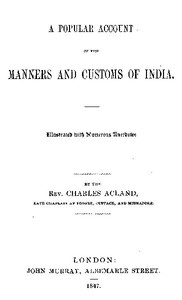
A Popular Account of the Manners and Customs of India — Key Ideas to Explore
Edition facts
For A Popular Account of the Manners and Customs of India — Key Ideas to Explore, the stored edition analysis reports 67,590 words, 4 hr 54 min estimated reading time, and 9 detected text sections.
The text analysis averages about 21.9 words per sentence, while the detected sections provide another way to judge how the source is divided.
Project Gutenberg metadata also associates the work with “India -- Description and travel,” connecting these edition facts with the source record’s subject description.
Calculated from edition completeness, EPUB availability, text structure and catalogue metadata. Not a user rating.
How this score is calculated
- Description quality20 pts
- Title & short description10 pts
- Source metadata20 pts
- Text length15 pts
- Chapters / structure15 pts
- EPUB file integrity20 pts
Total of 100 points, scaled to a 2.5-5.0 range. Editions with an empty description or a missing EPUB file are not scored.
Read the Text
a vociferation as to whose were the best. "Choop!--will ye choop?" I roared again. I then called the mollee, and desired him to turn out all the bullocks, for they had unfastened those which drew the carts, and let them all loose in the rice-ground in the compound, which was just ready for cutting. This order I hallooed out loud enough for the men to hear; and told him, as soon as he had done that, to come to me for a crowbar to break to pieces all the hackeries but six. This made them submit; and although they still continued making a great chattering, yet they soon began harnessing their bullocks. With these people we are obliged to appear very severe. They despise us as being of no caste; and were we not to be firm, they would imagine we were afraid of them.
We are now engaged in packing up our things, and shall start on the 25th, reach Balasore on the 28th, and remain there ten days, and then three days' more travelling will bring me to my head-quarters at Cuttack.
I have, with much trouble, endeavoured to persuade the people here that they ought to build a church: the Mohammedans have a splendid mosque, the Hindoos have a large temple, and yet we have no consecrated building for the worship of the true God; but, however, I hope this will be remedied. As I was passing the mosque the other day, I saw the muezzin shouting out that it was time for prayer, and stopping his ears with both hands, that he might not hear the terrible noise which he himself was making.
About a fortnight ago the judge went out shooting: he came to a large hole under the root of a tree, and heard a loud growling. He is a courageous man, so he was not afraid; but he told an Indian, who was with him, to get behind the tree, and then poke a long stick into the hole. Presently the growling became very loud and savage, and then out jumped an enormous bear, one of the most savage sort--the large black bear. The judge was ready, and shot it when it came out. On examining the hole, three young bears, only a few days old, were found. He sent for some Indians, who carried the dead body, and also the cubs, home, and then, as he knew that I was fond of animals, he sent the three little ones to me. They are very ugly, and cannot see yet. One of my goats had just had a kid, so I told the cook to make the kid into soup, and I brought the goat to the young bears. One man held the goat, another covered her eyes with his hands, and a boy held up the cubs to suck. The goat did not like it at all at first, but now she is quite contented, almost as much so as if they were her own young ones. I have given two of them away. In England you never taste goat's milk: it is most delicious; far better, I think, than cow's milk: we use it every day. Each goat, after the kid is taken from her, gives about three-quarters of a pint a-day. The judge has promised me a bottle full of the pure bear's grease.
Every one here knows that I am very fond of animals, and they are all very kind in sending them to me. I received the other day from a gentleman a present of a goat, which is quite as big as a small pony. If I were to get on its back my feet would not touch the ground; it is of a dark brown, and of the long-eared Thibet kind.
[Sidenote: BIRDS'-NESTS.]
I went out to tea last evening, and a lady gave me two nests made of platted grass, into which the birds enter through a hole at the bottom. They are about a yard long, and they hang swinging from the branch of a tree to which they are fastened. They are built in this form, in order to keep out the violent rains, and to preserve the birds from the monkeys.
[Sidenote: COST OF DRESS.]
The commonest articles of dress in Calcutta are at least three times as dear as they are in England. I bought a silk hat which would have cost five shillings at home, and paid fourteen rupees for it here; and some ribbon, which would have been threepence a-yard in England, cost a rupee and a half here. Then on the other hand many things are cheaper.
There has been no rain for two months, nor a cloud until the last day or two; now the clouds will continue to increase for a week, and then we shall have three days of rain, after that no more till the middle of June, except about three tremendous thunderstorms in April and May. The weather is now delightful: the thermometer varies from 60° to 80°; but I am glad of cloth clothes, and at night we have three blankets and a heavy counterpane. At this time of the year we have peas, beans, &c., and every one looks happy and cheerful, not healthy, for Europeans are all of a deadly white, and most of them exceedingly fat.
I was walking in the compound yesterday, and I saw something black, shaped very much like a small lobster, except that it had a pointed tail; and as soon as I went near it it turned its tail over its head and tried to sting me. I managed to get him into a bottle, which I filled with spirits.
The mungoose is very fond of serpents; he kills and eats them with great rapidity, and then jumps into my wife's lap to ask for some milk.
Balasore, Orissa, December 30, 1842.
The ancient house in which I live here is situated, like the rest of Balasore, on a large flat plain, extending north, south, and west, as far as I can see. The vegetation is scanty, and the trees are small. But turn towards the east and the eye is arrested by a most magnificent sight. At the distance of about seven miles rises quite abruptly from the plain a splendid range of volcanic hills, about two thousand feet in height. Judging from their appearance at this distance, they must be composed of reddish lava without any grass, but here and there a stumpy bush. I never saw anything to compare with them before. In England our hills are always rounded at the top; but here there are points and peaks and edges, as if you had been trying to cut a piece of paper in zigzag lines.
About fifteen miles beyond these great hills tower a still loftier range, lifting their deep-blue summits seven thousand feet into the clouds, and forming a background for the nearer and better-defined range.
On Monday we start with a picnic party and tents, &c., to explore these hills. We shall probably be out on our expedition for three or four days.
[Sidenote: HILL OF THE LARGE WHITE ANT.]
After standing gazing at these magnificent hills, I walked towards what appeared to be the remains of some mud hut: it was about five feet high, and in irregular blunt points at the top. When I came down to it I tried to break off one of the long bits, but it was too strong, and was as hard as a wall. However, on the other side I found a smaller projection, which I broke off by kicking against it, and found it full of round passages perforating it in all directions, the smallest about the size of a quill, the largest as big as my wrist. This was the large white ants' hill. Immediately after I had broken a portion of it there came a rush of the inhabitants from all the passages to see what was the matter. They examined the parts broken, and then some of them ran back. Presently a number more came, some dragging forward the others until they got them quite to the edge, when a bigger ant took hold of each of these prisoners and bit him in the neck until he killed him. I suppose the prisoners were those who had been on guard at that spot, or else those who built that part, and so were punished for my fault. Soon, however, they turned and attacked me, for I found many of them on my clothes and experienced the smart of their bite.
I now walked forward, and the next thing I came to was a human skull. In this part of the country wood is scarce, and therefore, when any poor person dies, instead of burning his body, they wait till evening, and then throw it out of doors, and by the next morning the jackals and vultures have picked the bones quite clean, and the ants then destroy all the fibres, whilst the sun bleaches the bones. I have picked up several of these skulls in the last few days; they appear very different from the skull of an European, being smaller, and very much narrower from ear to ear in proportion to the length from the eye to the back of the head; the forehead also retreats much more. Presently I came to two bamboo-trees; between them on the ground was a pair of doves, much smaller than our English ones, and of a bright reddish purple. They were walking about, whilst out of one of the bamboo-trees poked the head of a great snake, who was quietly watching them. I frightened away the doves, as I guessed the long gentleman's intentions. It is of a kind which does not hurt men, of a dirty-brown colour, about seven feet long.
Turning towards the house again, I was struck by the very beautiful plumage of a bird; its wings were striped transversely with black and white; it was about the size of a blackbird, with yellow neck and tail, and a very long head. It alighted on the ground and opened a most beautiful round crest growing fore and aft on its head, the colour of which, like the body, was an orange yellow, but there was an edging of white and black. It was the hoopoe. The only other striking thing I saw was a great vulture, with its naked red head and its tattered-looking feathers, puffing away at the top of our house, having most likely stuffed with human flesh till he could hardly move; and when I threw a stone at him, he hopped a little way along the roof and grunted.
[Sidenote: NATIVE LEGEND.]
Yesterday was New Year's day. I have just heard the origin of these hills, and will put it down while I remember it. The story is from one of the natives here.
"Many, many years ago there lived a giant in Ceylon, and this giant fell in love with the daughter of another giant at Lucknow, in Bengal, so he asked her father to let him marry her. But he said No, as the other lived in a little island, and was no real gentleman at all. Upon this Master Ceylon determined that, as her father said No, he would take her without leave, and off he started, seized the young lady, put her on his shoulders, and carried her across to Ceylon. But when the papa found that his daughter was gone, he got into a tremendous rage, and determined to go and punish the Ceyloney. So off he hurried, until he came to the straits which separate the island from the mainland. But when he tried to cross over, he found that he was not quite so tall as the Ceylonese gentleman by a few hundred yards, and that the water was too deep for him. So he stood still, and he scratched his head and wiped his forehead with his handkerchief, and thought and pondered what he should do to get across and punish the wicked thief. At last an idea struck him, and he trotted back all up India until he reached the Himalaya mountains, and, snatching up two of the largest of them, one in each hand, threw them into the straits, and thus made them shallow enough for him to pass over. But as he went along some of the rocks and earth slipped through his fingers, for you may suppose his hands were rather full; and the chains of hills which extend from Balasore for nearly three hundred miles are the pieces which he dropped as he went along." The tale does not inform us whether the giant's daughter was restored to him.
[Sidenote: NESTS OF WHITE ANTS.]
I have not been up the hills to-day, because some of the party were frightened at the number of bears and tigers which are said to be there; but I am in hopes we shall go in a few days. I have been looking about me a good deal lately, and have noticed one very curious thing. The ground for five or six miles from our house in one direction seems to be covered with mounds of earth and small bushes; on examining these closely, however, I find they are all the nests of white ants. The green ones are those that are deserted, and over which the grass has grown--the others are still inhabited. In the plain visible from my window there must be many hundreds of thousands of these hills, varying in height from three feet to ten or twelve, and many of them six feet in diameter; and all of these are formed by little insects no larger than the common English ant. One part of their manner of building is most extraordinary: their nests are always completely covered in, so that without kicking them you cannot see a single ant inside; there are one or two doors in different parts of the building, but they are seldom used.
Their mode of building is as follows:--One day, perhaps, you will perceive a single pinnacle of an ants' nest. You go and see it one day, and you find it slightly raised, but curved, like a headstone. So it increases daily until it reaches the size I have described. It is like a man building a house--as if he made a little closet with a roof on it, and then went inside and stayed there, while the closet swelled and swelled until it became a perfect house. At the foot of these ant-hills are a number of large black ants on the watch for any straggling white ants, which they kill and eat. These creatures abound in all our houses, and run about the floors: they are about an inch in length, and bite, but do not sting.
[Sidenote: MODE OF TRAVELLING.]
I ought to give you some account of our voyage to this place. We quitted Midnapore, after a hard week's packing, at nine o'clock on Tuesday evening, December 27th. On the Monday we went to dine and sleep at the house of the Captain of Engineers, because our own was in such a condition from packing; and after dinner on Tuesday at nine o'clock we entered our horrible palanquin. I flatter myself that most of the people at Midnapore were very sorry when we left. We had sixteen men to carry us, two mussalchees, or men who carry mussals (torches made of long strips of cotton bound tightly together and dipped in oil), and two banghy-bearers, to carry each two tin boxes with our clothes in them.
We soon got clear of the station of Midnapore, and then the scene became most wild and romantic--a narrow road, bounded on each side by an interminable jungle, or plain covered with low bushes so thickly matted together as to afford only passage to the deadly cobra, the snarling jackal, and the ravenous tiger. On the road our own palanquins, one a hundred yards in front of the other, carried by black men with merely a cloth round their loins, the red glaring torches showing the others who ran swiftly by their side, the banghy-bearers trying to keep up with us, and all keeping up a loud monotonous sing-song tune, which was varied occasionally by the shrill cry of the jackal, the grinning snarl of the hyæna, or in the distance the deeper roar of the tiger in search of his prey--and yet in the midst of all this we both slept well, awakened only occasionally by the plashing of the men through the fords of the river or the stopping at a village to change bearers.
[Sidenote: JELASORE.]
In the latter case we were not detained an instant, the fresh relays being in attendance with as much patience and regularity as if they were horses waiting for a coach. Thus we travelled on without interruption until we reached Danton, called Dantoon. This was about nine o'clock in the morning. At this place there is a dâk-bungalow--that is, a bungalow, or thatched house, built by Government for the accommodation of travellers. In Turkey it would be called a caravanserai. Here there is a man with fire and water, but the traveller brings his own provisions, wine, tea, bread, &c., in his palanquin, though he can generally get eggs. We stayed here about two hours, and had some tea, eggs, and biscuits, and no one who has not experienced it can have any idea of the comfort of a short rest after a night of dâk travelling. Although you lie down in the palanquin, yet every limb gets cramped, and the incessant jolting is most painful to the bones, even of one so fat as I am, and I have increased sadly in bulk since I came to India. Off we started again a little before eleven, and at about one we reached the house of an Indigo-planter at Jelasore. I never saw him before, but he received us most hospitably. His wife was rejoiced to see us--she had not seen a European lady for seventeen months, for their nearest neighbours live at a distance of forty miles, or about twelve hours' journey. Here we spent a most agreeable day, delighted with everything. In the evening I took a walk with our kind host to see an old fort.
Charles Acland's account, compiled from letters to his children, adopts an intimate, paternal tone that distinguishes it from contemporary travelogues. The narrative voice moves fluidly between descriptive passages on daily life—mosquitoes, white ants, bats—and dramatic set pieces, such as a prolonged tiger standoff where a native man holds a predator at bay through sheer eye contact. This anecdote, recounted in dialogue, reveals Acland's interest in the psychological dynamics between humans and animals, a theme he returns to with a bison encounter. The prose is unadorned but precise, favoring concrete detail over generalization.
A Conversational Frame
The book's structure as a series of letters to children shapes its voice. Acland frequently addresses his readers directly, using phrases like "I have told you" and "let us go home and to bed." This creates an informal, almost spoken quality, as if the reader is present during his evening reflections. The epistolary format also allows for abrupt shifts in topic—from a commissioner's dinner to the nuisance of bats—mirroring the associative logic of a personal letter. The preface notes that Acland wrote to "improve their minds," yet the tone rarely feels didactic; instead, it conveys a parent's desire to share wonder and danger alike.
The Human Eye as Narrative Device
Acland returns twice to the motif of a fixed gaze subduing a wild animal. In the tiger episode, the victim "stood perfectly still, and fixed his eyes steadily on the monstrous brute," causing the tiger to "quail" and slink away. The bison story repeats the pattern: the officer "fixed his eye upon that of the animal" until it retreats. These parallel accounts, told through dialogue between European and native characters, serve as embedded parables about composure and the "power of the human eye." Acland does not claim universal truth—one speaker concedes the tactic fails if the beast is "very hungry or very much excited"—but the repetition suggests a personal fascination with nerve as a survival tool.
Rhythms of Domestic and Wild
The text alternates between mundane domestic details and sudden violence. Acland describes mosquitoes and white ants with the same matter-of-factness as a tiger's approach. The pacing shifts abruptly: a dinner-table conversation leads into a life-or-death chase, then back to bedtime at ten o'clock, "a very late hour" in the Mofussil. This rhythm mirrors the precariousness of colonial life, where comfort and peril coexist. The bat passage, for instance, moves from a nuisance to a note on flying foxes, then dissolves into the next day's events. Acland's voice remains steady throughout, never sensationalizing the dangers, which makes the moments of tension more striking.
Readers attentive to narrative voice will notice how Acland's paternal address shapes the book's moral and emotional register. The letters were written not for publication but for family, which may account for their unguarded quality. The tiger and bison stories, told as secondhand anecdotes, invite scrutiny of how colonial encounters are mediated through dialogue. Acland's death shortly after these letters lends a retrospective poignancy to his cheerful descriptions of a climate that proved fatal.
Acland’s letters feel like sitting beside someone who once out-stared a tiger, yet still marvels at a cook’s quiet rituals. That same unhurried wonder fills The West Indies and the Spanish Main — A Closer Reading, though there the heat hits differently—less jungle, more coastline. I keep returning to those old pages the way one revisits a porch, memory and dust settling together.
Mila Moore
1 week agoSofia Hall
3 weeks agoOlivia Adams
3 weeks agoYour personal reading reflection
Build a private reading journal entry for this title.

David Flores
4 weeks ago