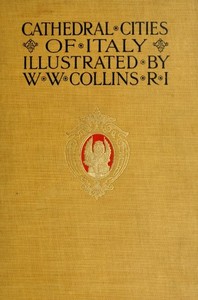
Cathedral Cities of Italy — Reading Companion

(0 User reviews)   92
In Category - Travel Narratives
Collins, W. W. (William Wiehe), 1862-1951 Project Gutenberg 2011 Not confirmed
Italy -- Description and travel; Cathedrals -- Italy Readers of public-domain and historical texts
Project Gutenberg digital edition en

Edition facts

Words 69,971
Reading time 305 min
Text sections 7

For Cathedral Cities of Italy — Reading Companion, the stored edition analysis reports 69,971 words, 5 hr 5 min estimated reading time, and 7 detected text sections.

The text analysis averages about 20.3 words per sentence, while the detected sections provide another way to judge how the source is divided.

Project Gutenberg metadata also associates the work with “Italy -- Description and travel,” connecting these edition facts with the source record’s subject description.

W. W. Collins examines Italian cathedrals through an artist's eye, focusing on architectural details, materials, and the interplay of light and shadow, with particular attention to Pisa's marble and the effects of weather.
Share
Editorial Edition Score 4.7/5

Calculated from edition completeness, EPUB availability, text structure and catalogue metadata. Not a user rating.

How this score is calculated
  • Description quality20 pts
  • Title & short description10 pts
  • Source metadata20 pts
  • Text length15 pts
  • Chapters / structure15 pts
  • EPUB file integrity20 pts

Total of 100 points, scaled to a 2.5-5.0 range. Editions with an empty description or a missing EPUB file are not scored.

Edition quality

Read the Text

way in Spain working on the Escorial for Philip II. The east end is the oldest part of the building, and is almost entirely taken up by three grand Gothic windows. The east window, which is of most beautiful tracery, was executed from the designs of a Frenchman, Nicholas Bonaventure. Both the other windows are fine, but the upper portion or rose pattern, although in itself very delicate, appears "stuck in," and not part of the design; some of the glass in these is very rich in colour. The archivolts of the arches are filled with figures which follow the curve in a rather uncomfortable style, not only here but in every other window save the fine classical of the façade.

The interior is grand, and of immense height, albeit the vaulting with its admirably painted tracery is evidence of the great skill of the Italian at "faking." The mellow light from the amber coloured glass of the octagon and the twilight filtering through the gorgeous hues of the other windows is remarkably and impressively pleasing. The columns of the nave, in clusters of eight shafts, are eighty feet high, and carry narrow capitals of foliage which form the base to eight canopied niches occupied by figures of saints--a fine feature. The aisles are double, the outside being lower than that next the nave. The four columns at the crossing which support the octagon are of larger dimensions than those in the nave. Two semicircular pulpits covered with bas-reliefs of gilded bronze stand on either side of the steps leading into the choir, to the solemn darkness of which the shadows thrown from the sounding-boards above make pictorially a good foreground introduction. These pulpits are supported by caryatides representing the Evangelists and four doctors of the Church.

The choir was designed by Pellegrini, and contains a fine sixteenth-century tabernacle of gilded bronze. Beneath is the subterranean church, through which one enters the tiny chapel, under the central spire, wherein is deposited, in a magnificent silver shrine the gift of Philip IV. of Spain, the body of S. Carlo Borromeo dressed in full pontificals. Born in 1538 he was created cardinal by his uncle, Pius IV., in 1561. After the close of the Council of Trent he assisted other prelates to draw up the epitome of Catholic doctrine, the "Catechismus Tridentinus"; but it is more for his good works and great charity, especially during the plague of 1576, that he lives in the hearts of the Milanese.

In the north transept is a very good example of the metal work of the thirteenth century, in the shape of a fine bejewelled bronze candelabrum. It forms a tree and has many quaint figures in its intricate design. In a chapel in this aisle is the old wooden crucifix which S. Carlo carried when barefooted he tramped the streets during the plague, tending the sick. In the south transept close to the corner near the staircase leading on to the roof is a monument to Giacomo and Gabriele de' Medici, brothers of Pius IV., and a bronze statue of S. Bartolommeo which represents him flayed. The south sacristy door is a fine specimen of Gothic work. Unlike the exterior effect, nothing obtrudes inside this great cathedral. The eye on entering looks straight up to the east, conscious as it travels there, of great pillars rising into the gloom of the vault above, of fine glass and restful solemnity, in which even the chapels in the aisles are lost, to be discovered later on only when searched for.

Next to "Mariæ Nascenti," but taking precedence in archæological interest, is the church of S. Ambrogio, a basilica dedicated by the Saint when bishop of Milan in 387 to SS. Gervasius and Protasius. It was enlarged and rebuilt in 881 and restored by Ricchini in 1631, all the original features being faithfully preserved. A closed courtyard stands below the level of the piazza outside and forms the Atrium beyond which no catechumens were allowed to pass. The capitals of the columns here have the tendency of early Christian Art and adaptations of Runic and Byzantine carving. The church is Lombardo Romanesque. Beneath the gallery over the peristyle is the celebrated door, well guarded by an iron grille, some of the cypress-wood panels of which formed portions of the gate of the Basilica Portiana closed by S. Ambrose against the Emperor Theodosius after his cruel slaughter in Thessalonica. The nave is entered by two side doors and is composed of eight bays, the columns of which are slender in proportion for the deep shadows of the dark aisles. Pilasters run up to the low round vaulting, the large galleries over the aisles being divided by these. Up a few steps which cross the nave at the last bay, and behind a low marble balustrade, is the High Altar, enclosed by one of the finest extant relics of the goldsmith's art. This magnificent casing bears the name of its German maker, Wolvinius. Some of the panels, notably that of the Transfiguration, are very Greek in treatment. The back is almost of better workmanship than the front and is more interesting, as Wolvinius has here illustrated the principal events in the life of the founder. The enamelled borders of these silver-gilt panels are of exquisite design. One of the saint as a child asleep in his cradle with a swarm of bees hovering around, considered a presage of future eloquence, is very naïve. The _baldachino_ above this altar is borne by four grand columns of black porphyry.

Up twelve steps are the choir and tribune, and at the end of these is the primitive throne of the Archbishop of Milan, known as the chair of S. Ambrose. The eighteen seats occupied by the suffragans of the province no longer exist, having been replaced in the sixteenth century by carved wooden stalls, and thus has perished a feature identical with the Cathedral at Torcello. The semi-domed roof of the Tribune is covered with a fine ninth-century mosaic which represents the seated figure of the Almighty, beneath whom are SS. Candida, Gervasius, Protasius, Marcellina and Satirus, and a representation of the cities of Milan and Tours--Tours because there, when S. Martin was undergoing martyrdom, the spirit of S. Ambrose went to give him strength. Beneath the choir is the crypt, and at its termination, exactly under the high altar in the church above, in a splendid casket of silver and crystal, repose the remains of three Saints, Ambrose, Gervasius and Protasius. There is a curious pulpit in the church of very early Lombard work, with an "Agape" or love feast carved upon its panels. Close by upon a granite pillar rests a bronze serpent, said to be the brazen serpent of the desert and presented to Archbishop Arnulphus by the Emperor of Constantinople. S. Ambrogio was the church in which the Lombard rulers were crowned with the Iron Crown that is the chief attraction in the neighbouring city of Monza.

So well known are the art treasures of Milan that it is hardly necessary to do more than allude to the many works of great interest in the Brera, formerly a Jesuit college, and in the celebrated Biblioteca Ambrosiana; or that greatest wonder of all which has drawn so many pilgrims to the Cenacolo, the refectory near the church of Santa Maria della Grazie--the much restored Last Supper by Leonardo da Vinci. The Castello of Milan was at one time the residence of the great Visconti family, and at the death of the last male representative passed by marriage into the hands of the first duke of the Sforza line. It was during their reign that Milan took the lead in the fashion of Europe (whence we have the word "milliner") and it was then that Leonardo wrought his masterpieces, including that great equestrian statue of Francesco Sforza which was the wonder of Milan, and of which posterity was so unhappily robbed by the French invasion.

From its position close to the confluence of the rivers Po and Ticino, Pavia, the "City of a hundred Towers," was for centuries a point of strategic importance. It is at present a great artillery station. Of its hundred towers that stood at intervals around the eleventh-century walls, hardly one remains, and the old fortifications which had been reconstructed at a later date, are rapidly being converted into a spacious and shady boulevard. The celebrated bridge is however still intact, despite many violent floods, a delight to the eye and a pleasant promenade on a hot day. This notable structure, which spans the Ticino, was built by one of the great Visconti family--Gian' Galeozzo--and is roofed in.

Pavia at one time was rich in noble churches. Many have been demolished, others have fallen into decay. The cathedral, dedicated to S. Stefano, stands on the site of one erected in the seventh century. The present edifice was designed by Bramante and constructed under the direction of one of his pupils, Cristoforo Rocci. In the original plan the nave, transepts, and choir were all of one size, but the nave is the only part in which the great architect's measurements were followed. The façade, approached by a good flight of steps, is unfinished. On the north, and adjoining a fine example of a late Romanesque gateway, stands the _campanile_.

The interior of the main building is grey stone which has not been spoilt by the application of the whitewash brush. A fine pulpit, somewhat similar to those at Milan, stands out from one of the massive piers that support the octagon. It is of singularly large dimensions and is supported by well-carved wooden figures of the Fathers of the Church. The octagon, which carries a good dome and tower and is best seen from the market square, rises well above the roofs of the nave and choir. A gallery running round the entire cathedral forms a triforium, broken only by _trasparente_ lights in the apse and side chapels of the choir. These windows accentuate the bad points of the _barroque_ altars beneath. The clerestory lights are circular. If it were not for the magnificent tomb in which repose the remains of S. Augustine, the greatest of the Fathers of the Latin Church, the cathedral would be, notwithstanding the fame of its designer, the least interesting ecclesiastical building in Pavia.

Experts disagree as to who was responsible for the fine monument which covers S. Augustine's remains. The body of the saint had been removed from Hippo, a suffragan see of Carthage, to Sardinia during the Arian persecutions. It rested there until Liutprand, the Lombard king, having purchased it, placed it in the church of S. Pietro in Cielo d'Oro; and when this church was destroyed it was conveyed to the cathedral. On certain festivals the silver casket, portions of which are the original, that contains the bones of the saint robed in full pontificals is removed from its usual position and hoisted up behind the tomb, so that the devout can mount a temporary wooden stair and look on all that is left of the great father.

A figure of the saint lies stretched on the sepulchral urn that usually holds the silver casket. This rests on the basement, or lowest, of the four tiers that compose the monument. Around it are figures of the lesser saints of his Order. Above are bas-reliefs of the chief events in his life and the miracles which after his death were performed in different places through his intercessions. The liberal arts, the cardinal virtues, and many symbols adorn the tomb, which is also decorated with statues of saints and angels, two hundred and ninety in all. They are extremely well executed and enhance the beauty of the design.

The church of S. Michele is a primitive structure and bears traces of being the precursor of all ecclesiastical edifices of the Lombard style of architecture. It was originally a basilica, but short transepts have been added and the roof, which is groined, is vaulted with stone. The oldest part of the church is the crypt, which is under the choir. This is probably the building, or part of it, in which Unulfus sought sanctuary in 661 when fleeing from King Grimoladus. Four compound piers in the nave are adorned with an extraordinary series of sphinxes, symbols, animals and other figures. The façade is decorated with reliefs in a richly coloured sandstone, and has a gabled gallery that is continued round the exterior as far as the apse.

The portals are covered with a profusion of very archaic imagery in which Pagan as well as Christian subjects form most of the decoration. Sculptured bands of sandstone are placed in courses along the whole front and medallions let into the walls. These are very massively built of stone, and though restoration is evident throughout the church it still bears the impress of great age.

Sta. Maria del Carmine is a fourteenth-century building of Gothic design, and is one of the very best examples of brickwork in all Italy. The beautiful rose window of the west front and the three pointed doors with their well-moulded terra-cotta ornament could hardly be finer. Seven elegant pinnacles stand on the rather heavy cornice, forming a good set off to the _campanile_, which, surmounted by a brick spire, is a landmark in the district. The brick piers of the interior are exceptionally good; four squares constitute the nave, the arches of each carry simple groining. Two small lancet-shaped arches, out of all proportion with the massive brick piers that support them, open into the aisles. They have double capitals, the upper being of stone, the lower of carved brick.

In the ruined church of S. Pietro in Cielo d'Oro stood the tomb of Boethius, who under Theodoric held high office in the state. Boethius was executed in Pavia after a long and rigorous confinement in the Casa Malsap ina, during which he wrote his incomparable "Consolations of Philosophy." This work was translated into many languages and was one of the most widely known treatises in the Middle Ages. Alfred the Great translated it into Saxon. Another connection with England exists through Archbishop Lanfranc who accompanied William the Conqueror across the sea and was made prelate of Canterbury. The district round Pavia is not healthy, a condition due probably to the intricate system of irrigation by which the pastures are kept green with a rank-growing grass. Between Pavia, Piacenza and Lodi--a triangle with the last-named at the northern point--lies the country which yields the best Parmesan cheese. The fields are of three kinds, those nearly always under water, those irrigated, and those used for rotation crops. The cattle that are utilised for cheese-making are mostly Swiss bred, and being valuable are well looked after. They are stalled at sundown in the buildings attached to the great farms, where farmhouse, cottages, barns and stables are all enclosed within a high wall. The little rectangular patches of meadow on which they feed are enclosed by rows of poplars or willows which make the landscape very monotonous. In winter a dense fog often shrouds the countryside and a deadly chill pervades the atmosphere, while the humidity of summer, when the sun draws the moisture from the soaking earth, is very enervating.

When October comes in its yearly round and the autumn afternoons close in, it is sometimes good to sit idly outside a caffè with the pernicious cigarette and ruminate on the glories of a past summer--better this than to hustle up the street a sight-seeing. A hot day was ending and the Bergamo of mediæval times towered above the haze of a sun-baked land and the smoke that curled upwards in thin wreaths from the city below. "La Città Alta" thus raised its head proudly against the copper-coloured sky, thrusting its bulwarks to the edge of one of the last spurs of the Alps that here creep down on to the plain. What a grand prospect from the shady boulevard on those ramparts which encircle the old fortress! The sun has not yet set; beneath lies the Borgo S. Leonardo, the lower city, a busy place with factory chimneys on its outskirts; beyond, a sea of verdure, cut by lines of tall poplars and here and there a slender _campanile_, stretches away over Lombardy until lost in the haze past the towers and domes of Monza, Cremona, and distant Milan.

There is something very fascinating in the quiet and exclusive old city. Its streets are steep and narrow, its houses seem to rake the sky, the rattle of wheels does not often disturb the aristocratic silence, a silence accentuated tenfold when one has left behind its busy plebeian partner on the plain below, and whisked upwards by the funicular, found oneself suddenly amidst high walls. Great spaces of faced stone are these walls, pierced by tiny windows, almost forbidding in their austerity; and though glimpses of foliage and flowering creepers break through, the pervading air is one of mystery and intrigue.

In the wars with Austria, Bergamo was a great rallying-point for patriots and a continual thorn in the side of that polyglot empire. The names of heroic Bergamasque who died for their country are inscribed on sundry tablets on the walls under the old Brotello. This interesting building stands at one end of the little Piazza Garibaldi, and is somewhat similar to the one which forms the illustration to Como, with the difference that here a fine open stairway leads up to the first floor. The great hall is now occupied as a library. In a corner at the head of the stairs rises a massive quadrangular belfry, one of the prominent features in the outline of "La Città Alta."

Beyond the Brotello lies the Cathedral, a well-proportioned Renaissance building, which, by its juxtaposition to the much more ancient church of Sta Maria Maggiore, looks comparatively of recent date. It is constructed entirely of white marble and has a good dome. A Madonna by G. Bellini behind the high altar is its great treasure, and the only thing in it worthy of notice.

Sta Maria is an early Lombard pile of buildings, with a very lofty tower and an octagon over the crossing, which rises in four galleried storeys surmounted by a low spire. Good galleries extend round the exterior of the apse, and side chapels are thrust out at odd places with no particular plan. The east porch is by far the most interesting feature, and is an elaborate piece of work in _breccia_ and white marble. The supporting pillars rest on the backs of two lions, the old ecclesiastical symbol of strength, the columns of the portal are beautifully sculptured, and one of them, encircled with admirable figures, is very fine. Above is a canopy under which, on his horse, sits King Lupus with two attendants, while beneath a second canopy on top are statuettes of the Virgin and Child, and the two Marys. The west porch is almost similar to this, but of not so intricate a design. It has also no canopies, but is surmounted by a turret niche, let into the wall of the main building, in which is the figure of the patroness. The doors of these two portals are of superbly grained rosewood. They open into the transepts, which are the finest portions of the interior, the carved choir stalls and screen by Stefano da Bergamo are considered the best in Italy.

Adjoining the east porch is the Capella Colleoni, the mausoleum of Bartolommeo Colleoni the celebrated _condottiere_ of the fifteenth century, whose equestrian statue in front of the church of SS. Giovanni e Paolo in Venice is remarkable, not only as a work of art, but as exemplifying the power and rugged strength of a great man.

W. W. Collins, a painter and member of the Royal Institute of Painters in Water Colours, approaches Italy's cathedral cities with the eye of an artist rather than a historian. His descriptions dwell on the physical fabric of buildings—the color and weathering of stone, the play of light across arcades, and the visual effect of decorative details. In his account of Pisa Cathedral, for instance, he notes how the white marble has been 'baked to a beautiful warm yellow and light red' by the sun, while the north side, exposed to the bitter tramontana wind, is 'blistered and scored' into an unpleasant ashen white. Such observations reveal a sensibility attuned to materiality and environment.

Architectural Description as Visual Experience

Collins rarely offers a dry inventory of architectural features. Instead, he describes how a building looks in specific conditions. The façade of Pisa Cathedral is analyzed in terms of its layered galleries: 'the slender pillars that support the arches of these galleries have wonderfully carved capitals, and stand out in the brilliant afternoon sun from the deep shadow behind with marvellous effect.' He notes the arrangement of columns—round on the façade and apses, pilasters elsewhere—as 'an extremely good arrangement' that enhances the building's length without breaking up the wall surface. Even the interior's 'forest of columns and arches' is evaluated for its visual complexity, with the observation that 'if it were not for the fine proportions of the nave, the eye would have but little rest.'

Materials and Weathering

Collins pays close attention to the physical condition of stone and the effects of climate. At Pisa, he contrasts the warm yellow and light red of the sun-baked south side with the 'ashen white' of the north, where the marble is 'blistered and scored' by the cold tramontana. He also remarks on the 'crude mosaics in the tympanums' as 'a jarring colour note which one would willingly suppress,' while praising the 'wonderful patterns of inlaid marble' and 'rich ornamentation of vine-leaves and floral forms, human heads and animals' that embellish the façade. This sensitivity to material decay and repair—the lead-covered penthouse that 'wards off the inclemency of the weather'—suggests a writer who sees buildings as living, aging objects.

Selective Detail and Omission

Collins does not attempt a comprehensive guide. He focuses on what strikes his eye, often omitting historical context or complete inventories. For example, he mentions that the bronze doors of Pisa's façade are 'good examples of the seventeenth century' without naming their makers, and attributes the design of six altars to Michelangelo with a brief 'is attributed to.' He notes that mosaics in the transept apses are 'said to be designed by Cimabue' but adds that 'the same origin can be more justly c[?]'—the text breaks off, leaving the judgment incomplete. This selectivity mirrors the artist's habit of choosing what to paint, and it invites the reader to see the cathedrals as a series of vivid, composed scenes rather than encyclopedic entries.

Collins's text rewards readers who share his interest in the visual and tactile qualities of architecture. His judgments are those of a practitioner—praising a 'good arrangement' of columns, lamenting a 'jarring colour note'—and his descriptions are most vivid when he captures the effect of light on stone. The book is less a systematic guide than a painter's notebook, offering a series of sharp, personal observations that can enrich a traveller's own encounter with these buildings.

That rainy afternoon, I lingered over Collins’s notes on Pisa’s marble, how dampness deepened its white into honey. Something about material weather—stone absorbing sky—stayed with me. Later, searching shelves, I found a worn volume on Siam, its pages thick with heat instead of rain. Odd comfort, that same patient watching: Siam : The Land of the White Elephant as It Was and Is — Background and Themes felt like turning to another window.

There are no reviews for this eBook.

0
0 out of 5 (0 User reviews )

Add a Review

Your Rating *
There are no comments for this eBook.

Reader reflection

What did you think of this book?

Answer a few questions and save a private reflection on this device.

Your progress 0 / 10
1

How far have you progressed with this book?

2

Was reading this book enjoyable?

3

Would you recommend this book to another reader?

4

Did the language feel accessible?

Related eBooks