1

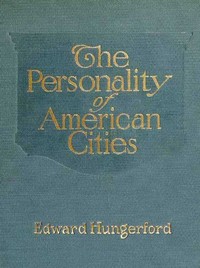
The Personality of American Cities — Themes and Context
301
9
Project Gutenberg
2012
United States -- Description and travel; United States -- Social life and customs -- 1865-1918; Cities and towns -- United States
Readers of public-domain and historical texts
Project Gutenberg digital edition
en
Edition facts
Words: 113,355
Reading time: 493 min
Text sections: 14
Source:
Project Gutenberg record #40884
Edward Hungerford's 1913 travelogue examines fourteen U.S. cities through their physical layout, transit systems, and daily rhythms, using specific details like Pittsburgh's hill-climbing trolleys and New York's skyscraper congestion to reveal each city's character.
Edward Hungerford opens The Personality of American Cities with a frank admission: the book took nearly four years to prepare, and he visited each city multiple times—except Charleston, New Orleans, and the three North Pacific cities. This hands-on approach shapes his method. Rather than offering a booster's tour, he focuses on how a city's geography, transit, and architecture create its distinctive flavor. The preface lists cities he wished he could have included—Portland, Detroit, Milwaukee, Indianapolis, Cincinnati, Louisville, Omaha, Kansas City, and three Canadian cities—making clear this is a selective, personal survey, not an encyclopedia.
Structure as a Window into Character
Hungerford organizes his book as a series of fourteen chapters, each devoted to a single city or cluster. The table of contents moves from Boston (“Our Ancient Hub”) through New York, Philadelphia, Baltimore, Washington, Richmond, Charleston, Rochester, Pittsburgh, Cleveland, Chicago, St. Louis, and the Pacific Northwest. This sequence is roughly geographic but also thematic: older eastern cities come first, then industrial centers, then western ones. Within each chapter, Hungerford typically begins with the city's physical setting—its rivers, hills, or harbor—then moves to its business district, residential areas, and transit systems. The Pittsburgh chapter, for example, opens with the city's location at the junction of two rivers forming the Ohio, then describes the narrow flat-land business center, the suburban exodus, and the extraordinary commuter rail service. This consistent structure lets readers compare cities on the same terms.
Recurring Images: Transit as a City's Pulse
Throughout the excerpts, transit systems serve as Hungerford's primary lens for understanding a city's personality. In Pittsburgh, he devotes several paragraphs to the streetcars: “It takes big cars to climb those hills,” he writes, and notes that when New Yorkers see them, “they are chariots of steel, hardly smaller than those that thread the subway.” He also reports that Pittsburgh has the fourth-largest suburban train service in the country, with four hundred passenger trains arriving and departing from a single terminal daily, ninety-five percent for commuters. This focus on transit is not mere description; it reveals social and political dynamics. The Pittsburgh streetcar conductors, he claims, are tied to the political machine, making it dangerous to “talk back” to them. In contrast, he notes that Cleveland, though larger in population, has “not a single distinctive suburban train run in or out.” These contrasts make transit a shorthand for each city's governance, class structure, and daily life.
Movement Between Scenes: From Business to Suburb
Hungerford frequently shifts between downtown and residential areas, using movement as a structural device. In Pittsburgh, he describes the business center as a “narrow spit of flat-land” comparable to lower Manhattan, then notes that “no one lives in Pittsburgh itself, unless under absolute compulsion.” The suburbs—Sewickley, East Liberty, and dozens of smaller communities—house the better part of the population. This movement is not just geographic; it carries social weight. The commuter trains and trolleys become the arteries that connect work and home, and their inadequacy (congestion, political interference) becomes a measure of the city's problems. Hungerford also moves between scales: from the broad view of the city's setting to the specific detail of a streetcar conductor's profanity. This oscillation between panorama and anecdote keeps the prose grounded while conveying a sense of place.
The Voice of the Observer: Specificity and Restraint
Hungerford's authorial voice is that of a seasoned traveler who trusts his own observations. He does not rely on statistics or secondhand accounts; instead, he reports what he has seen and heard. In the Pittsburgh section, he includes a direct anecdote: a lifelong resident protested to a conductor and was met with “a volley of profanity.” A bystander warned the passenger to keep quiet to avoid arrest. Hungerford presents this as evidence of the political machine's grip, not as hearsay. He also uses comparative references to anchor his descriptions: Pittsburgh's business center “exactly corresponding with Manhattan island below the City Hall and of even less area.” This habit of comparison—Pittsburgh versus New York, Cleveland versus Pittsburgh—gives the reader a familiar benchmark. Yet he avoids sweeping claims about the cities' futures or importance, sticking to what he has witnessed. The result is a travelogue that feels reportorial rather than promotional.
Hungerford's method rewards readers who pay attention to the physical details he selects: the width of streets, the size of streetcars, the number of commuter trains. These concrete facts, not abstract praise, carry his argument about each city's personality. The book is best read as a series of snapshots from 1913, each framed by the author's clear-eyed curiosity. Readers interested in urban history or the evolution of American transit will find a wealth of specific, usable detail.
Reader reflection
Record your reading impressions
A brief reflection can help important ideas stay with you longer.
Your progress
0
/
10
2
Was reading this book enjoyable?
3
Would you pass this book on to a friend?
4
How easy was the book to follow?
5
How did the reading compare with what you expected?
6
Would this book work well in a reading group?
7
How clear did the writing feel?
8
Did this book create an emotional response?
9
What is the main idea you are taking away?
10