1

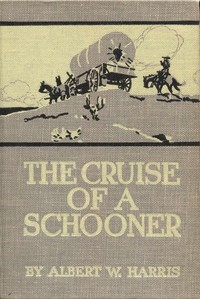
The Cruise of a Schooner — Story, Setting & Ideas
1442
7
Project Gutenberg
2013
West (U.S.) -- Description and travel; Harris, Albert W. (Albert Wadsworth), 1867-1958 -- Travel -- West (U.S.)
Readers of public-domain and historical texts
Project Gutenberg digital edition
en
Edition facts
Words: 57,261
Reading time: 249 min
Text sections: 7
Source:
Project Gutenberg record #42351
Albert W. Harris recounts a 1911 overland journey from the Pacific Ocean eastward, blending a personal narrative of realizing childhood 'air castles' with detailed accounts of travel challenges across the American West.
Editorial Edition Score
4.7/5
★★★★★
★★★★★
Calculated from edition completeness, EPUB availability, text structure and catalogue metadata. Not a user rating.
Edition quality
The opening pages of The Cruise of a Schooner establish a distinctive narrative voice: Albert W. Harris writes in a self-deprecating, conversational tone, describing his youthful 'queer notions' and 'air castles' about owning a pony and a ranch. He admits that these dreams were dismissed by others, yet he eventually found himself possessing 'the farm and the ponies' he had imagined. This personal, reflective preface sets the stage for a travelogue that is as much about the fulfillment of long-held aspirations as it is about the physical journey itself.
From Air Castles to Overland Reality
Harris frames his narrative around the concept of 'air castles'—dreams that gradually materialize. He recounts how, after acquiring the farm and ponies of his boyhood fantasies, he began planning an overland trip to California. Interestingly, when he finally started, he 'started from the Pacific Ocean and drove east,' a reversal of the expected westward trajectory. This inversion hints at a deliberate, perhaps playful, approach to his journey. The preface reveals a man who is both reflective and determined, acknowledging the skepticism of 'ordinary mortals' while quietly proving them wrong. The reader is thus introduced to a narrator who values persistence and self-deprecating humor over boastfulness.
Stuck in the Wash: A Lesson in Humility
One of the most vivid excerpts describes a moment of misjudgment at a desert wash. Harris admits he 'enjoyed seeing me stuck' and recounts how he ignored his companion Bob's lead, driving his team into a difficult stream crossing. The passage is rich with specific details: the horses losing their footing on a 'slippery bank,' the need to lighten the load by carrying items uphill, and the eventual use of a borrowed shovel from the station at Thompson. The narrative pace slows to match the laborious process of extricating the wagon, and Harris’s willingness to recount his own error—'admitting I was stuck and needed help'—adds a layer of authenticity. The episode underscores the constant negotiation between human ambition and the unforgiving terrain.
Rain, Mud, and Improvised Bridges
Another excerpt captures a day of relentless rain, where the party wakes to find horses standing in a 'miniature lake' and the wagon leaking onto the Doctor’s head. Harris describes a cold breakfast, a noon meal cooked over a kerosene stove inside the wagon, and a late start at 2 P.M. The roads become 'very heavy and slippery,' forcing the group to build a bridge from railroad ties and later cut down a bank to cross a wash. The need for a shovel becomes critical, leading Harris to ride Dixie two miles to Thompson to borrow one. The day’s progress amounts to only six miles, half spent in the wagon during rain and the rest in digging and bridge-building. This passage highlights the slow, gritty reality of overland travel, where even small distances demand ingenuity and physical effort.
Readers approaching The Cruise of a Schooner should expect a narrative that moves between reflective passages and detailed, obstacle-driven episodes. Harris’s voice is that of a seasoned traveler who is not afraid to admit mistakes, and his account rewards attention to the small, practical decisions that define a journey. The book offers a firsthand perspective on early twentieth-century travel across the West, grounded in the author’s personal history and his evolving relationship with the landscapes he crosses.
Reader reflection
Before you leave, reflect on the book
Use these questions to collect your thoughts before moving on.
Your progress
0
/
10
2
Did this book hold your interest?
3
How likely are you to recommend this book?
4
How much effort did this book require?
5
How personally connected did you feel to the book?
6
What did you appreciate most?
7
How useful were the ideas in this book?
8
Was the book what you thought it would be?
9
What changed or sharpened your thinking?
10