1

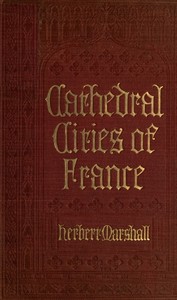
Cathedral Cities of France — Story, Setting & Ideas
36
6
Project Gutenberg
2012
France -- Description and travel; Cathedrals -- France
Readers of public-domain and historical texts
Project Gutenberg digital edition
en
Edition facts
Words: 66,411
Reading time: 289 min
Text sections: 10
Source:
Project Gutenberg record #40390
This editorial note examines how Herbert and Hester Marshall's 1907 travelogue intertwines architectural description with historical narrative, using the Joan of Arc episode at Orléans and the Vendôme occupation account to reveal tensions between medieval grandeur and modern conflict.
Editorial Edition Score
4.8/5
★★★★★
★★★★★
Calculated from edition completeness, EPUB availability, text structure and catalogue metadata. Not a user rating.
Edition quality
Herbert and Hester Marshall's Cathedral Cities of France (1907) is a travelogue that pairs architectural observation with historical anecdote, but its most striking passages emerge when the authors step away from stone and glass. The book's method is cumulative: each chapter moves through a city's streets, noting a cathedral's west front, a market square, a river view, then pivots to a chronicle of siege or coronation. This dual focus creates a persistent tension between the permanence of sacred buildings and the violence that has unfolded around them.
The Joan of Arc Lens at Orléans
The Orléans chapter demonstrates how the Marshalls use a single historical figure to organize their material. They note that the city's name 'is most likely to call up' Joan of Arc, and they contrast the triumphant memory at Orléans with the captivity and death at Rouen. The narrative then shifts to a detailed account of the 1429 siege, drawn from The Times war correspondence of 1870–71. This borrowing is revealing: the authors rely on a modern journalist's description of the Prussian occupation to evoke the medieval English blockade. The result is a layered text where a 1907 reader is asked to see Joan's 'love of directness' through the lens of recent German artillery. The Marshalls do not claim completeness; they present the siege as a vignette, not a full history.
War Correspondence as Travel Writing
In the Vendôme section, the Marshalls insert a long quotation from The Times describing the Prussian occupation of 1870. The passage depicts villagers who 'obey their visitors with alacrity' but have 'no good cheer' to give. This is not architectural description; it is a report of civilian fear under military occupation. The authors juxtapose this with their own earlier description of the Loire's 'clear green water' and 'snowy linen' at the lavoirs. The contrast is deliberate: the peaceful river scene is undercut by the memory of foreign soldiers at the doors. The Marshalls do not editorialize; they let the quotation stand as a counterpoint to their own picturesque prose. This technique forces the reader to hold two images simultaneously—the timeless cathedral city and the recent war.
Architectural Detail as Historical Evidence
The Marshalls ground their observations in specific features. At Vendôme, they note 'fine choir stalls of the fifteenth century' with 'miséricordes' whose carving is 'very interesting in its variety and quaintness of design.' This is not generic praise; it points to a particular element that survives from the medieval period. Similarly, at Orléans they mention a 'memorial tablet' describing Joan as 'Victrix Anglorum.' These small artifacts—a carved seat, an inscribed stone—become anchors for the larger historical narratives. The authors treat buildings as documents, reading them for evidence of craft and conflict. They do not claim to have seen every cathedral; the preface states the chapters are 'notes put together during summers spent in France' and do not 'cover all the Cathedral cities.' This modesty lends credibility to their focused observations.
The Traveler's Perspective on Ruin
Throughout the excerpts, the Marshalls show a particular interest in ruins and repairs. At Vendôme, the castle is 'old ruined' and the town lies 'beneath its shelter.' At Orléans, the English 'bastilles' are described as having been 'strong' but are now gone. The authors are writing in 1907, less than forty years after the Franco-Prussian War, and their descriptions carry an awareness of recent destruction. They do not dwell on damage, but the choice of details—a broken castle, a blocked bridge—suggests a landscape shaped by repeated sieges. The reader is invited to see the cathedral not as an isolated monument but as part of a city that has been fought over, rebuilt, and fought over again.
Readers approaching Cathedral Cities of France will find it most rewarding when they attend to the gaps between the architectural descriptions and the historical interludes. The Marshalls do not resolve the tension between peaceful stone and violent history; they present both without commentary. This editorial note has highlighted three specific patterns: the use of Joan of Arc as a narrative device, the incorporation of war correspondence, and the attention to small architectural details. These features distinguish the book from a mere guide and make it a document of its own time—a pre-war travelogue that already senses the fragility of the scenes it describes.
Reader reflection
Take a moment to reflect on this book
Create a short personal record of your experience with this book.
Your progress
0
/
10
2
Did this book hold your interest?
3
Would you encourage someone else to read it?
4
How much effort did this book require?
5
Did the book offer a fresh perspective?
6
Which part made the strongest impression?
7
Could you see yourself revisiting this book?
8
How useful were the ideas in this book?
9
What changed or sharpened your thinking?
10