1

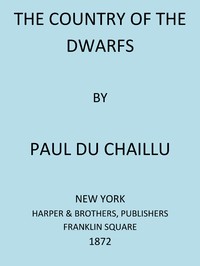
The Country of the Dwarfs — Edition Insights
863
6
Project Gutenberg
2015
Africa, West -- Description and travel; Negrillos
Readers of public-domain and historical texts
Project Gutenberg digital edition
en
Edition facts
Words: 82,998
Reading time: 361 min
Text sections: 10
Source:
Project Gutenberg record #48643
Du Chaillu's 1871 narrative of his expedition into equatorial Africa, blending travelogue, natural history, and ethnographic observation. The catalog subjects 'Africa, West -- Description and travel' and 'Negrillos' only partially capture the text's focus on gorilla hunting, local politics, and the author's self-promotion as 'Oguizi'.
Editorial Edition Score
4.9/5
★★★★★
★★★★★
Calculated from edition completeness, EPUB availability, text structure and catalogue metadata. Not a user rating.
Edition quality
Du Chaillu presents himself as 'Oguizi,' a spirit or wonder-worker, a role that shapes his interactions with African rulers like Quengueza and Mayolo. The narrative opens with a dedication to publisher Fletcher Harper and a table of contents promising gorilla encounters, 'superstitions,' and a journey 'toward where the sun rises.' Yet the catalog subjects—'Africa, West -- Description and travel' and 'Negrillos'—suggest a straightforward geographical or ethnographic account. The excerpts reveal a more complex blend: Du Chaillu defends eating monkey as 'delicious and delicate food,' photographs a wounded gorilla, and records Mayolo's recovery from illness as a political event. The text is as much about Du Chaillu's persona as about the region.
The Author as Oguizi: Self-Fashioning in the Field
Du Chaillu repeatedly casts himself as a supernatural figure. Mayolo declares, 'I knew that the Oguizi did not like to see me ill,' and the author accepts the title without correction. This framing serves multiple purposes: it grants him authority, explains his medical interventions, and justifies his requests for porters and food. When Mayolo recovers, he shouts, 'Here I am, alive! The Otando people said I should die because the Spirit had come, but here I am!' The local belief that the Oguizi killed Remandji and Olenda is mentioned without denial. Du Chaillu also uses his 'magic'—an illustrated paper—to astonish his hosts. This self-presentation is a key structural element, not merely a cultural curiosity.
Eating Monkey and Defending the Palate
A striking passage defends the consumption of monkey meat. Du Chaillu anticipates reader disgust: 'Horrible! you will say; the idea of eating monkeys! It is perfectly dreadful!' He counters by describing the 'nchègai, the nkago, the miengai, and the ndova' as 'balls of fat' in season, and claims a haunch grilled on charcoal is 'simply delicious.' He even jokes, 'I wish I had a monkey here, ready for cooking. I would invite you to partake of it.' This rhetorical move—addressing a presumed squeamish audience—reveals the text's dual purpose: to inform and to provoke. The catalog subject 'Description and travel' underplays such vivid, opinionated passages.
Political Theater: Palaver, Presents, and Performance
Du Chaillu's narrative is punctuated by formal 'palavers' and gift distributions. King Quengueza engages in 'diplomacy' over names and settlements; Mayolo delivers a speech lasting 'more than an hour' before agreeing to travel east. The author records these events with attention to protocol: 'Mayolo deferred his answer till the next day. I suppose he wanted to prepare himself for a great speech.' The celebration of Mayolo's recovery involves 'jar after jar of native beer,' dancing, and gunfire. These scenes show that travel in this region required constant negotiation. The catalog subject 'Negrillos' (a term for pygmy peoples) appears nowhere in the excerpts; instead, the text focuses on the author's relationships with village leaders.
Readers should approach The Country of the Dwarfs as a document of 19th-century exploration rhetoric, not a neutral record. Du Chaillu's persona as Oguizi, his defense of monkey-eating, and his detailed accounts of palavers reveal a narrator actively shaping his story. The catalog subjects provide only a starting point; the text itself is richer and more contradictory. Pay attention to what Du Chaillu chooses to emphasize—and what he omits.
Reader reflection
Before you leave, reflect on the book
Use these questions to collect your thoughts before moving on.
Your progress
0
/
10
2
How much did you enjoy the reading experience?
3
Would you pass this book on to a friend?
4
How demanding did the text feel?
5
How original did the book feel?
6
Would this book work well in a reading group?
7
Was the book what you thought it would be?
8
Did the story or argument move comfortably?
9
In one sentence, what did you learn?
10