1

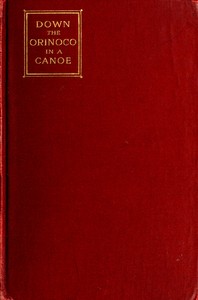
Down the Orinoco in a Canoe — Inside the Classic
306
7
Project Gutenberg
2015
Colombia -- Description and travel; Venezuela -- Description and travel; Orinoco River (Venezuela and Colombia)
Readers of public-domain and historical texts
Project Gutenberg digital edition
en
Edition facts
Words: 53,922
Reading time: 235 min
Text sections: 6
Source:
Project Gutenberg record #50506
Santiago Pérez Triana recounts his canoe journey down the Orinoco River, blending travel narrative with reflections on memory, civilization, and nature. The book includes an introduction by R. B. Cunninghame Graham that humorously addresses the obscurity of Bogotá and the eccentricity of actually reading a friend's manuscript.
Editorial Edition Score
4.7/5
★★★★★
★★★★★
Calculated from edition completeness, EPUB availability, text structure and catalogue metadata. Not a user rating.
Edition quality
R. B. Cunninghame Graham’s introduction sets an unusual tone for a travel book: he confesses to having actually read the manuscript, a practice he calls “eccentricity, which is worse than the sin of witchcraft.” He then digresses into a wry anecdote about a U.S. Secretary of State who, upon granting a consular appointment for Bogotá, asked the author, “where in thunder is Bogoter, any way?” This framing immediately establishes the work as both a serious narrative and a playful engagement with cultural ignorance.
Pérez Triana’s own prose, by contrast, is lyrical and philosophical. In Chapter XI, he describes memory as an artist that “seizes one moment of life, fashions and records it in marble or in bronze,” and insists that “what was, is; what was, must be.” The journey down the Orinoco becomes a vehicle for meditations on permanence and change, with the river itself serving as both a literal route and a metaphor for the flow of time.
A Preface That Refuses Convention
Cunninghame Graham’s preface is a self-aware performance. He mocks the typical preface-writer who “look contemptuously at the unopened bundle of his friend’s proofs” and then opines on everything under the sun. By contrast, he has read the book—in both Spanish and English—and thus condemns himself as “a pedant, perhaps a palterer with the truth.” The humor is dry and pointed, and it subtly defends the value of careful reading over fashionable ignorance.
The anecdote about the Secretary of State underscores a theme that runs through the book: the gap between metropolitan assumptions and the realities of South America. Bogotá, Graham notes, is “the greatest literary centre south of Panama,” yet it remains geographically and conceptually remote to many. This tension between perception and experience is one the author himself will navigate on the river.
Memory as an Unchanging Gallery
In Chapter XI, Pérez Triana shifts from travelogue to a sustained reflection on memory. He writes that “the gallery of the mind, the vast storehouse of the past, is infinite,” and that it preserves “the living record of our life” against time and change. The passage is structured as a series of sensory snapshots—the “tremulous shadowy hues of early night,” the “glory of the rising sun,” the “thunder of the ocean”—each held in permanent suspension.
He explicitly compares this mental archive to Keats’s “Grecian Urn,” where love knows no disappointment and unheard melodies are sweeter. The analogy suggests that his journey, though completed years ago, remains vividly present; the act of writing is itself an attempt to fix experience in a form as durable as marble. This philosophical interlude gives the travel narrative a meditative depth, inviting readers to consider how place and memory intertwine.
Civilization’s Thin Veneer
A striking passage in the excerpts questions the stability of civilization. Pérez Triana observes that “if beauty be but skin-deep, civilization is not more profoundly ingrained, and the smallest rub reveals the primitive ravening beast.” The remark appears in a context discussing humanity’s “dreary endeavour to protect man from the rascality of man,” suggesting that legal and social structures are merely a fragile overlay on a more brutal nature.
This skepticism is not developed at length in the available text, but it resonates with the setting: a canoe journey through remote forests and plains where the trappings of urban life fall away. The author does not romanticize the “savages of the forest” but rather implies a continuum between their behavior and that of “civilized” people. The observation adds a moral complexity to what might otherwise be a straightforward adventure narrative.
Readers approaching Down the Orinoco in a Canoe should be prepared for a work that alternates between concrete travel details and abstract reflection. The excerpts show a writer who is as interested in the nature of memory and the fragility of civilization as in the logistics of river travel. Pay attention to the shifts in register—from Graham’s ironic preface to Pérez Triana’s lyrical prose—and to the way the landscape itself becomes a stage for philosophical inquiry. The book rewards those who read slowly, savoring the unexpected turns.
Reader reflection
What was your reading experience?
Capture what you thought, learned, and would like to remember.
Your progress
0
/
10
2
What was your overall reaction to the book?
3
How likely are you to recommend this book?
4
Did the language feel accessible?
5
What did you think about the pace?
6
How strong was your personal connection to the text?
7
Do you expect to return to this book?
8
Did you gain anything practical from the text?
9
What is the main idea you are taking away?
10