1

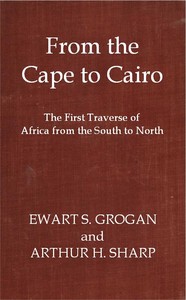
From the Cape to Cairo: The First Traverse of Africa from South to North — Story, Setting & Ideas
1580
6
Project Gutenberg
2014
Africa -- Description and travel; Grogan, Ewart Scott, 1874-1967
Readers of public-domain and historical texts
Project Gutenberg digital edition
en
Edition facts
Words: 98,592
Reading time: 429 min
Text sections: 12
Source:
Project Gutenberg record #45396
Ewart Grogan and Arthur Sharp's account of the first south-to-north traverse of Africa, combining hunting narratives, encounters with local communities, and reflections on colonial infrastructure, with a preface by Cecil Rhodes.
Editorial Edition Score
4.8/5
★★★★★
★★★★★
Calculated from edition completeness, EPUB availability, text structure and catalogue metadata. Not a user rating.
Edition quality
The narrative opens with a dedication to Cecil Rhodes and a preface in which Rhodes himself, writing from Government House in Buluwayo, frames Grogan's journey as a youthful Cambridge undergraduate's vacation feat that outdid 'the ponderous explorers of the world.' This framing establishes a tone of imperial ambition and personal adventure. The text then shifts into a detailed account of elephant hunting, where Grogan describes the motion of an elephant as 'exactly similar to the motion of a ship' and the difficulty of retracing his path through thorn jungle after a chase. These early pages reveal a voice that moves between self-deprecating humor and precise natural observation.
Voice and Self-Presentation
Grogan's narrative voice is notably direct and often wry. When he shoots his first elephant, he records that he 'was a proud man' carrying the beast's tail back to camp. Yet he also undercuts his own achievement: the elephant was 'only a small bull.' This blend of pride and modesty recurs. He describes the difficulty of extracting himself from the jungle with the same matter-of-fact tone he uses for negotiating with villagers. The prose is unadorned but vivid, relying on concrete details—the 'short, stubby bristles' of elephant skin, the 'elaborate gate and stockade' of a hidden village—rather than rhetorical flourishes. The co-author Arthur Sharp's contribution is not distinguishable in these excerpts, but the first-person singular suggests Grogan is the primary narrator for the hunting episodes.
Encounters and Cultural Observations
Grogan's interactions with local populations are recorded with a mixture of curiosity and colonial assumptions. When he arrives unexpectedly in a stockaded village, he notes that the inhabitants had 'put the village in a state of defence' after hearing his shots. He defuses the situation by leaning his rifle against a hut and extending his hand—a gesture that 'allayed their suspicions.' Later, he observes that local people refused to eat elephant meat but would eat hippo, calling it 'a very subtle distinction.' Such details offer glimpses of cultural practices, though they are filtered through Grogan's perspective. The text also mentions 'youthful cannibals' who devour boiled elephant trunk, a term that reflects the era's racialized language rather than verified ethnography.
Pace and Structural Rhythm
The excerpts show a clear alternation between action set-pieces and quieter logistical passages. The elephant hunt unfolds in rapid, breathless sentences: 'I tried for the brain-shot with my .303. He threw his trunk into the air, and fell like a rock—dead.' Then the pace slackens as Grogan describes the difficulty of returning through the thornbush, the negotiation for a guide, and the camp routine of buying beans. This rhythm—bursts of physical exertion followed by slower travel and trade—likely structures much of the book. The preface by Rhodes, with its focus on railways and telegraphs, introduces a contrasting thematic pace: the long-term, infrastructural vision of imperial development against the immediate, bodily experience of walking through Africa.
Readers should attend to how Grogan balances the roles of hunter, explorer, and ethnographer. The text rewards attention to small, precise observations—the way thorns swing back into place, the shape of a village stockade—more than to grand declarations. The co-authorship with Sharp may introduce shifts in voice or perspective that are not evident in these excerpts. The book is best approached as a document of its time, revealing both the physical realities of overland travel in 1890s Africa and the imperial mindset that framed it as a 'first traverse.'
Reader reflection
What was your reading experience?
Capture what you thought, learned, and would like to remember.
Your progress
0
/
10
2
Did this book hold your interest?
3
Would you encourage someone else to read it?
4
What was the reading difficulty like?
5
Did you gain anything practical from the text?
6
What did you appreciate most?
7
How strong was your personal connection to the text?
8
Did this book create an emotional response?
9
Which lesson or insight stayed with you?
10