1

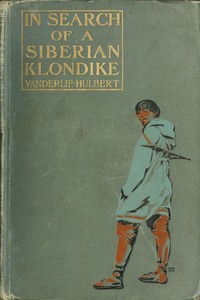
In Search of a Siberian Klondike — Key Ideas to Explore
334
8
Project Gutenberg
2012
Siberia (Russia) -- Description and travel; Gold mines and mining -- Russia (Federation) -- Siberia
Readers of public-domain and historical texts
Project Gutenberg digital edition
en
Edition facts
Words: 56,436
Reading time: 246 min
Text sections: 7
Source:
Project Gutenberg record #41237
A first-person narrative of a gold prospecting expedition through Kamchatka and Siberia in 1899, as told by Washington B. Vanderlip and set down by Homer B. Hulbert. The account details harsh travel, native encounters, and the practical realities of searching for gold in a remote, frozen landscape.
Editorial Edition Score
4.7/5
★★★★★
★★★★★
Calculated from edition completeness, EPUB availability, text structure and catalogue metadata. Not a user rating.
Edition quality
The narrative voice in In Search of a Siberian Klondike is that of Washington B. Vanderlip, a prospector who recounts his 1899 expedition through Kamchatka and northeastern Siberia. The book is presented as his first-person account, set down by Homer B. Hulbert, and the prose carries the direct, practical tone of a man more accustomed to action than literary flourish. Vanderlip describes the landscape, the people, and the grueling work of gold prospecting with a matter-of-factness that underscores the harsh realities of the region. The pace shifts noticeably between detailed logistical descriptions—outfitting, dog-sledging, thawing frozen ground—and moments of sudden danger or absurdity, such as a near-disastrous sled ride down a snowy slope that leaves Vanderlip laughing while his native companions curse.
Voice and the Role of the Narrator
The book is explicitly framed as Vanderlip's story, with Hulbert acting as amanuensis. This dual authorship creates a curious effect: the prose is polished and structured, yet retains the rhythms of oral storytelling. Vanderlip frequently addresses the reader directly, as when he describes the start of a dog-sled run as “a gymnastic performance for the driver.” His observations are often wry, as when he notes that Russian law prohibited liquor traffic, but his party brought it anyway. The voice is that of an experienced frontiersman, confident in his judgments but not boastful. He credits his native guides, like Chrisoffsky, with crucial knowledge, and he does not shy from admitting his own mistakes—such as the impulsive decision to slide down a mountain that nearly ended in disaster.
Pace and the Rhythm of Hardship
The narrative alternates between methodical preparation and sudden, intense action. Early chapters detail the purchase of supplies, the hiring of men, and the intricacies of dog-sledging—a slow, deliberate pace that mirrors the tedium of travel. Then, without warning, the pace accelerates: a sled breaks through a snow-bridge into open water, and Vanderlip must change into dry fur socks before his feet freeze. The gold-prospecting sequences follow a similar pattern: days of slow thawing and digging, then the brief, tense moment of panning gravel. The most vivid shift occurs during the sled ride down the mountain, where the prose becomes almost cinematic: the dogs become a “howling, wrangling ball of dog-fur,” and Vanderlip admits he “utterly refused to see the serious side.” These changes in pace keep the reader engaged, even when the gold itself proves elusive.
Recurring Details and the Texture of the Journey
Certain details recur throughout the excerpts, building a textured portrait of life on the trail. The polka, a long pole used for steering and braking, appears repeatedly as a tool of survival. The native guide Chrisoffsky is a constant presence, his warnings and practical advice forming a counterpoint to Vanderlip's impulsiveness. The cold is ever-present: the thermometer “between ten and fifteen degrees below zero,” the need to change wet boots immediately, the frozen ground that must be thawed with fires. Food is a recurring motif—boiled fish-eyes as a delicacy, the “wholesale suicide of salmon” during spawning season. These small, concrete observations ground the narrative in sensory reality, making the reader feel the cold, the hunger, and the dogged persistence required to continue.
Readers should approach this book as a travelogue and a practical memoir, not a thriller. The gold is never found in paying quantities, and the narrative is less about discovery than about the process of searching. Pay attention to the relationship between Vanderlip and his native guides, particularly Chrisoffsky, whose expertise often saves the expedition. The book's value lies in its unvarnished depiction of a specific time and place—the Russian Far East at the turn of the century—and in the voice of a man who lived to tell the tale.
Reader reflection
Before you leave, reflect on the book
Use these questions to collect your thoughts before moving on.
Your progress
0
/
10
2
Was reading this book enjoyable?
3
Would you pass this book on to a friend?
4
Did the language feel accessible?
5
How distinctive were its ideas or approach?
6
Which element worked best for you?
7
How would you describe its reading pace?
8
Was the book what you thought it would be?
9
What is the main idea you are taking away?
10