1

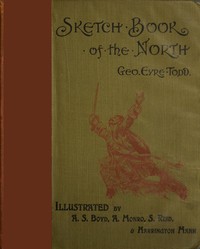
Sketch-Book of the North — Story, Setting & Ideas
1620
18
Project Gutenberg
2017
Scotland -- Description and travel; Scotland -- History
Readers of public-domain and historical texts
Project Gutenberg digital edition
en
Edition facts
Words: 51,062
Reading time: 223 min
Text sections: 36
Source:
Project Gutenberg record #54083
George Eyre-Todd's 1903 collection of 30 impressionistic sketches blends Scottish travel writing with local history, folklore, and pastoral observation, illustrated by four artists. The excerpts reveal a lyrical, scene-based approach that often subordinates historical narrative to sensory description.
Editorial Edition Score
4.9/5
★★★★★
★★★★★
Calculated from edition completeness, EPUB availability, text structure and catalogue metadata. Not a user rating.
Edition quality
George Eyre-Todd’s Sketch-Book of the North (1903) is a collection of thirty short pieces that blend travel writing, local history, and pastoral observation. Despite its catalog subjects—Scotland’s description and travel, and its history—the excerpts show a work that often subordinates historical narrative to sensory, scene-based description. The opening sketch, “A Roman Road,” begins not with the road itself but with a painterly view of “moor and woodland and meadow” under “mild radiance of early spring,” only later noting that “history marks with a crimson stain the field of many a battle.” This tension between landscape and historical incident runs through the book.
Landscape Before Narrative
The excerpts consistently prioritize setting over story. In “A Roman Road,” the Roman road is almost incidental to the panoramic description of the Border landscape. Similarly, “From a Field-Gate” devotes most of its length to the sensations of a midsummer afternoon—the “sweet breath of the clove-pinks,” the “faint gurgle of the river,” the “blue butterfly lazily opens and shuts its wings”—before any historical or folkloric content appears. The narrator’s pocket copy of “gentle Allan Ramsay” is the only explicit literary reference. This pattern suggests that Eyre-Todd’s method is to immerse the reader in a place’s atmosphere before introducing its associations.
Illustrations as Narrative Partners
The book includes four illustrators—A. S. Boyd, A. Monro, S. Reid, and Harrington Mann—whose work is listed in a separate illustration index. The excerpts do not include the images, but the captions hint at their dramatic content: “Signal of Death,” “The Death of Keppoch,” “Massacre of Glencoe,” “Murray’s Curse.” These titles suggest that the illustrations often depict the violent historical episodes that the text itself may treat more obliquely. For example, the text of “A Roman Road” mentions battles only as a “crimson stain,” while the illustration list includes no image for that sketch. The visual and verbal narratives may thus complement or contrast with each other.
Recurring Sensory Motifs
Certain sensory details recur across the excerpts. Light is frequently described as “soft,” “mild,” or “dazzling”; sounds are “faint” or “murmur”; scents of clover, sweetbrier, and clove-pinks are noted. The narrator often positions himself at a threshold—a field-gate, a ruined tower, the edge of a wood—from which he observes both near and far. This framing device creates a consistent observational stance. The excerpts also share a tendency to personify nature: a river “gleams like a shining serpent,” the sky “sheds peace upon the heart.” These motifs unify the collection despite its varied subjects.
Readers approaching Sketch-Book of the North should expect a work that is more descriptive than narrative, more atmospheric than event-driven. The sketches reward attention to their sensory detail and to the interplay between text and the absent illustrations. The catalog subjects of travel and history are present, but they are filtered through a lyrical, scene-based sensibility that often leaves historical events in the background.
Reader reflection
What was your reading experience?
Capture what you thought, learned, and would like to remember.
Your progress
0
/
10
2
How did the book work for you overall?
3
Would you pass this book on to a friend?
4
How easy was the book to follow?
5
Did anything about the book feel genuinely new?
6
Would you start a conversation about this book?
7
What did you think about the pace?
8
What did you appreciate most?
9
What did this book teach you most?
10