1

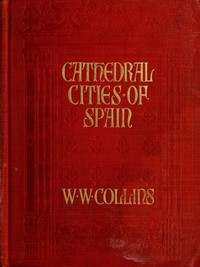
Cathedral Cities of Spain — Text and Context
38
8
Project Gutenberg
2012
Spain -- Description and travel; Cathedrals -- Spain
Readers of public-domain and historical texts
Project Gutenberg digital edition
en
Edition facts
Words: 57,894
Reading time: 252 min
Text sections: 7
Source:
Project Gutenberg record #40356
W. W. Collins, R.I., combines travelogue and architectural study in this 1909 illustrated volume. His descriptions of Spanish cathedrals and cities are grounded in personal observation, with attention to local customs, sensory details, and historical anecdotes, offering a vivid portrait of early 20th-century Spain.
Editorial Edition Score
4.7/5
★★★★★
★★★★★
Calculated from edition completeness, EPUB availability, text structure and catalogue metadata. Not a user rating.
Edition quality
W. W. Collins, R.I., opens his account of Spanish cathedral cities with a preface that frames religion as the unifying force of a nation otherwise divided by regional differences. He traces the evolution of ecclesiastical architecture from ninth-century Asturian churches through Romanesque and Gothic styles, linking each phase to the Moorish retreat. The author’s dual role as writer and illustrator shapes the narrative: he frequently notes where he set up his easel, and his observations are those of a painter attuned to light, texture, and composition.
A Painter’s Eye for Place
Collins writes as a working artist, and his prose often reads like a sketchbook. In Salamanca, he confesses that he wandered to a rocky promontory not for the view but “to get away from the stenches and filth of the town.” He describes flies settling on his colour box and paper, and beggars with “horrible sores.” Yet he admits that such squalor was “part and parcel of my dream” of Spain. This candor about discomfort—and the romance he finds despite it—distinguishes his travelogue from more sanitized accounts. His descriptions of Avila’s walls, “forty feet high, twelve thick, with eighty-six defensive towers,” are precise, as if measuring for a drawing. The visual details are never generic: granite slabs “set end upwards,” a plaza where bullfights once took place, a lane where suicides are marked by red chalk crosses.
History Told Through Stone and Ritual
Collins weaves historical episodes into his architectural descriptions, often with a storyteller’s flair. In Avila, he recounts the 1465 deposition of King Enrique IV, whose effigy was dragged from the city, crowned, then kicked about in a “game of ‘socker.’” The anecdote is vivid but unattributed; Collins does not cite a source, presenting it as local lore. Similarly, he notes that Avila’s walls were built under the supervision of “a Frenchman and an Italian, Florian de Pituenga and Cassandro,” a detail that suggests archival research or guidebook consultation. His method is associative: a building prompts a story, and the story deepens the sense of place. He does not attempt a systematic history but selects episodes that resonate with the physical remains.
Sensory Immersion and Unvarnished Observation
Collins’s narrative is unusually frank about the unpleasant aspects of travel. In Salamanca, he complains of “stenches and filth” and compares the flies to the plague of Egypt. He describes the “desert created by the French at the south-west angle of the city,” a reference to urban destruction during the Peninsular War. Yet he also finds beauty: the “chirrigueresque façade” of the Ayuntamiento, the “fine Plaza” where bullfights once occurred. His willingness to record both the sublime and the repellent gives his account a documentary quality. He does not romanticize poverty or decay; instead, he treats them as facts to be noted alongside architectural details. This balance between aesthetic appreciation and gritty realism is a consistent thread.
The Authorial Voice: Confessional and Self-Aware
Collins frequently inserts himself into the narrative, not as a heroic traveler but as a fallible observer. He admits to smoking his pipe on a suicide-haunted cliff, and confesses that his motive was “inglorious”—to escape the city’s stench. This self-deprecating tone humanizes the guidebook genre. He also acknowledges the limits of his knowledge: when describing the crosses on the wall, he says “on inquiry I was told” rather than asserting fact. His prose is conversational, with phrases like “I do not think that anywhere” and “I can now appreciate fully.” These touches create intimacy, as if the reader is walking beside him. Yet he never loses sight of his purpose: to document the cathedrals and cities of Spain with an artist’s precision.
Collins’s work rewards readers who enjoy a blend of architectural description, personal anecdote, and unvarnished travelogue. His painterly eye and willingness to record discomfort alongside beauty make this a distinctive period piece. Approach it as a companion to the illustrations—the text and images were designed together—and as a window into how an early twentieth-century British artist experienced Spain’s monumental heritage.
Reader reflection
Take a moment to reflect on this book
Create a short personal record of your experience with this book.
Your progress
0
/
10
2
How much did you enjoy the reading experience?
3
Would you pass this book on to a friend?
4
What was the reading difficulty like?
5
Was the book easy to understand?
6
How strong was your personal connection to the text?
7
Is this a title worth rereading?
8
How valuable was this book for your own interests?
9
In one sentence, what did you learn?
10