1

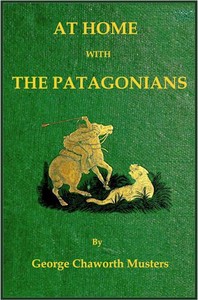
At home with the Patagonians — Reading Notes
386
8
Project Gutenberg
2013
Patagonia (Argentina and Chile) -- Description and travel; Tzoneca language -- Glossaries, vocabularies, etc.
Readers of public-domain and historical texts
Project Gutenberg digital edition
en
Edition facts
Words: 139,159
Reading time: 606 min
Text sections: 15
Source:
Project Gutenberg record #42483
George Chaworth Musters' 1871 account of a year among the Tehuelche people of Patagonia, based on his travels from the Straits of Magellan to the Rio Negro. The narrative balances ethnographic observation with travelogue, noting contrasts between Indigenous customs and European expectations, and acknowledging the limitations of his own perspective.
Editorial Edition Score
4.9/5
★★★★★
★★★★★
Calculated from edition completeness, EPUB availability, text structure and catalogue metadata. Not a user rating.
Edition quality
George Chaworth Musters opens his 1871 narrative with a frank admission: readers expecting precise scientific geography or tales of hair-breadth escapes will be disappointed. Instead, he offers a “faithful record of life with the Indians all the year round,” aiming to make his audience “really at home with the Tehuelches.” This tension between expectation and actuality runs through the book. Musters, a retired Royal Navy commander, travelled from the Straits of Magellan to the Rio Negro, living among the Tehuelche people for a year. His account is neither a dry survey nor a sensational adventure story, but a detailed observation of daily life, customs, and social structures, filtered through a Victorian naval officer’s sensibility. The preface sets the tone: he acknowledges the lack of scientific instruments and the impossibility of carrying them, yet insists his map is “so far accurate, and, if incomplete, at least is not imaginative.” This careful, self-aware framing invites readers to consider what kind of knowledge a traveller can reliably produce.
Mourning Rites and Material Evidence
One of the most detailed passages in the excerpts describes Tehuelche funeral practices. Musters notes that the body is sewn in a mantle and buried sitting upright, facing east, with a cairn of stones. He contrasts this with accounts by other travellers, such as Mr. Wood, who described graves on the sea-coast and exhumation practices. Musters is cautious: “I have never seen any of the graves described in Mr. Wood’s work… nor did the exhumation and removal of the body ever come under my notice.” He doubts such practices among the Tehuelche, citing their rule never to mention the deceased. This moment reveals Musters’ method: he weighs his own observations against others’ reports, and limits his claims to what he personally witnessed. The death of a child prompts a particularly elaborate ritual: the horse the child rode is strangled with lazos (unlike other horse killings, which use bolas), and the saddle, cradle, and belongings are burned. The parents throw valuables into the fire, some of which are snatched by wailing women as recompense. Musters records that on one occasion fourteen horses were slaughtered for an only child of rich parents. These details are not merely exotic; they show a society where material wealth is publicly destroyed to express grief, and where the rules of sacrifice differ by context.
Beliefs Without Idols
Musters devotes careful attention to Tehuelche religion, distinguishing it from that of the Pampas and Araucanians. He notes the absence of sun-worship, though the new moon is saluted with muttered words he could never hear. The Tehuelche believe in a great good Spirit, but Musters is skeptical of the creation story told by his informant Casimiro, suspecting it may be a “confused combination” with missionary teaching. He observes a “great tendency in the Indian mind” to combine marvels and cap one legend with another. Yet he affirms that they do believe in a good Spirit, who lives “careless of mankind.” There are no idols or objects of worship, and no periodical religious festival—contra other travellers, whom Musters accuses of confusing Araucanian customs with Patagonian. The driving force of religious practice is fear of malicious evil spirits, propitiated by a wizard or medicine man. Musters’ account here is notably restrained: he does not claim deep insight into belief, but reports what he saw and heard, and flags where his understanding may be incomplete. This section exemplifies his broader approach: he presents evidence, notes discrepancies with other sources, and resists over-interpretation.
The Traveller's Limitations as a Source
Throughout the excerpts, Musters is unusually explicit about the constraints on his knowledge. He could not carry instruments for scientific measurement; his map is based on compass readings and is “so far accurate.” He could not hear the words muttered at the new moon. He suspects Casimiro’s creation story may be syncretic. He distinguishes between what he saw (funerals in the interior) and what he did not (graves on the coast). This self-awareness is a defining feature of the narrative. Musters also notes the difficulty of interpreting Indian customs: “There is a great tendency in the Indian mind thus to combine the marvels told them.” He does not present himself as an omniscient observer, but as a fallible one. His preface warns readers that the book is not sensational, and his closing remarks in the excerpts reiterate that he offers a “faithful record” rather than a thrilling tale. For modern readers, this honesty is valuable: it allows us to see both what Musters observed and the limits of his perspective. His account is a primary source shaped by Victorian assumptions, but one that openly acknowledges its own gaps.
Musters’ narrative rewards readers who attend to its small, precise observations: the way a horse is killed, the muttered phrase at moonrise, the cairn that grows with each passing traveller. He does not claim to have uncovered the inner life of the Tehuelche, but he provides a record of outward practices that is unusually careful about its own reliability. Reading At Home with the Patagonians means reading with an eye for what Musters saw, what he missed, and what he chose to doubt.
Reader reflection
Your personal reading reflection
Build a private reading journal entry for this title.
Your progress
0
/
10
2
What was your overall reaction to the book?
3
Would you recommend this book to another reader?
4
How demanding did the text feel?
5
Did it raise ideas you would like to talk about?
6
Did the story or argument move comfortably?
7
Did anything about the book feel genuinely new?
8
How well did it match your expectations?
9
What changed or sharpened your thinking?
10