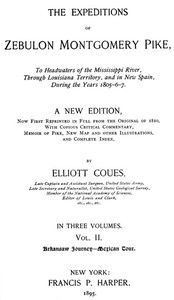
The Expeditions of Zebulon Montgomery Pike, Volume 2 (of 3) To Headwaters of the Mississippi River Through Louisiana Territory, and in New Spain, During the Years — Themes and Context

(4 User reviews)   1131
In Category - Exploration
Pike, Zebulon Montgomery, 1779-1813, Coues, Elliott, 1842-1899 Project Gutenberg 2013 Not confirmed
Mississippi River -- Description and travel; West (U.S.) -- Description and travel; West (U.S.) -- History -- To 1848; New Mexico -- Description and travel; Pike, Zebulon Montgomery, 1779-1813 -- Travel -- West (U.S.); West (U.S.) -- Discovery and exploration Readers of public-domain and historical texts
Project Gutenberg digital edition en

Edition facts

Words 215,412
Reading time 937 min
Text sections 20

The Expeditions of Zebulon Montgomery Pike, Volume 2 (of 3) To Headwaters of the Mississippi River Through Louisiana Territory, and in New Spain, During the Years — Themes and Context can be approached with a clearer sense of reading commitment from its source measurements: 215,412 words, 15 hr 37 min estimated reading time, and 20 detected text sections.

The text analysis averages about 18.9 words per sentence, while the detected sections provide another way to judge how the source is divided.

Project Gutenberg metadata also associates the work with “Mississippi River -- Description and travel,” connecting these edition facts with the source record’s subject description.

This volume covers Pike's Arkansaw Journey and Mexican Tour, with his own narrative, letters, and Elliott Coues's critical commentary. The text shifts between terse itineraries, defensive official correspondence, and reflective passages on exploration, revealing a voice that is at once pragmatic, ambitious, and strained by physical hardship.
Share
Editorial Edition Score 4.9/5

Calculated from edition completeness, EPUB availability, text structure and catalogue metadata. Not a user rating.

How this score is calculated
  • Description quality20 pts
  • Title & short description10 pts
  • Source metadata20 pts
  • Text length15 pts
  • Chapters / structure15 pts
  • EPUB file integrity20 pts

Total of 100 points, scaled to a 2.5-5.0 range. Editions with an empty description or a missing EPUB file are not scored.

Edition quality

Read the Text

ITINERARY: UP THE MISSOURI AND OSAGE RIVERS, AND THROUGH KANSAS TO THE PAWNEE VILLAGE ON THE REPUBLICAN RIVER, JULY 15TH-SEPTEMBER 30TH, 1806, 357-416

ITINERARY, CONTINUED: FROM THE PAWNEE VILLAGE THROUGH KANSAS AND COLORADO TO PIKE'S PEAK, OCTOBER 1ST-NOVEMBER 30TH, 1806, 417-459

ITINERARY, CONCLUDED: IN THE MOUNTAINS OF COLORADO ON HEADWATERS OF THE ARKANSAW AND RIO GRANDE, DECEMBER 1ST, 1806-FEBRUARY 26TH, 1807, 460-510

PIKE'S DISSERTATION ON LOUISIANA, 511-538

WILKINSON'S REPORT ON THE ARKANSAW, 539-561

CORRESPONDENCE, 562-594

ITINERARY: THROUGH NEW MEXICO ON THE RIO GRANDE TO EL PASO, FEBRUARY 27TH-MARCH 21ST, 1807, 595-647

ITINERARY, CONTINUED: THROUGH OLD MEXICO, IN CHIHUAHUA, DURANGO, AND COAHUILA, TO THE PRESIDIO GRANDE, MARCH 22D-MAY 31ST, 1807, 648-689

ITINERARY, CONCLUDED: THROUGH TEXAS TO NATCHITOCHES ON THE RED RIVER OF LOUISIANA, JUNE 1ST-JULY 1ST, 1807, 690-717

OBSERVATIONS ON NEW SPAIN, 718-806

CORRESPONDENCE, 807-839

CONGRESSIONAL REPORT AND ACCOMPANYING DOCUMENTS, 840-856

_THE ARKANSAW JOURNEY._

ITINERARY: UP THE MISSOURI AND OSAGE RIVERS, AND THROUGH KANSAS TO THE PAWNEE VILLAGE ON THE REPUBLICAN RIVER, JULY 15TH-SEPT. 30TH, 1806.

Tuesday, July 15th, 1806. We sailed from the landing at Belle Fontaine[I-1] about 3 o'clock p. m., in two boats. Our party consisted of two lieutenants, one surgeon, one sergeant, two corporals, 16 privates and one interpreter.[I-2] We had also under our charge chiefs of the Osage and Pawnees, who, with a number of women and children, had been to Washington. These Indians had been redeemed from captivity among the Potowatomies, and were now to be returned to their friends at the Osage towns. The whole number of Indians amounted to 51.

We ascended the river about six miles, and encamped on the south side behind an island. This day my boat swung around twice; once when we had a tow-rope on shore, which it snapped off in an instant. The Indians did not encamp with us at night. Distance six miles.[I-3]

_July 16th._ We rejoined our red brethren at breakfast, after which we again separated, and with very severe labor arrived late in the evening opposite the village of St. Charles,[I-4] where the Indians joined us. Distance 15 miles.

_July 17th._ We crossed the river to learn if any communications had arrived from St. Louis, and if there was any news of other Indian enemies of the Osages. Called at Mr. James Morrison's, and was introduced to Mr. [George] Henry, of New Jersey, about 28 years of age; he spoke a little Spanish and French tolerably well; he wished to go with me as a volunteer. From this place I wrote letters back to Belle Fontaine, whilst the Indians were crossing the river. A man by the name of Ramsay reported to the Indians that 500 Sacs, Ioways, and Reynards were at the mouth of Big Manitou [_i. e._, the band under Pashepaho (Stabber) and Quashquame (Lance)]. This gave them considerable uneasiness, and it took me some time to do away the impression it made upon them, for I by no means believed it. We were about sailing when my interpreter [Vasquez] was arrested by the sheriff at the suit of Manuel De Liza [or Lisa[I-5]], for a debt between $300 and $400, and was obliged to return to St. Louis. This made it necessary for me to write another letter to the general.[I-6] We encamped about three-fourths of a mile above the village.

_July 18th._ Lieutenant Wilkinson and Dr. Robinson went with [one soldier and] the Indians across the country to the village of La Charette.[I-7] Mr. George Henry engaged, under oath, to accompany me on my tour. Wrote to the general, and inclosed him one of Henry's engagements.[I-8] After we had made our little arrangements we marched by land and joined the boats, which had sailed early [in charge of Sergeant Ballenger], at twelve o'clock. Two of the men being sick, I steered one boat and Mr. Henry the other, by which means we were enabled to keep employed our full complement of oars, although we put the sick men on shore. Encamped on the north side. About eleven at night a tremendous thunderstorm arose, and it continued to blow and rain, with thunder and lightning, until day. Distance 15 miles.[I-9]

_July 19th._ In consequence of the rain we did not put off until past nine o'clock; my sick men marched. I had some reason to suspect that one of them [Kennerman[I-10]] intended never joining us again. At dinner time the sick man of my own boat came on board; I then went on board the other, and we continued to run races all day. Although this boat had hitherto kept behind, yet I arrived at the encamping ground with her nearly half an hour before the other. The current not generally so strong as below. Distance 14 miles.[I-11]

_Sunday, July 20th._ Embarked about sunrise. Wishing to ascertain the temperature of the water, I discovered my large thermometer to be missing, which probably had fallen into the river. Passed one settlement on the north side, and, after turning the point to the south, saw two more houses on the south side. We encamped [on the south] in a long reach which bore north and west. The absentees had not yet joined us. Distance 15 miles.[I-12]

_July 21st._ It commenced raining near day, and continued until four o'clock in the afternoon; the rain was immensely heavy, with thunder and lightning remarkably severe. This obliged me to lie by; for, if we proceeded with our boats, it necessarily exposed our baggage much more than when at rest, as the tarpaulin could then cover all. We set sail at a quarter past four o'clock, and arrived at the village of La Charette at a little after the dusk of the evening. Here we found Lieutenant Wilkinson and Dr. Robinson with the Indians; also, Baroney [Vasquez[I-13]], our interpreter, with letters from the general and our friends. The weather still continued cloudy, with rain. We were received in the house of Mr. Chartron, and every accommodation in his power was offered us. Distance six miles.[I-14]

_July 22d._ We arranged our boats, dried our lading, and wrote letters for Belle Fontaine.

_July 23d._ I dispatched an express to the general, with advertisements relative to Kennerman, the soldier who had deserted.[I-15] We embarked after breakfast, and made good progress. Lieutenant Wilkinson steered one boat and I the other, in order to detach all the men on shore, with the Indians, that we could spare. We crossed to the south side, a little below Shepherd river. Dr. Robinson killed a deer, which was the first killed by the party. Distance 13 miles.[I-16]

_July 24th._ We embarked at half past six o'clock. Very foggy. The Indians accompanied by only three of my people. Lieutenant Wilkinson being a little indisposed, I was obliged to let Baroney steer his boat. We made an excellent day's journey, and encamped [on the south] five miles from [below] the Gasconade river. Killed three deer, one bear, and three turkeys. But three or four of the Indians arrived; the others encamped a small distance below. Distance 18 miles.[I-17]

_July 25th._ We embarked at half past six o'clock, and arrived at the entrance of the Gasconade river at half past eight o'clock, at which place I determined to remain the day, as my Indians and foot people were yet in the rear, and they had complained to me of being without shoes, leggings, etc. Distance five miles.[I-18]

One of our Pawnees did not arrive until late; the other had communicated his suspicions to me that the Oto, who was in company, had killed him: he acknowledged that he proposed to him to take out their baggage and return to St. Louis. The real occasion of his absence, however, was his having followed a large fresh trace up the Gasconade a considerable distance; but finding it led from the Missouri, he examined it and discovered horses to have been on it; he then left it, joined ours, and came in. This being generally the route taken by the Potowatamies, when they go to war against the Osage, it occasioned some alarm. Every morning we were awakened by the mourning of the savages, who commenced crying about daylight, and continued for the space of an hour. I made inquiry of my interpreter with respect to this, who informed me that this was a custom not only with those who had recently lost their relatives, but also with others who recalled to mind the loss of some friend, dead long since, and joined the other mourners purely from sympathy. They appeared extremely affected; tears ran down their cheeks, and they sobbed bitterly; but in a moment they dry their cheeks and cease their cries. Their songs of grief generally run thus: "My dear father exists no longer; have pity on me, O Great Spirit! you see I cry forever; dry my tears and give me comfort." The warriors' songs are thus: "Our enemies have slain my father (or mother); he is lost to me and his family; I pray to you, O Master of Life! to preserve me until I avenge his death, and then do with me as thou pleaseth."

_July 26th._ We commenced at five o'clock to ferry the Indians over the Gasconade, and left the entrance of this river at half past six o'clock in the afternoon. Met five Frenchmen, who informed us that they had just left the Osage river, and that it was so low they could not ascend it with their canoe. We wrote letters and sent them back by them.[I-19] Dr. Robinson, Baroney, Sparks, and all the Indians encamped about one league above us. Killed one bear, two deer, one otter, three turkeys, and one raccoon. Distance 15 miles.[I-20]

_Sunday, July 27th._ We embarked at half past five o'clock, and arrived at the Indians' camp at seven o'clock. They had been alarmed the day before, and in the evening sent men back in the trace, and some of the chiefs sat up all night. Breakfasted with them. About half past three o'clock encamped in sight of the Osage river. There being every appearance of rain, we halted thus early in order to give the Indians time to prepare temporary camps, and to secure our baggage. I went out to hunt, and firing at a deer, near two of the Indians who were in the woods, they knew the difference of the report of my rifle from their guns, were alarmed, and immediately retired to camp. Distance 13 miles.[I-21]

_July 28th._ Embarked at half past five o'clock, and at half past ten arrived at the Osage[I-22] river, where we stopped, discharged our guns, bathed, etc. We then proceeded on about six miles, where we waited for and crossed the Indians to the west shore; we then proceeded on to the first island, and encamped on the west side, Sans Oreille and only four or five young men coming up, the rest encamping some distance behind. Killed one deer and one turkey. Distance 19 miles.

_July 29th._ All the [rest of the] Indians arrived very early. Big Soldier, whom I had appointed the officer to regulate the march, was much displeased that Sans Oreille and the others had left him, and said for that reason he would not suffer any woman to go in the boat and by that means separate the party; but in truth it was from jealousy of the men whose women went in the boats. He began by flogging one of the young men and was about to strike Sans Oreille's wife, but was stopped by him and told that he knew he had done wrong, but that the women were innocent. We then crossed them and embarked at half past eight o'clock. About twelve o'clock we found the Indians rafting the river, when the first chief of the Little Osage, called Tuttasuggy, or Wind, told me that the man whom Big Soldier struck had not yet arrived with his wife, "but that he would throw them away." As I knew he was extremely mortified at the dissensions which appeared to reign amongst them, I told him by no means [to do so]; that one of my boats should wait for the woman and her child, but that the man might go to the devil, as a punishment for his insubordination.

I then left Baroney with one boat, and proceeded with the other. We were called ashore by three young Indians, who had killed some deer; and, on putting them on board, gave them about one or two gills of whisky, which intoxicated all of them. It commenced raining about one o'clock, and continued incessantly for three hours, which obliged us to stop and encamp. One of our men, Miller, lost himself, and did not arrive until after dark. Killed five deer, one turkey, and one raccoon. Distance 14 miles.[I-23]

_July 30th._ After the fog dispersed I left Lieutenant Wilkinson with the party to dry the baggage, and went with Dr. Robinson and Bradley. About two o'clock we returned, set sail, and having passed the first rapid about three miles, encamped on the eastern shore. Killed three deer. Distance five miles.[I-24]

_July 31st._ We embarked early, and passed several rapids pretty well. Dined with the Indians. Two of them left us in the morning for the village, and they all had an idea of doing the same, but finally concluded otherwise. One of the Osages, who had left the party for the village, returned and reported that he had seen and heard strange Indians in the woods. This we considered as merely a pretext to come back. I this day lost my dog, and the misfortune was the greater, as we had no other dog which would bring anything out of the water. This was the dog Fisher had presented to me at Prairie des Chiens. Killed three deer and one turkey. Distance 18 miles.[I-25]

_Aug. 1st._ It having rained all night, the river appeared to have risen about six inches. We spread out our baggage to dry, but it continuing to rain at intervals all day, the things were wetter at sundown than in the morning. We rolled them up and left them on the beach. We sent out two hunters in the morning, one of whom killed three deer; all the Indians killed three more.

_Aug. 2d._ The weather cleared up. The lading being spread out to dry, Dr. Robinson, myself, Bradley, Sparks, and Brown went out to hunt. We killed four deer, the Indians two. Having reloaded the boats, we embarked at five o'clock, and came about two miles. The river rose, in the last 24 hours, four inches.

_Sunday, Aug. 3d._ Embarked early, and wishing to save the fresh [take advantage of the rise in the river], I pushed hard all day. Sparks was lost, and did not arrive until night. We encamped about 25 paces from the river, on a sand-bar. Near day I heard the sentry observe that the boats had better be brought in; I got up and found the water within a rod of our tent, and before we could get all our things out it had reached the tent. Killed nine deer, one wildcat, one goose, and one turkey. Distance 18 miles.[I-26]

_Aug. 4th._ We embarked early and continued on for some time, not being able to find a suitable place to dry our things, but at length stopped on the east shore. Here we had to ferry the Indians over a small channel which we did not before observe; all of them, however, not arriving, we put off and continued our route. Finding our progress much impeded by our mast, I unshipped it and stripped it of its iron, and, after Lieutenant Wilkinson had carved our names on it, set it adrift, followed by the yards. This mast had been cut and made at [our wintering post on] Pine creek, Upper Mississippi. After proceeding some miles, we found the Indians on the west shore, they having rafted the river. We stopped for them to cook, after which we proceeded. The navigation had become very difficult from the rapidity of the current, occasioned by the rise of the water, which rose one foot in an hour. Killed two deer. Rainy. Distance 10 miles.[I-27]

_Aug. 5th._ We lay by this day, in order to give the Indians an opportunity to dry their baggage. Dr. Robinson and myself, accompanied by Mr. Henry, went out to hunt; we lost the latter about two miles from camp. After hunting some time on the west shore, we concluded to raft the river, which we effected with difficulty and danger, and hunted for some time, but without success. We then returned to the party and found that Mr. Henry, who had been lost, had arrived one hour before us; he had met one of the soldiers, who brought him in.

To-day in our tour I passed over a remarkably large rattlesnake, as he lay curled up, and trod so near him as to touch him with my foot, he drawing himself up to make room for my heel. Dr. Robinson, who followed me, was on the point of treading on him, but by a spring avoided it. I then turned round and touched him with my ramrod, but he showed no disposition to bite, and appeared quite peaceable. The gratitude which I felt toward him for not having bitten me induced me to save his life. Killed four deer. River rises 13 inches. Rain continues.

_Aug. 6th._ We embarked at half past eight o'clock, it having cleared off and had the appearance of a fine day. Passed [Little] Gravel river [of Pike, now Big Gravois creek] on the west.[I-28] About three miles above this river the Indians left us and informed me that, by keeping a little to the south and west, they would make in 15 miles what would be at least 35 miles for us. Dr. Robinson, Mr. Henry, and Sergeant Ballenger accompanied them. Killed two deer. Distance 13 miles.

_Aug. 7th._ Not being detained by the Indians, we are for once enabled to embark at a quarter past five o'clock. The river having fallen since yesterday morning about four feet, we wish to improve every moment of time previous to its entire fall. We proceeded extremely well, passed the Saline [read Great Gravel[I-29]] river [of Pike, now Grand Auglaise creek] on the east, and encamped opposite La Belle Roche on the west shore. This day we passed many beautiful cliffs on both sides of the river; saw a bear and wolf swimming the river. I employed myself part of the day in translating into French a talk of General Wilkinson's to Cheveux Blanche.[I-30] Distance 21 miles.

_Aug. 8th._ We embarked at 20 minutes past five o'clock. Found the river had fallen about two feet during the night. At the confluence of the Youngar[I-31] with the Osage river we breakfasted. Encamped at night on a bar. Distance 21 miles.

_Aug. 9th._ We embarked at five o'clock, and at half past six met the Indians and our gentlemen. They had met with nothing extraordinary. They had killed in their excursion seven deer and three bear. We proceeded to an old wintering ground, where there were eight houses, occupied last winter by [Blank], who had not been able to proceed any higher for want of water. Passed the Old Man's Rapids, below which, on the west shore, are some beautiful cliffs. Dined with the Indians, after which we passed Upper Gravel river on the west, and Pottoe [qu. Poteau?] river on the east. Sparks went out to hunt, and did not arrive at our encampment, nor did the Indians. Distance 25 miles.[I-32]

_Sunday, Aug. 10th._ Embarked a quarter past five o'clock, when the sun shone out very clearly; but in 15 minutes it began to rain, and continued to rain very hard until one o'clock. Passed the Indians, who were encamped on the west shore, about half a mile, and halted for them. They all forded the river but Sans Oreille, who brought his wife up to the boats, and informed me that Sparks had encamped with them, but left them early to return in search of us. We proceeded after breakfast. Sparks arrived just at the moment we were embarking. The Indians traversing the country on the east had sent Sparks with Sans Oreille. About two o'clock split a plank in the bottom of the batteau. Unloaded and turned her up, repaired the breach, and continued on the route. By four o'clock found the Indians behind a large island; we made no stop, and they followed us. We encamped together on a bar, where we proposed halting to dry our corn, etc., on Monday. Killed four deer. Distance 18½ miles.[I-33]

Pike's narrative in this volume is a study in contrasts: the brisk, factual tone of his daily itineraries sits uneasily alongside the elaborate, self-justifying language of his official letters. In one passage, he describes his papers as 'an undigested mass' and laments his weak eyes and chest pain, yet he also boasts of possessing 'immense matter' that opens 'a wide and splendid field for harvests of honor.' This tension between exhaustion and ambition pervades the text.

Elliott Coues's editorial apparatus adds another layer, with footnotes that correct, expand, or question Pike's claims. The result is a layered document—part travelogue, part political report, part scholarly reconstruction—where the reader must weigh Pike's words against the editor's annotations.

The Itinerary Voice: Precision and Omission

Pike's chapter headings read like stripped-down logs: 'Up the Missouri and Osage Rivers, and through Kansas to the Pawnee Village on the Republican River, July 15th-September 30th, 1806.' The prose inside is similarly lean, recording distances, directions, and encounters with minimal embellishment. Yet this apparent objectivity is itself a rhetorical choice. By omitting personal reactions or descriptive flourishes, Pike presents himself as a reliable, scientific observer—a persona that contrasts sharply with the more emotional, defensive tone of his correspondence.

Coues's footnotes frequently intervene to clarify or correct these terse entries. For instance, when Pike mentions a location or a Native American group, Coues supplies modern names, historical context, or cross-references to other explorers' accounts. This editorial presence reminds the reader that the itinerary is not a transparent record but a constructed narrative, shaped by Pike's priorities and later scrutinized by a scholar.

The Letter as Performance: Defense and Self-Promotion

Pike's correspondence, especially the long letter to General Wilkinson excerpted here, reveals a different register. The sentences grow longer, the vocabulary more ornate: he writes of 'the anxious desires of the miser, and the waking thoughts and sleeping dreams of the man of ambitious and aspiring soul.' This is not the language of a field report but of a man arguing for his own importance. He defends his decisions—such as not allowing his sergeant to join him—and emphasizes the hardships he endured, from mutilated papers to physical pain.

At the same time, Pike is careful to flatter his superiors and propose future projects. He offers to compile 'the compleatest survey of Louisiana ever yet taken' and hints at his desire to travel to Washington. The letter thus functions as both a justification and a bid for continued patronage, its rhetorical flourishes masking the precariousness of his situation.

Coues's Editorial Lens: Annotating Uncertainty

Elliott Coues, a former army surgeon and editor of Lewis and Clark, brings a critical eye to Pike's text. His footnotes do not simply explain obscure terms; they actively interrogate Pike's claims. For example, when Pike mentions that the sergeant killed one of his men, Coues adds a note (V'-7) that quotes a letter from General Salcedo accusing the sergeant of 'great intractability.' This juxtaposition of sources allows the reader to see the same event from multiple perspectives.

Coues also flags inconsistencies and gaps. He notes where Pike's page numbering continues from Volume 1, and where footnotes were missing or had to be approximated. By preserving the original's 'inconsistent spelling and hyphenation' while correcting 'obvious typographical errors,' Coues creates a text that is both faithful to the 1810 edition and critically annotated. The result is a scholarly edition that acknowledges its own limitations.

Readers approaching this volume should attend to the interplay between Pike's voice and Coues's annotations. The narrative is not a seamless account but a patchwork of genres—itinerary, letter, report—each with its own conventions and biases. Pay particular attention to moments where Pike's tone shifts, or where Coues's footnotes introduce doubt. These are the points at which the text reveals its constructed nature, and where the most interesting questions about exploration, authority, and memory arise.

Reading Pike’s defensive letters, I felt that ache of distance—so much effort poured into words that might never catch up with him. It reminded me of the same solitary patience in Sven Hedin’s wanderings, where every step was a quiet argument with the unknown. There is a strange comfort in that shared, human strain across Trans-Himalaya: Discoveries and Adventurers in Tibet. Vol. 1 (of 2) — Background and Themes, as if we, too, are just passing through.

Benjamin Thomas
1 month ago

Michael Harris
1 week ago

Sebastian Wright
2 weeks ago

Owen Hall
1 month ago

4
4 out of 5 (4 User reviews )

Add a Review

Your Rating *
  • ...
    Lori Vickie Guzman - 1 month ago
    This volume presents Pike's journals with extensive footnotes that enhance understanding. The firsthand accounts are remarkable. However, the language is archaic and the narrative jumps around, making it hard to follow at times. For those interested in early American exploration, it's a necessary read, but it requires patience.

  • ...
    Emily Carpenter - 3 weeks ago
    The Expeditions Of Zebulon Montgomery Pike is an invaluable historical document that sheds light on the American frontier. Volume 2 covers Pike's explorations through the Louisiana Territory and into Spanish lands, offering detailed observations of geography, Native American tribes, and challenges faced. The editors provide helpful annotations. This is a treasure for history buffs and essential reading for understanding the mapping of the American West.

  • ...
    Brett Shane Hale - 1 week ago
    As a historical record, this book has some value, but I found it tedious to read. The expedition diaries are often repetitive and lack the narrative flair of similar works like Lewis and Clark. The editing is overly academic, with footnotes interrupting the flow. Unless you're a specialist, you might want to skip this dense tome.


Reader reflection

What did you think of this book?

Answer a few questions and save a private reflection on this device.

Your progress 0 / 10
1

Which reading stage best describes you?

2

How much did you enjoy the reading experience?

3

Would you pass this book on to a friend?

4

How easy was the book to follow?

Related eBooks