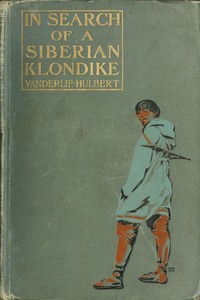
In Search of a Siberian Klondike — Key Ideas to Explore

(2 User reviews)   364
In Category - Exploration
Vanderlip, Washington Baker, 1867-, Hulbert, Homer B. (Homer Bezaleel), 1863-1949 Project Gutenberg 2012 Not confirmed
Siberia (Russia) -- Description and travel; Gold mines and mining -- Russia (Federation) -- Siberia Readers of public-domain and historical texts
Project Gutenberg digital edition en

Edition facts

Words 56,436
Reading time 246 min
Text sections 7

The catalog record for In Search of a Siberian Klondike — Key Ideas to Explore provides practical reading context through 56,436 words, 4 hr 6 min estimated reading time, and 7 detected text sections.

The text analysis averages about 21.8 words per sentence, while the detected sections provide another way to judge how the source is divided.

Project Gutenberg metadata also associates the work with “Siberia (Russia) -- Description and travel,” connecting these edition facts with the source record’s subject description.

A first-person narrative of a gold prospecting expedition through Kamchatka and Siberia in 1899, as told by Washington B. Vanderlip and set down by Homer B. Hulbert. The account details harsh travel, native encounters, and the practical realities of searching for gold in a remote, frozen landscape.
Share
Editorial Edition Score 4.7/5

Calculated from edition completeness, EPUB availability, text structure and catalogue metadata. Not a user rating.

How this score is calculated
  • Description quality20 pts
  • Title & short description10 pts
  • Source metadata20 pts
  • Text length15 pts
  • Chapters / structure15 pts
  • EPUB file integrity20 pts

Total of 100 points, scaled to a 2.5-5.0 range. Editions with an empty description or a missing EPUB file are not scored.

Edition quality

Read the Text

nnan was connected and where he spent one winter.

Making this my headquarters, I was to work out in various directions in search of the yellow metal, and finally I was to use my own judgment as to whether I should strike northeast to Bering Strait, following the Stenova range of mountains, or southward to Ola, where a steamship could stop and take me off the following summer. As we shall see, the main points of this plan were carried out, though not in the order here given.

As to the means for reaching Kamchatka I had no choice. There is no royal mail steamship route to these boreal regions. A "tramp" steamship is annually chartered by the great firm of Kunst and Albers in Vladivostok, and rechartered by them to the Russian government, to take the Governor-general on his annual visit to Saghalien and the trading posts in Kamchatka, and even as far northward as Anadyr, situated inland from Bering Sea on the Anadyr River. At each of these trading posts is a Russian magistrate, or _nitcheilnik_, and a guard of about twenty Cossacks. The annual steamer carries the supplies for these officials and for the traders, as well as the goods which are used in trade. On her return, the steamer brings back the furs of the Russian Chartered Company, who hold all the furring rights of northeastern Siberia.

In the summer of 1898 the steamer _Cosmopolite_ was scheduled to make the annual voyage. She was a German tramp steamer of one thousand tons. Besides the captain there was but one other foreign officer. The crew was Chinese. In addition to the annual mails she carried a full cargo of tea, flour, sugar, tobacco, and the thousand and one articles that make the stock in trade of the agents of the Chartered Company. She was allowed to carry no wines or liquors, with the exception of sixty bottles of vodka for each trader, and that for his private use only. He is strictly forbidden to sell a drop to the natives. For a first offense he is heavily fined, and for a second he serves a term of penal servitude on the island of Saghalien. This law is in brilliant contrast to the methods of other governments in respect to liquors. Africa and the Pacific Islands bear witness to the fact that, from the standpoint both of humanity and mere commercial caution, the Russian government is immeasurably ahead of other powers in this respect. The sale of intoxicants demoralizes the natives and "kills the goose that lays the golden egg." Of course there is an occasional evasion of the law. The natives of Siberia are passionately fond of spirits of any kind, and, having tasted a single glass, will sell anything they have--even their wives and daughters--for another. When they are in liquor a single wineglass of vodka will induce them to part with furs which in the London market would bring ten pounds. Besides this annual steamship, two Russian men-of-war cruise north along the coast, looking for American whalers who bring alcoholic liquors to exchange for skins.

I decided to take with me two Koreans from Vladivostok. They were gold-miners from southern Siberia. Being expert horse-packers and woodsmen and speaking a little Russian, they were sure to be of great use to me. They were named Kim and Pak respectively; both are among the commonest family names in Korea, the Kim family having originated at least as early as 57 B.C. Kim was thirty years old and was possessed of a splendid physique. He could take up four hundred pounds of goods and carry them a quarter of a mile without resting. Koreans are taught from childhood to carry heavy weights on their backs. They use a chair-like frame, called a _jigi_, which distributes the weight evenly over the shoulders and hips and enables them to carry the maximum load with the minimum of fatigue. Kim was always good-natured even under the most discouraging circumstances, and he was fairly honest. Pak was thirty-eight, tall and thin, but enormously strong. He enjoyed the possession of only one eye, for which reason I promptly dubbed him "Dick Deadeye." He was a cautious individual, and always "packed" his money in his clothes, sewed up between the various thicknesses of cloth; and whenever he had a bill to pay and could not avoid payment, he would retire to a secluded place, rip himself open, and return with the money in his hand and a mysterious look on his face, as if he had picked the money off the bushes.

Having secured the services of this precious pair, I promptly marched them off to the store of one Enoch Emory to exchange their loose Korean clothes for something more suited to the work in hand. This Enoch Emory, by the way, is a character unique in Siberian history. When sixteen years old he came out from New England as cabin-boy on a sailing vessel which had been sent by an American company to establish trading stations on the Amur. He left the vessel and went into one of the company's stores. He now "owns" the company and is one of the wealthiest merchants in Siberia. The company operates immense stores in Nikolaievsk, Blagovestchensk, and Khabarovka, with a large receiving store at Vladivostok. Emory always favors American goods and sells immense numbers of agricultural implements and of other things in the manufacture of which America excels. This is the only great American firm in Siberia. Emory makes his home in Moscow and comes out once a year to inspect his stores. He is a typical Yankee of the David Harum stamp.

When my two protégés came to change Korean dress for American it was difficult to decide just where the dress left off and the man began. The Korean bathing habits are like those of the medieval anchorite, and an undergarment, once donned, is lost to memory. Besides the two Koreans, I engaged the services of a Russian secretary named Nicolai Andrev. He was an old man and not by any means satisfactory, but he was the only one I could get who knew the Russian mining laws and who could make out the necessary papers, in case I should have occasion to stake out claims. As it turned out, he hampered the movements of the party at every turn; he could not stand the hard knocks of the journey, and I was obliged to drop him later at the town of Ghijiga. His lack of teeth rendered his pronunciation of Russian so peculiar that he was no help to me in acquiring the language, which is not easy to learn even under the best of circumstances. I was also accompanied by a young Russian naturalist named Alexander Michaelovitch Yankoffsky. As this name was quite too complicated for everyday use, I had my choice of paring it down to "Alek," "Mike," or "Yank," and while my loyalty to Uncle Sam would naturally prompt me to use the last of these I forbore and Alek he became. He did not take kindly to it at first, for it is _de rigueur_ to address a Russian by both his first and second names, the latter being his father's name with _vitch_ attached. This was out of the question, however, and he succumbed to the inevitable.

So our complete party consisted of five men, representing three languages. None of my men knew any English, and I knew neither Russian nor Korean, beyond a few words and phrases. But before two months had elapsed, I had, by the aid of a pocket dictionary, my little stock of Korean words, and a liberal use of pencil and paper, evolved a triglot jargon of English, Korean, and Russian that would have tried the patience of the most charitable philologist.

The steamer was to sail in eight days, and this necessitated quick work in making up my outfit. For guns I picked a twelve-bore German fowling-piece with a rifle-barrel beneath, in order to be equipped for either small or large game without being under the necessity of carrying two guns at once; a Winchester repeating rifle, 45-90; an .88 Mannlicher repeating rifle; and two 45-caliber Colt revolvers. As money is little used among the natives of the far North, it was necessary to lay in a stock of goods to use in trade. For this purpose I secured one thousand pounds of Moharka tobacco. It is put up in four-ounce packages and costs fifteen rouble cents a pound. I procured also two thousand pounds of sugar both for personal use and for trade. This comes in solid loaves of forty pounds each. Next in order came two thousand pounds of brick-tea. Each brick contains three pounds, and in Hankau, where it is put up, it costs twelve and a half cents a brick. It is made of the coarsest of the tea leaves, twigs, dust, dirt, and sweepings, and is the kind universally used by the Russian peasantry. I also secured one hundred pounds of beads, assorted colors, and a goodly stock of needles, together with ten pounds of colored sewing-silks which the natives use to embroider the tops of their boots and the edges of their fur coats. Then came a lot of pipe-bowls at a cent apiece, assorted "jewelry," silver and brass rings, silk handkerchiefs, powder and shot, and 44-caliber cartridges. The last mentioned would be useful in dealing with the natives near the coast, who commonly use Winchester rifles. Those further inland use the old-fashioned musket exclusively.

For my own use I laid in a goodly supply of Armour's canned beef, canned fruits, dried fruits, lime-juice, bacon, three thousand pounds of beans, canned tomatoes, tinned butter, coffee, German beef-tea put up in capsules an inch long by half an inch thick (which proved extremely fine), and canned French soups and conserves. Besides these things, and more important than all, I took two tons of black bread--the ordinary hard rye bread of Russia, that requires the use of a prospecting hammer or the butt of a revolver to break it up. This was necessary for barter as well as for personal use.

Judging from my experiences in Australia, Burma, Siam, and Korea, as well as from my reading of Nansen, I thought it best not to encumber myself with any liquors excepting four bottles of brandy, which were carried in the medicine-chest and used for medicinal purposes only. My medical outfit consisted of four main articles, quinine, morphine, iodoform, and cathartic pills. With these four one can cope with almost anything that is likely to happen. The chest contained also bandages, absorbent cotton, mustard leaves, a hot-water bottle, two small surgeon's knives, and a pair of surgical scissors.

After a prolonged search for really good pack-saddles, I concluded that such things were unknown in Siberia; so, calling in a Chinese carpenter, I gave him a model of an Arizona pack-saddle, with instructions to turn out a dozen at the shortest possible notice. I proposed to teach my Koreans how to throw the "diamond hitch," but I found later, to my humiliation, that what the Korean does not know about packing is not worth knowing. Either Kim or Pak could do it quicker and better than I. Two thousand years of this sort of thing have left little for the Korean to learn.

Mining-tools were of course a necessity. Even in Vladivostok I could not secure what I wanted. I therefore took what I could get. I purchased drills, hammers, a crow-bar, a German pump which was guaranteed to pump sand (but which I found later would pump nothing thicker than pure water), a quantity of blasting powder called "rack-a-rock," picks, shovels, wire, nails, and other sundries. The Russian shovel is an instrument of torture, being merely a flat sheet of iron with a shank for the insertion of a handle, which latter is supposed to be made and fitted on the spot. As there is no bend at the neck of the shovel, the lack of leverage makes it a most unwieldy and exasperating utensil. As for the Russian pick, it has but one point, and in its construction is clumsy beyond belief. Even the Korean picks are better. I also carried a simple blow-pipe outfit, an aneroid, a compass, gold-screens, and gold-pans, with other necessary appliances for prospecting. These preparations were made very hurriedly, as the _Cosmopolite_ was the only steamer going north during the season.

Tourists sometimes ask if it would not be possible to secure passage on this annual steamer and take the trip along the coast to Bering Sea and back. There is nothing to prevent it. The trip of three months, stopping at ten or twelve points along the coast, could be made for about three hundred roubles, a rouble representing fifty cents in gold. But the trip would be of little value or interest, because, in the first place, the natives bring down their furs to the trading stations during the winter, when the ice makes traveling possible, so that one would have very little opportunity of seeing anything of native life, or of securing any of the valuable furs that come out of this region each year. It would be impossible for the tourist to pick up any good ones in summer. Outside of natives and furs, it is difficult to see what interest there could be in such a trip, unless the tourist is studying the habits of mosquitos and midges, in which case he would strike a veritable paradise.

SAGHALIEN AND THE CONVICT STATION AT KORSAKOVSK

Departure of the expedition--Arrival at Korsakovsk--Condition of convict station--Freedom allowed prisoners, most of whom are murderers--Wreck of the steamer and loss of outfit--Gold lace and life-preservers--Return to Korsakovsk--Russian table manners--The Russian's naïve attitude toward bathing--Some results of the intermarriage of criminals--How Yankee shrewdness saved some confiscated photographs--Pleasant sensations on being shaved by a murderer--Predominance of American goods.

At six o'clock in the afternoon of July 22, 1898, the Governor-general with his wife and suite, resplendent in gold lace and buttons, came aboard in the rain. The anchor was heaved up and we pointed southward toward the open sea, which is reached by way of a passage from half a mile to three miles wide and twelve miles long. The shore on either side bristles with armaments which, together with the narrowness of the passage, make Vladivostok entirely impregnable from the sea.

There is a story, however, which the Russians never like to hear. One morning, after a night of dense fog, as the sun cleared away the mist, four big British men-of-war were found anchored within two hundred yards of the city, and could have blown it skyward without a shot from the batteries, being safe from the line of fire. Since then big guns have been mounted to cover the inner harbor. Reaching open water, we turned to the northeast and set our course toward the southern point of the island of Saghalien, for the Governor-general was to inspect the convict station of Korsakovsk.

Three days of uneventful steaming at ten knots an hour brought the shores of Saghalien above the horizon. We saw a long, curved beach backed by low-lying hills covered with fields and woodland. As the place could boast no harbor, we dropped anchor in the open roadstead a mile from shore. Our whistle had long since waked to life an asthmatic little steam-launch, which soon came alongside. We forthwith invaded her stuffy little cabin and she waddled shoreward.

As we approached the rough stone quay, we had our first glimpse of Russian convict life. A gang of prisoners were at work mending the seawall. Some of them wore heavy iron balls at their ankles, which they had to lift and carry as they walked, else they dragged ponderously along the ground. These balls would weigh about a hundred pounds apiece. The convicts seemed to be well fed, but were excessively dirty and unkempt. They appeared to be men of the very lowest grade of mental development. It must be remembered that no political convicts are confined on the island of Saghalien. They are kept in the far interior of Siberia, where the chances of escape are much less, and where there is no possibility of contact with others than their own jailers. The convicts on Saghalien are almost all desperate criminals. As there is no such thing as capital punishment in Siberia, Saghalien is the terrestrial Valhalla of these doomed men, a sort of ante-mortem purgatory.

We stepped out upon the quay and walked up into the town. The street was about fifty feet wide, with a neat plank walk on either side. The houses were all log structures, but not the kind we are accustomed to associate with that name. The Russian makes the best log house in the world. The logs are squared and carefully fitted together. The windows are mostly double, and the houses, all of one story, are warm enough to be habitable. The streets are lined with small shops and stores. The entire population outside of the officials consists of convicts, most of whom enjoy almost complete freedom within the limits of the town. It gives one a queer feeling to walk through the streets of a town and know that all the storekeepers, carpenters, blacksmiths, clerks, butchers, and bakers are or have been desperate criminals. This town of Korsakovsk contains about two thousand people, of whom nine tenths are convicts.

I asked if I might inspect the prison, expecting a prompt refusal, and was surprised when informed that I could go wherever I pleased. Approaching the main entrance to the prison, I found the two heavy gates off their hinges and the convicts coming and going at their own pleasure. A sleepy Cossack was on guard, and he did not even challenge me. The prison buildings were arranged around a large quadrangle. The prisoners were talking, lying about at their ease, with a few at work on little wood carvings.

I was astonished to see no prison bars anywhere, but after I had looked about at my leisure, one of the officers took me in charge and led me into another part of the grounds, where we found a sentry on guard, armed only with a revolver. This guard took us in hand and conducted us to a small building which appeared to be heavily barred. Inside were rows of clean, dry, whitewashed cells, half a dozen of which were occupied by convicts who had recently committed murder on the island, and were about to be sent north to the dreaded coal-mines, where they would be chained to wheelbarrows. These would be their constant companions for seven years, night and day, summer and winter.

In the workshops the convicts seemed to be trying to do as little as possible. They were making tools, hinges, horse-shoes, farming-implements, and other simple ironwork. In another portion of the shops they were making wagons and carts. Very many of the convicts are farmers, and they seemed to be cultivating the surrounding fields with success. In the main offices I found a dozen clerks smoking and drinking tea. They were all convicts, most of them having dark crimes to their discredit.

Leaving the prison, we walked down the street and soon came to a little stand, where bread and milk were being sold by a nice-looking Russian girl. I asked on what charge she had been brought to Saghalien. The officer interpreted my question. The girl laughed and said that she had murdered her husband. She was twenty-three years old.

We had arrived at ten in the morning, and, as we left at four in the afternoon, my inspection of the town was necessarily brief, but enough had been seen to give impetus to even a very ordinary imagination.

The narrative voice in In Search of a Siberian Klondike is that of Washington B. Vanderlip, a prospector who recounts his 1899 expedition through Kamchatka and northeastern Siberia. The book is presented as his first-person account, set down by Homer B. Hulbert, and the prose carries the direct, practical tone of a man more accustomed to action than literary flourish. Vanderlip describes the landscape, the people, and the grueling work of gold prospecting with a matter-of-factness that underscores the harsh realities of the region. The pace shifts noticeably between detailed logistical descriptions—outfitting, dog-sledging, thawing frozen ground—and moments of sudden danger or absurdity, such as a near-disastrous sled ride down a snowy slope that leaves Vanderlip laughing while his native companions curse.

Voice and the Role of the Narrator

The book is explicitly framed as Vanderlip's story, with Hulbert acting as amanuensis. This dual authorship creates a curious effect: the prose is polished and structured, yet retains the rhythms of oral storytelling. Vanderlip frequently addresses the reader directly, as when he describes the start of a dog-sled run as “a gymnastic performance for the driver.” His observations are often wry, as when he notes that Russian law prohibited liquor traffic, but his party brought it anyway. The voice is that of an experienced frontiersman, confident in his judgments but not boastful. He credits his native guides, like Chrisoffsky, with crucial knowledge, and he does not shy from admitting his own mistakes—such as the impulsive decision to slide down a mountain that nearly ended in disaster.

Pace and the Rhythm of Hardship

The narrative alternates between methodical preparation and sudden, intense action. Early chapters detail the purchase of supplies, the hiring of men, and the intricacies of dog-sledging—a slow, deliberate pace that mirrors the tedium of travel. Then, without warning, the pace accelerates: a sled breaks through a snow-bridge into open water, and Vanderlip must change into dry fur socks before his feet freeze. The gold-prospecting sequences follow a similar pattern: days of slow thawing and digging, then the brief, tense moment of panning gravel. The most vivid shift occurs during the sled ride down the mountain, where the prose becomes almost cinematic: the dogs become a “howling, wrangling ball of dog-fur,” and Vanderlip admits he “utterly refused to see the serious side.” These changes in pace keep the reader engaged, even when the gold itself proves elusive.

Recurring Details and the Texture of the Journey

Certain details recur throughout the excerpts, building a textured portrait of life on the trail. The polka, a long pole used for steering and braking, appears repeatedly as a tool of survival. The native guide Chrisoffsky is a constant presence, his warnings and practical advice forming a counterpoint to Vanderlip's impulsiveness. The cold is ever-present: the thermometer “between ten and fifteen degrees below zero,” the need to change wet boots immediately, the frozen ground that must be thawed with fires. Food is a recurring motif—boiled fish-eyes as a delicacy, the “wholesale suicide of salmon” during spawning season. These small, concrete observations ground the narrative in sensory reality, making the reader feel the cold, the hunger, and the dogged persistence required to continue.

Readers should approach this book as a travelogue and a practical memoir, not a thriller. The gold is never found in paying quantities, and the narrative is less about discovery than about the process of searching. Pay attention to the relationship between Vanderlip and his native guides, particularly Chrisoffsky, whose expertise often saves the expedition. The book's value lies in its unvarnished depiction of a specific time and place—the Russian Far East at the turn of the century—and in the voice of a man who lived to tell the tale.

Reading about Vanderlip’s frozen, patient hunt for gold in Siberia, I kept thinking of another long, strange journey—Stanley’s search through the Congo for Emin Pasha. Both men moved through vast, indifferent landscapes, not for glory but for a single, elusive thread. There is a quiet loneliness in that persistence. It made me revisit In Darkest Africa, Vol. 1; or, The Quest, Rescue, and Retreat of Emin, Governor of Equatoria — Key Ideas to Explore, and I felt the same strange kinship with its weary footsteps.

Aria Taylor
1 month ago

Luke Adams
1 month ago

4.5
4.5 out of 5 (2 User reviews )

Add a Review

Your Rating *
There are no comments for this eBook.

Reader reflection

Before you leave, reflect on the book

Use these questions to collect your thoughts before moving on.

Your progress 0 / 10
1

Where are you in your reading?

2

Was reading this book enjoyable?

3

Would you pass this book on to a friend?

4

Did the language feel accessible?

Related eBooks