1

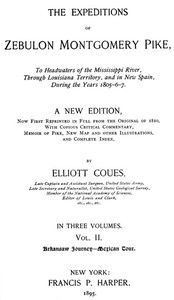
The Expeditions of Zebulon Montgomery Pike, Volume 2 (of 3) To Headwaters of the Mississippi River Through Louisiana Territory, and in New Spain, During the Years — Themes and Context
39
11
Project Gutenberg
2013
Mississippi River -- Description and travel; West (U.S.) -- Description and travel; West (U.S.) -- History -- To 1848; New Mexico -- Description and travel; Pike, Zebulon Montgomery, 1779-1813 -- Travel -- West (U.S.); West (U.S.) -- Discovery and exploration
Readers of public-domain and historical texts
Project Gutenberg digital edition
en
Edition facts
Words: 215,412
Reading time: 937 min
Text sections: 20
Source:
Project Gutenberg record #43775
This volume covers Pike's Arkansaw Journey and Mexican Tour, with his own narrative, letters, and Elliott Coues's critical commentary. The text shifts between terse itineraries, defensive official correspondence, and reflective passages on exploration, revealing a voice that is at once pragmatic, ambitious, and strained by physical hardship.
Editorial Edition Score
4.9/5
★★★★★
★★★★★
Calculated from edition completeness, EPUB availability, text structure and catalogue metadata. Not a user rating.
Edition quality
Pike's narrative in this volume is a study in contrasts: the brisk, factual tone of his daily itineraries sits uneasily alongside the elaborate, self-justifying language of his official letters. In one passage, he describes his papers as 'an undigested mass' and laments his weak eyes and chest pain, yet he also boasts of possessing 'immense matter' that opens 'a wide and splendid field for harvests of honor.' This tension between exhaustion and ambition pervades the text.
Elliott Coues's editorial apparatus adds another layer, with footnotes that correct, expand, or question Pike's claims. The result is a layered document—part travelogue, part political report, part scholarly reconstruction—where the reader must weigh Pike's words against the editor's annotations.
The Itinerary Voice: Precision and Omission
Pike's chapter headings read like stripped-down logs: 'Up the Missouri and Osage Rivers, and through Kansas to the Pawnee Village on the Republican River, July 15th-September 30th, 1806.' The prose inside is similarly lean, recording distances, directions, and encounters with minimal embellishment. Yet this apparent objectivity is itself a rhetorical choice. By omitting personal reactions or descriptive flourishes, Pike presents himself as a reliable, scientific observer—a persona that contrasts sharply with the more emotional, defensive tone of his correspondence.
Coues's footnotes frequently intervene to clarify or correct these terse entries. For instance, when Pike mentions a location or a Native American group, Coues supplies modern names, historical context, or cross-references to other explorers' accounts. This editorial presence reminds the reader that the itinerary is not a transparent record but a constructed narrative, shaped by Pike's priorities and later scrutinized by a scholar.
The Letter as Performance: Defense and Self-Promotion
Pike's correspondence, especially the long letter to General Wilkinson excerpted here, reveals a different register. The sentences grow longer, the vocabulary more ornate: he writes of 'the anxious desires of the miser, and the waking thoughts and sleeping dreams of the man of ambitious and aspiring soul.' This is not the language of a field report but of a man arguing for his own importance. He defends his decisions—such as not allowing his sergeant to join him—and emphasizes the hardships he endured, from mutilated papers to physical pain.
At the same time, Pike is careful to flatter his superiors and propose future projects. He offers to compile 'the compleatest survey of Louisiana ever yet taken' and hints at his desire to travel to Washington. The letter thus functions as both a justification and a bid for continued patronage, its rhetorical flourishes masking the precariousness of his situation.
Coues's Editorial Lens: Annotating Uncertainty
Elliott Coues, a former army surgeon and editor of Lewis and Clark, brings a critical eye to Pike's text. His footnotes do not simply explain obscure terms; they actively interrogate Pike's claims. For example, when Pike mentions that the sergeant killed one of his men, Coues adds a note (V'-7) that quotes a letter from General Salcedo accusing the sergeant of 'great intractability.' This juxtaposition of sources allows the reader to see the same event from multiple perspectives.
Coues also flags inconsistencies and gaps. He notes where Pike's page numbering continues from Volume 1, and where footnotes were missing or had to be approximated. By preserving the original's 'inconsistent spelling and hyphenation' while correcting 'obvious typographical errors,' Coues creates a text that is both faithful to the 1810 edition and critically annotated. The result is a scholarly edition that acknowledges its own limitations.
Readers approaching this volume should attend to the interplay between Pike's voice and Coues's annotations. The narrative is not a seamless account but a patchwork of genres—itinerary, letter, report—each with its own conventions and biases. Pay particular attention to moments where Pike's tone shifts, or where Coues's footnotes introduce doubt. These are the points at which the text reveals its constructed nature, and where the most interesting questions about exploration, authority, and memory arise.
Reader reflection
What did you think of this book?
Answer a few questions and save a private reflection on this device.
Your progress
0
/
10
2
How much did you enjoy the reading experience?
3
Would you pass this book on to a friend?
4
How easy was the book to follow?
5
What did you appreciate most?
6
Is this a title worth rereading?
7
How original did the book feel?
8
Did the book give you something worth debating?
9
What is the main idea you are taking away?
10